
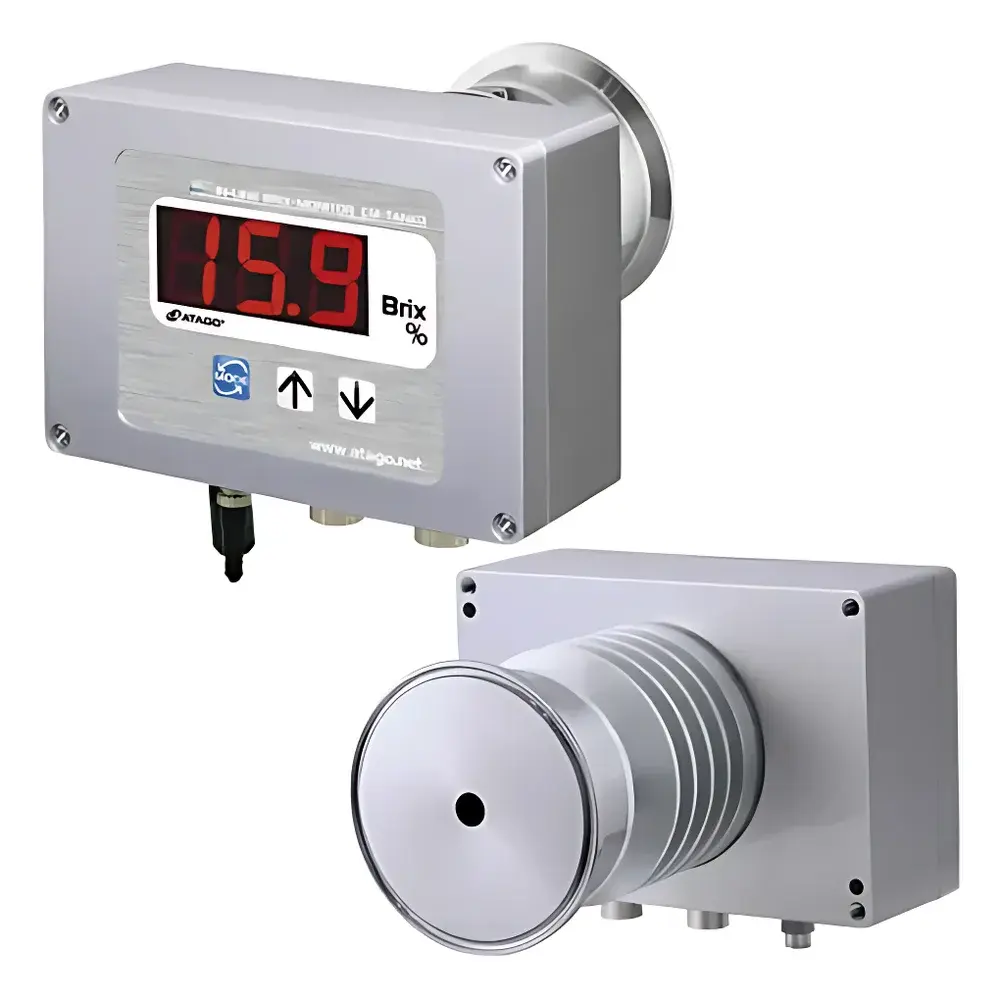
ATAGO CM-TANKα (FER) Online Refractometer
| Brand | ATAGO |
|---|---|
| Origin | Japan |
| Model | CM-TANKα (FER) |
| Product Type | Online Refractometer |
| Measurement Range | Brix 0.00–80.0% |
| Accuracy | ±0.1% Brix |
| Resolution | 0.01% Brix (0.00–9.99%), 0.1% Brix (≥10.0%) |
| Temperature Compensation Range | 5–100 °C |
| Measurement Time | ~1 s |
| Output | DC 2–20 mA / RS-232C |
| Prism Material | Synthetic Sapphire |
| Sample Cell Material | SUS316L |
| Power Consumption | 3 VA |
| Supply Voltage | DC 24 V |
| Ingress Protection Rating | IP67 |
| Dimensions (W×H×D) | 160 × 167 × 110 mm |
| Weight | 2.4 kg (main unit only) |
Overview
The ATAGO CM-TANKα (FER) Online Refractometer is an industrial-grade, in-line process refractometer engineered for continuous, real-time measurement of aqueous solution concentration expressed as Brix (% w/w sucrose equivalent). It operates on the principle of critical angle refractometry: a collimated LED light beam passes through a synthetic sapphire prism in direct optical contact with the process liquid; the resulting refraction angle is detected by a high-resolution linear image sensor and converted into a precise Brix value using factory-calibrated algorithms. Designed specifically for tank-side mounting via standard 3A sanitary clamp (3S), the instrument enables non-invasive, flow-independent concentration monitoring without sampling loops or bypass lines — minimizing maintenance, eliminating dead-leg contamination risks, and ensuring compliance with hygienic design principles common in food, beverage, pharmaceutical, and chemical manufacturing.
Key Features
- Hygienic, clamp-mounted installation compatible with 3A/3S sanitary piping standards — no wetted parts require disassembly for calibration or cleaning.
- Synthetic sapphire prism (Mohs hardness 9) ensures exceptional abrasion resistance and long-term optical stability under aggressive cleaning-in-place (CIP) and sterilization-in-place (SIP) conditions.
- Stainless steel sample cell constructed from electropolished SUS316L meets FDA 21 CFR 178.3570 and EHEDG guidelines for food-contact surfaces.
- Automatic temperature compensation (ATC) across 5–100 °C using an integrated Pt100 RTD sensor, referenced to the internationally accepted ICUMSA sucrose reference table.
- Dual-output interface: isolated 4–20 mA analog signal (scalable to user-defined Brix range) plus RS-232C serial port for configuration, diagnostics, and data logging.
- Robust IP67-rated aluminum housing rated for washdown environments; operates continuously at ambient temperatures from −10 to +50 °C.
- Measurement cycle time of approximately one second supports rapid process feedback control in dynamic blending, dilution, or evaporation applications.
Sample Compatibility & Compliance
The CM-TANKα (FER) is validated for use with clear to mildly turbid aqueous solutions including sugar syrups, fruit juices, dairy concentrates, brines, glycol solutions, and fermentation broths. It is not intended for highly viscous, opaque, or suspended-solid-laden streams without prior inline filtration. The instrument complies with IEC 61000-6-2 (immunity) and IEC 61000-6-4 (emissions), carries CE marking per the EU Machinery Directive 2006/42/EC and Electromagnetic Compatibility Directive 2014/30/EU, and conforms to hygienic design requirements outlined in 3-A Sanitary Standards #100-01 and EHEDG Doc. 8. Traceability of calibration is supported through NIST-traceable reference standards (e.g., ATAGO Brix Calibration Solutions, Cat. No. 3566). When integrated into automated systems, it supports audit-ready operation under GLP and GMP frameworks when paired with compliant SCADA or DCS platforms that implement 21 CFR Part 11-compliant electronic signatures and audit trails.
Software & Data Management
Configuration and diagnostics are performed via ATAGO’s proprietary PC-based software (CM-TANK Utility), which runs on Windows OS and communicates over RS-232C. The utility allows users to set analog output scaling, adjust ATC parameters, perform zero/span verification using certified reference fluids, and export timestamped measurement logs in CSV format. While the device itself does not store historical data, its 4–20 mA output is compatible with PLCs, DCS historians, and cloud-based IIoT platforms (e.g., Siemens Desigo, Rockwell FactoryTalk, or AWS IoT Core) for trend analysis, SPC charting, and predictive maintenance modeling. Optional Modbus RTU firmware upgrade (available upon request) enables integration into legacy industrial networks without protocol gateways.
Applications
- Fermentation process monitoring in ethanol, beer, wine, and bio-pharmaceutical production — tracking sugar depletion and ethanol buildup in real time.
- Concentration control during multi-effect evaporation of fruit purees, tomato paste, or whey protein isolates.
- Blending accuracy verification in soft drink syrup preparation and dairy ingredient dosing.
- In-line quality assurance for CIP rinse water recovery — confirming absence of residual caustic or acid via refractive index deviation.
- Continuous density proxy measurement in desalination pre-treatment and glycol-based heat transfer fluid circuits.
FAQ
Does the CM-TANKα (FER) require periodic recalibration?
Yes — ATAGO recommends annual verification against traceable Brix standards; more frequent checks are advised after mechanical shock, extreme thermal cycling, or exposure to abrasive slurries.
Can it be installed on pressurized tanks?
Yes — the unit is rated for static pressures up to 10 bar (145 psi) at 20 °C when mounted with appropriate 3S clamp torque (recommended: 25–30 N·m).
Is temperature measurement independent of the Brix reading?
No — temperature is measured simultaneously and used exclusively for automatic compensation of the refractive index; it is not provided as a standalone process variable unless enabled via custom firmware.
What cleaning agents are compatible with the sapphire prism and SUS316L cell?
All standard CIP chemicals including 2–4% NaOH, 1–2% HNO₃, peracetic acid, and hydrogen peroxide — provided maximum temperature does not exceed 100 °C and exposure duration remains within typical CIP cycle limits (≤30 min).
How is alignment maintained during thermal expansion of the tank wall?
The elastomeric O-ring seal and floating clamp design accommodate axial and radial movement up to ±0.3 mm, preserving optical coupling integrity without manual re-alignment.




