
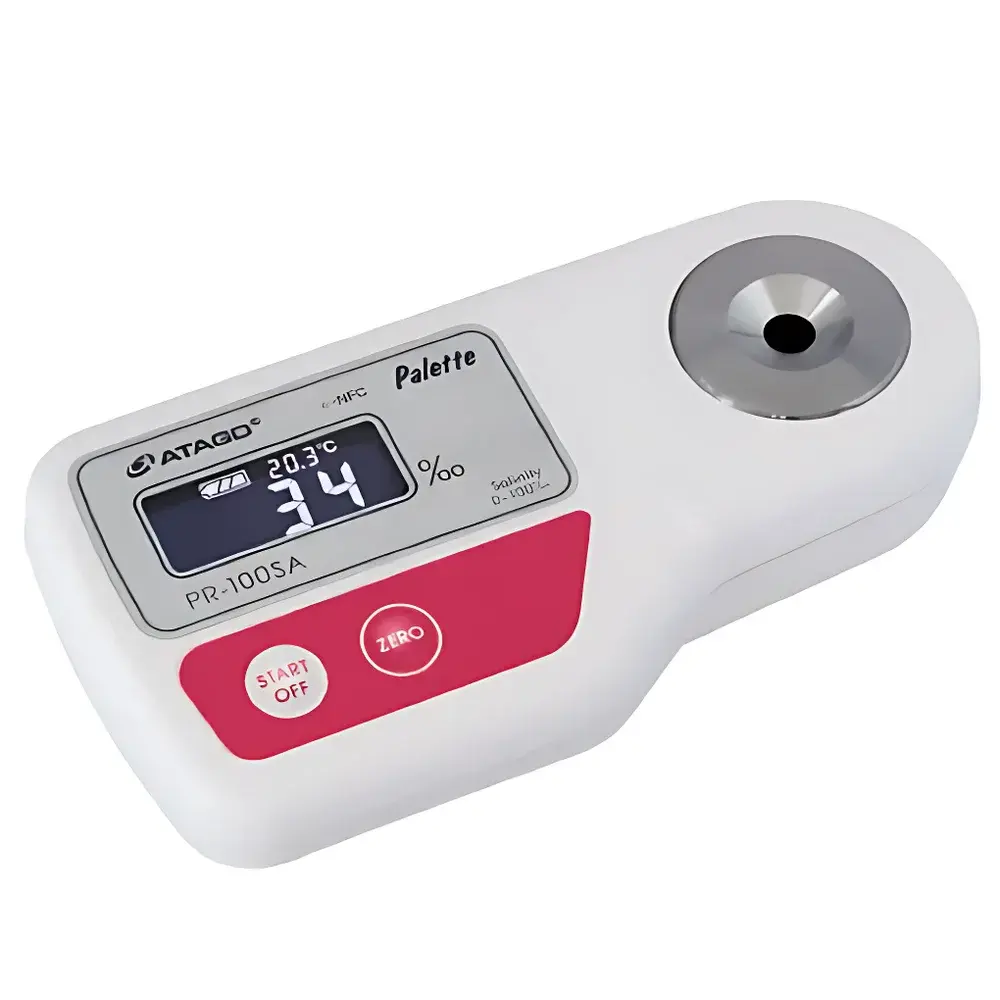
ATAGO PR-100SA Portable Digital Seawater Salinometer
| Brand | ATAGO |
|---|---|
| Origin | Japan |
| Model | PR-100SA (Seawater) |
| Measurement Range | 0.00–100.0 ‰ (w/w) |
| Accuracy | ±2 ‰ of reading |
| Resolution | 1 ‰ |
| Temperature Compensation | Automatic (ATC), 5–40 °C |
| Power Supply | 9 V alkaline battery (006P) |
| IP Rating | IP64 |
| Dimensions | 17 × 9 × 4 cm |
| Weight | 220 g (instrument only) |
Overview
The ATAGO PR-100SA Portable Digital Seawater Salinometer is a compact, field-deployable instrument engineered for rapid, reagent-free determination of salinity in marine and brackish water systems. It operates on the principle of electrical conductivity measurement—leveraging the linear correlation between ionic concentration and conductance in aqueous solutions. Unlike optical refractometers or titration-based methods, the PR-100SA employs a precision-conductive cell integrated into a funnel-shaped prism chamber, enabling direct contact measurement with minimal sample volume (≈10 mL). This design eliminates interferences from suspended solids or coloration commonly encountered in turbid aquaculture or coastal water samples. The device features built-in Automatic Temperature Compensation (ATC) calibrated to the practical salinity scale (PSS-78) reference curve, ensuring traceable results across the operational ambient range of 5–40 °C. Its rugged, IP64-rated enclosure provides dust resistance and protection against water splashes—critical for dockside, hatchery, or onboard vessel use.
Key Features
- Conductivity-based measurement method compliant with ISO 7888:2012 (Water quality — Determination of electrical conductivity) and ASTM D1125-20 (Standard Test Methods for Electrical Conductivity of Water)
- Funnel-type prism chamber optimized for seawater matrix—reduces surface tension effects and improves electrode wetting consistency
- True automatic temperature compensation (ATC) referenced to PSS-78, eliminating manual correction tables or external thermometers
- Low sample requirement (≈10 mL) minimizes waste and enables repeated testing without significant water draw from sensitive cultures
- Battery-powered operation (9 V alkaline, 006P) supports >5,000 measurements per set; no AC adapter required for remote deployments
- High-contrast LCD display with backlight (optional activation) ensures readability under variable lighting conditions, including deck-level daylight and shaded lab benches
- Calibration verification via standard KCl solution (e.g., 35 g/kg) aligns with NOAA and IOC reference protocols for oceanographic salinity validation
Sample Compatibility & Compliance
The PR-100SA is validated for use with natural seawater, artificial seawater preparations, brine solutions, and aquaculture effluents containing typical ion profiles (Na⁺, Cl⁻, Mg²⁺, SO₄²⁻, Ca²⁺, K⁺). It is not intended for high-viscosity fluids, organic solvents, or heavily contaminated industrial effluents where electrode fouling may occur. The instrument meets CE marking requirements for electromagnetic compatibility (EMC Directive 2014/30/EU) and low-voltage safety (LVD Directive 2014/35/EU). While not FDA 21 CFR Part 11–compliant (as it lacks audit trail or user authentication), its measurement repeatability (≤±1.5 ‰ over 20 consecutive readings at 35 ‰) supports GLP-aligned environmental monitoring workflows when paired with documented calibration logs.
Software & Data Management
The PR-100SA is a standalone, non-data-logging instrument. All measurements are displayed in real time and must be manually recorded. No proprietary software, USB interface, or Bluetooth connectivity is included—intentionally designed to reduce failure points in humid, saline environments. For laboratory integration, users may employ standardized digital logbooks or LIMS-compatible templates aligned with ISO/IEC 17025 documentation practices. Calibration records—including date, standard used (e.g., “KCl 35 g/kg”), operator ID, and ambient temperature—should be retained for audit readiness.
Applications
- Marine aquaculture: Routine salinity verification in larval rearing tanks, broodstock systems, and recirculating aquaculture systems (RAS)
- Oceanographic fieldwork: Rapid spot-checking during coastal surveys, estuarine transects, or buoy maintenance operations
- Aquarium and public aquarium management: Monitoring system stability during water changes, quarantine procedures, or coral propagation cycles
- Environmental compliance: Supporting NPDES permit reporting for discharge salinity thresholds in nearshore zones
- Educational laboratories: Demonstrating ionic strength–conductivity relationships in undergraduate marine science curricula
FAQ
Does the PR-100SA require calibration before each use?
No—calibration is recommended before first use and after extended storage (>30 days), or when switching between significantly different salinity ranges (e.g., from estuarine to open-ocean samples). Daily verification using a certified 35 ‰ KCl standard is advised for critical applications.
Can this instrument measure salinity in freshwater or low-salinity estuaries?
Yes—the 0.00–100.0 ‰ range covers freshwater (0 ‰), brackish water (0.5–30 ‰), and hypersaline lagoons (up to 100 ‰), though accuracy degrades below 2 ‰ due to inherent conductivity noise floor limitations.
Is the electrode replaceable or serviceable?
The conductive cell is sealed and non-user-replaceable; ATAGO recommends factory servicing for electrode degradation or drift exceeding ±3 ‰ after recalibration.
How does ATC function without a separate temperature probe?
An integrated NTC thermistor embedded adjacent to the conductivity cell measures solution temperature in real time, applying algorithmic correction based on the IAPSO TEOS-10 formulation for seawater conductivity.
What maintenance is required for long-term reliability?
Rinse the prism chamber thoroughly with deionized water after each measurement; dry with lint-free cloth. Store in supplied protective case with silica gel desiccant to prevent salt crystallization on contacts.






