
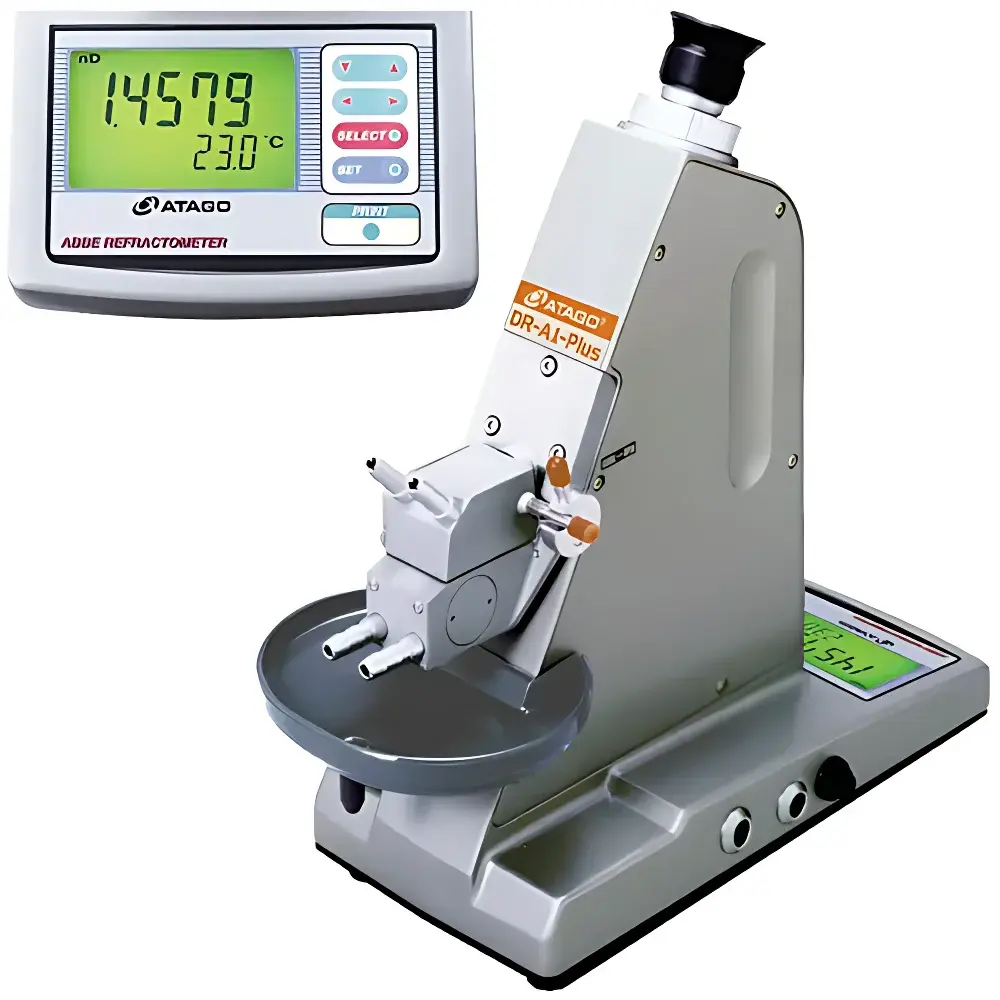
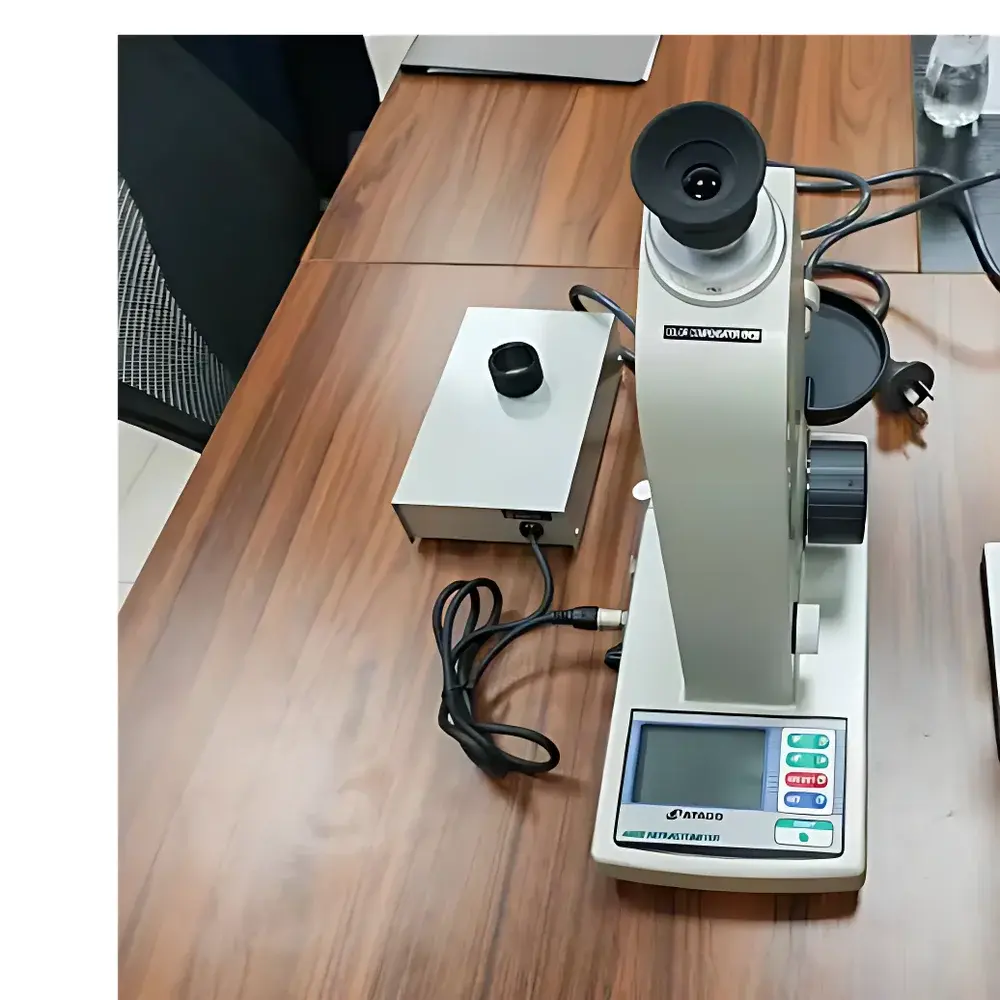
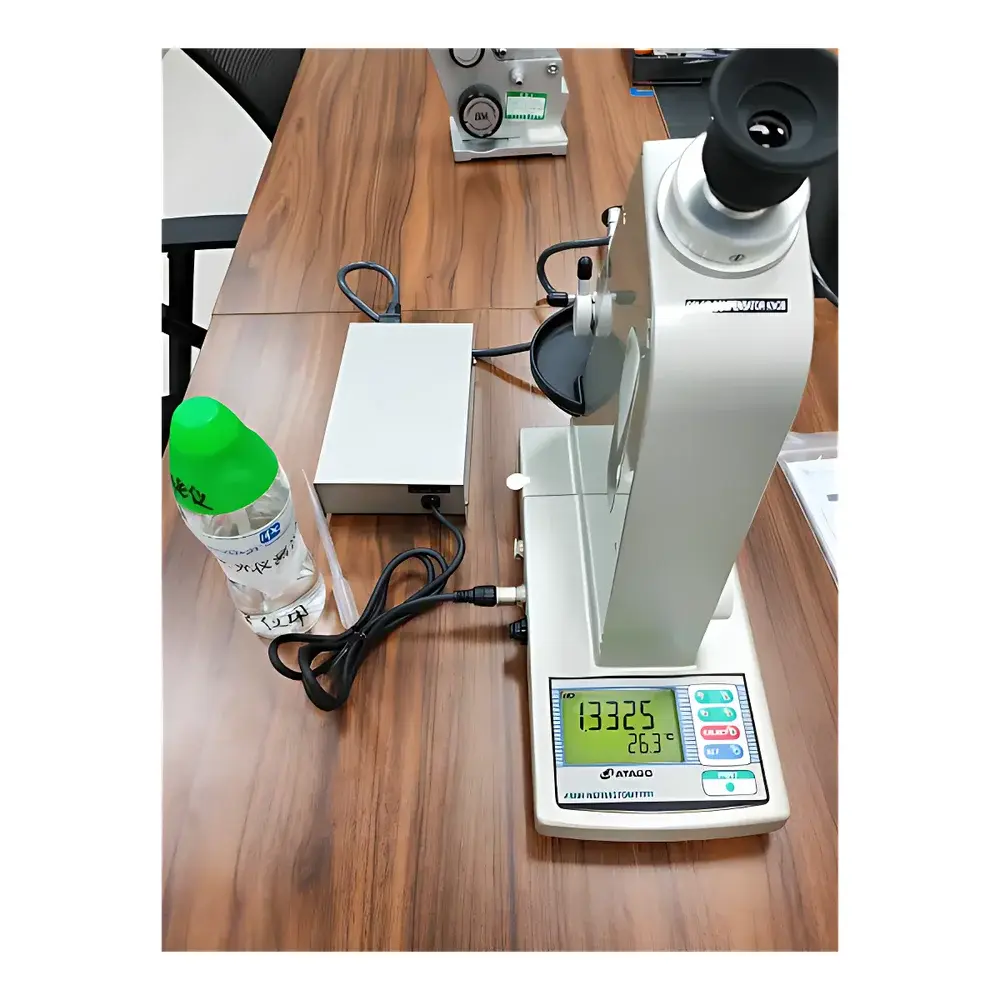
ATAGO DR-A1-Plus Advanced Digital Abbe Refractometer
| Brand | ATAGO |
|---|---|
| Origin | Japan |
| Model | DR-A1-Plus |
| Type | Benchtop Abbe Refractometer |
| Temperature Control | Yes |
| Digital Display | Yes |
| Refractive Index Range | 1.3000–1.7100 |
| Brix Range | 0.0–100.0% |
| Refractive Index Accuracy | ±0.0002 |
| Brix Accuracy | ±0.1% |
| Temperature Accuracy | ±0.2°C |
| Resolution | RI 0.0001, Brix 0.1% |
| Measurement Temp Range | 5–50°C |
| Interface | RS-232C |
| Power | AC Adapter (100–240 V, 50/60 Hz), 16 VA |
| Dimensions (Main Unit) | 13 × 29 × 31 cm |
| Weight (Main Unit) | 6.0 kg |
Overview
The ATAGO DR-A1-Plus Advanced Digital Abbe Refractometer is a precision optical instrument engineered for high-accuracy refractive index (nD) and Brix concentration measurements in laboratory and industrial quality control environments. Based on the classical Abbe principle—employing collimated white light, a double-prism system, and critical angle detection—the DR-A1-Plus replaces traditional ocular reading with a high-resolution digital display, eliminating parallax and observer-dependent variability. Its integrated Peltier temperature control ensures stable thermal conditions across the 5–50°C measurement range, enabling automatic temperature compensation (ATC) per ISO 21748 and ASTM D1218 standards. Designed for rigorous daily use, the instrument delivers traceable, repeatable results essential for method validation under GLP and GMP frameworks.
Key Features
- Digital dual-parameter readout: Simultaneous real-time display of refractive index (nD) and Brix (%) with 0.0001 RI / 0.1% Brix resolution
- Peltier-based active temperature control: Maintains sample prism surface within ±0.2°C of setpoint, supporting compliance with USP and pharmacopeial temperature requirements
- Optimized optical path: High-transmittance prisms and LED illumination yield bright, high-contrast field-of-view with sharply defined shadow line—critical for turbid, colored, or heterogeneous samples (e.g., fruit pulp suspensions, crude oil fractions, polymer solutions)
- No-chromatic-aberration design: Eliminates manual color correction via dedicated achromatizing mechanism, ensuring consistent nD values independent of sample hue or spectral absorption
- RS-232C serial interface: Enables direct data export to LIMS, Excel, or validated laboratory software; compatible with FDA 21 CFR Part 11-compliant audit trail configurations when paired with compliant host systems
- Robust benchtop architecture: All-metal housing, vibration-damped base, and ESD-safe enclosure meet IEC 61326-1 for electromagnetic compatibility in shared analytical labs
Sample Compatibility & Compliance
The DR-A1-Plus accommodates a broad spectrum of liquid and semi-liquid samples—including viscous syrups, emulsions, dark beverages (e.g., molasses, soy sauce), and thermally sensitive formulations—without requiring dilution or filtration. Its large prism surface (22 mm × 22 mm) and shallow sample well minimize air entrapment and support rapid equilibration. The instrument conforms to key international standards governing refractometric analysis: ISO 21748 (repeatability assessment), ISO 5725 (accuracy validation), and AOAC Official Method 932.12 for Brix determination in food matrices. It is routinely deployed in QC laboratories accredited to ISO/IEC 17025, where documented uncertainty budgets (k=2) for nD and Brix are established using NIST-traceable sucrose reference standards.
Software & Data Management
While the DR-A1-Plus operates as a standalone instrument, its RS-232C port supports bidirectional communication with third-party data acquisition platforms. Users may configure automated data logging intervals, assign sample IDs, and append metadata (operator ID, timestamp, ambient conditions) prior to transmission. When integrated into regulated environments, the device functions as a “dumb terminal” — all audit trails, electronic signatures, and data integrity controls reside in the host system per ALCOA+ principles. Optional accessories—including the DP-AD(C) digital printer and 60-C5 recirculating chiller—extend operational flexibility without compromising calibration integrity.
Applications
- Food & Beverage: Brix quantification in juices, jams, dairy concentrates, and fermented products; sugar inversion monitoring in confectionery R&D
- Pharmaceuticals: Excipient concentration verification (e.g., glycerin, propylene glycol), syrup density profiling, and stability-indicating assays
- Chemical Manufacturing: Solvent purity checks (e.g., ethanol/water azeotrope verification), polymer solution concentration, and surfactant micelle characterization
- Academic Research: Teaching optical physics principles; calibrating spectrophotometric methods; validating predictive models for refractive index vs. composition
- Petrochemicals: Hydrocarbon blend analysis, lubricant additive concentration, and biodiesel FAME content estimation via empirical correlations
FAQ
Does the DR-A1-Plus require external calibration verification?
Yes. While factory-calibrated using NIST-traceable standards, users must perform periodic verification using certified reference liquids (e.g., distilled water at 20°C: nD = 1.3330, Brix = 0.0%) in accordance with internal SOPs and ISO/IEC 17025 Clause 6.6.
Can it measure samples below 5°C or above 50°C?
No. The Peltier system is rated for 5–50°C operation. Samples outside this range must be pre-conditioned; measurement accuracy is not guaranteed beyond specified thermal limits.
Is the RS-232C interface compatible with modern Windows/macOS systems?
Yes—via USB-to-serial adapters certified to FTDI or Silicon Labs chipsets. Driver installation and COM port mapping follow standard OS protocols; no proprietary software is required.
What maintenance is recommended for long-term optical performance?
Daily prism cleaning with lens tissue and reagent-grade isopropanol; annual inspection of Peltier module thermal paste and LED luminance output by authorized ATAGO service centers.
How does ATAGO ensure metrological traceability for the DR-A1-Plus?
Each unit ships with a Certificate of Calibration referencing JCSS (Japan Calibration Service System) standards, with uncertainty values reported at k=2 (95% confidence level) per ISO/IEC 17025 Annex A.3.




