
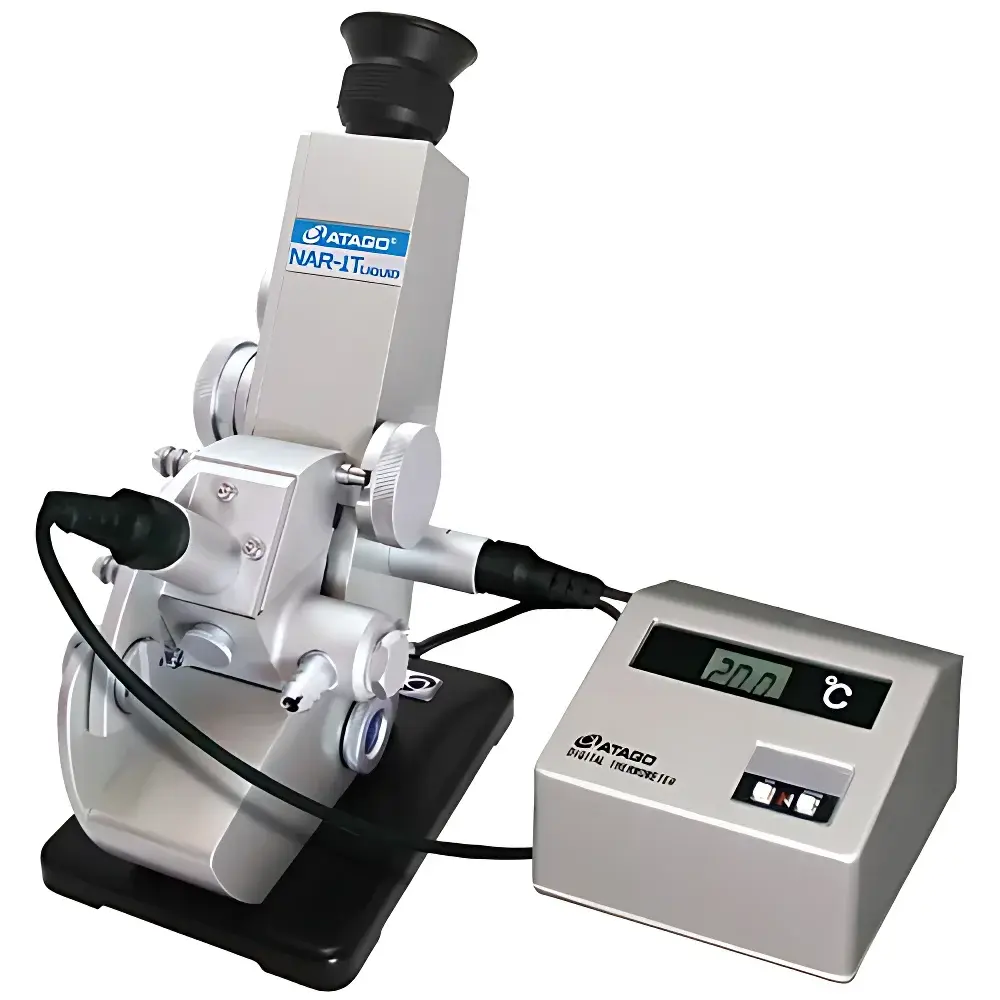
ATAGO NAR-1T Liquid Abbe Refractometer
| Brand | ATAGO |
|---|---|
| Origin | Japan |
| Model | NAR-1T LIQUID |
| Type | Benchtop Abbe Refractometer |
| Refractive Index Range | 1.3000–1.7000 |
| Brix Range | 0.0–95.0% |
| Refractive Index Accuracy | ±0.0002 |
| Brix Accuracy | ±0.1% |
| Refractive Index Resolution | 0.001 |
| Brix Resolution | 0.5% |
| Temperature Measurement Range | 5–50°C |
| Temperature Accuracy | ±0.2°C (ambient) |
| Power Supply | AC 100–240 V, 50/60 Hz |
| Power Consumption | 5 VA |
| Dimensions (main unit) | 13 × 18 × 23 cm |
| Weight (main unit) | 1.8 kg |
| Dimensions (temperature display module) | 10 × 11 × 7 cm |
| Weight (temperature display module) | 0.5 kg |
Overview
The ATAGO NAR-1T Liquid Abbe Refractometer is a precision optical instrument engineered for the accurate determination of refractive index (nD) and Brix concentration in homogeneous liquid samples. Based on the classical Abbe principle—utilizing total internal reflection at the prism-sample interface—the instrument provides direct analog readout of nD and %Brix without digital electronics or software dependency. Its optical design incorporates a high-stability glass prism (sodium D-line wavelength, 589.3 nm), adjustable collimator, and calibrated vernier scale, enabling traceable measurements compliant with ISO 21748, ASTM D1218, and USP . Designed for routine quality control and academic instruction, the NAR-1T delivers metrological reliability in environments where robustness, minimal maintenance, and long-term calibration stability are prioritized over automated data capture.
Key Features
- High-precision Abbe optical system with dual-scale eyepiece: simultaneous refractive index (1.3000–1.7000, resolution 0.001) and Brix (0.0–95.0%, resolution 0.5%) readout
- Temperature-compensated measurement capability via integrated temperature sensor module (5–50°C range; ±0.2°C accuracy relative to ambient)
- Benchtop configuration with rigid aluminum alloy housing and anti-vibration base for stable optical alignment
- No battery or internal electronics required for core optical function—mechanical operation ensures immunity to electromagnetic interference and extended service life
- Compliant with international standard reference conditions: measurements referenced to 20°C using built-in temperature correction table (nF−nC dispersion values provided for spectral characterization)
- Low power consumption (5 VA) and universal AC input (100–240 V, 50/60 Hz) support global laboratory deployment without voltage conversion
Sample Compatibility & Compliance
The NAR-1T is validated for use with clear, non-volatile, non-suspension liquids including aqueous sugar solutions, organic solvents, glycerol-water mixtures, pharmaceutical syrups, fruit juices, and light hydrocarbon fractions. It is unsuitable for opaque, highly viscous (>500 mPa·s), or volatile samples that may evaporate before reading stabilization. The instrument conforms to GLP documentation requirements when used with standardized operating procedures (SOPs), manual logbook entries, and periodic verification against NIST-traceable sucrose standards (e.g., SRM 84d). While it does not incorporate active temperature control, its passive thermal mass and ambient temperature monitoring allow correlation of readings to ISO 2859-1 sampling plans and ASTM E105 random sampling protocols.
Software & Data Management
The NAR-1T operates as a standalone optical instrument with no embedded firmware, USB interface, or proprietary software. All measurements are manually recorded, making it inherently compatible with paper-based or LIMS-integrated workflows requiring audit-ready documentation. Users may integrate temperature readings from the auxiliary display module into electronic lab notebooks (ELNs) or Excel-based QC databases. For regulated environments governed by FDA 21 CFR Part 11, the absence of electronic records eliminates requirements for electronic signature validation—however, full traceability is maintained through operator identification, timestamped entries, and physical calibration certificate archiving per ISO/IEC 17025 clause 7.7.
Applications
- Food & Beverage: Brix quantification in fruit juices, soft drinks, honey, and dairy concentrates per AOAC 932.12 and Codex Alimentarius STAN 212–1999
- Pharmaceutical Manufacturing: Excipient concentration verification (e.g., dextrose, sorbitol) in liquid dosage forms under USP and Ph. Eur. 2.2.2
- Petrochemical QA: Hydrocarbon purity screening and solvent identity confirmation using refractive index fingerprinting (ASTM D1218)
- Academic Research: Teaching fundamental optics, solution thermodynamics, and colligative property relationships in undergraduate physical chemistry laboratories
- Sugar Industry: Raw juice and syrup concentration monitoring during evaporation and crystallization processes (ICUMSA Method GS7/3-11)
FAQ
Does the NAR-1T support automatic temperature compensation (ATC)?
No. It includes a separate temperature display module for ambient monitoring but lacks active Peltier-based ATC. Users must apply manual corrections using the included nF−nC dispersion table or reference to ISO 21748 Annex B.
Can it measure turbid or particulate-containing liquids?
No. Scattering from suspended solids or air bubbles disrupts the critical angle detection; samples must be filtered (≤0.45 µm) and degassed prior to analysis.
Is calibration traceable to national standards?
Yes—when calibrated using certified sucrose standards (e.g., NIST SRM 84d) or distilled water (nD = 1.3330 at 20°C), results meet ISO/IEC 17025 traceability requirements.
What maintenance is required?
Prism surface cleaning with lens-grade tissue and reagent-grade ethanol after each use; annual verification of mechanical zero point and scale linearity by authorized ATAGO service centers.
Is the instrument suitable for GMP-regulated production environments?
Yes—as a Class I measuring device, it supports GMP Annex 15 verification protocols when accompanied by documented IQ/OQ/PQ, calibration logs, and operator training records.




