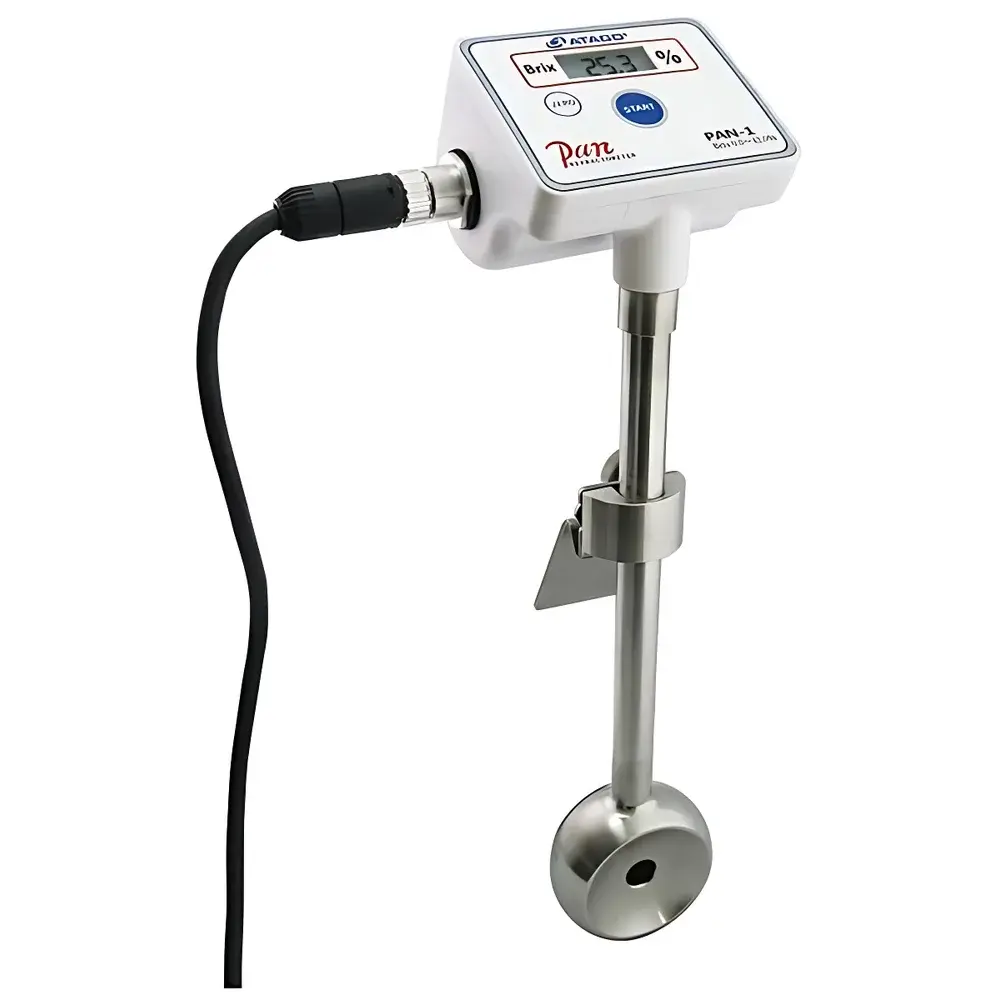
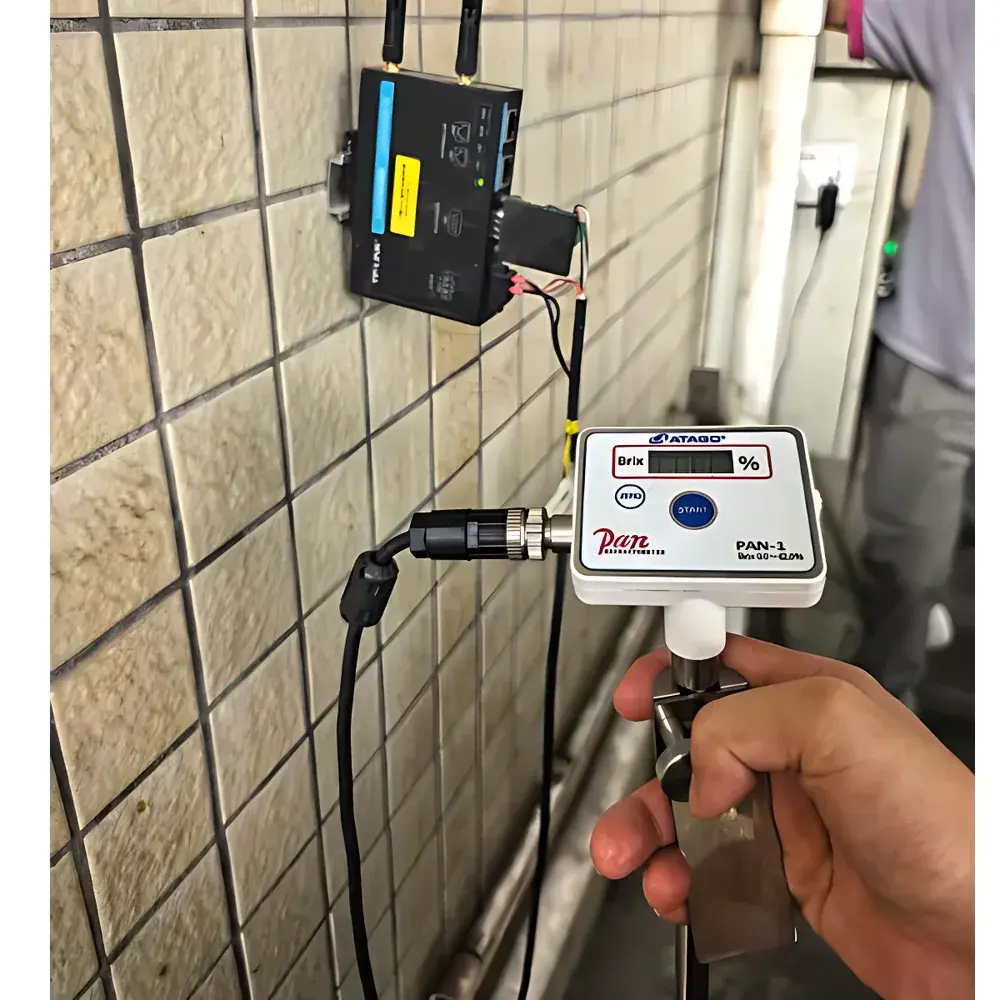
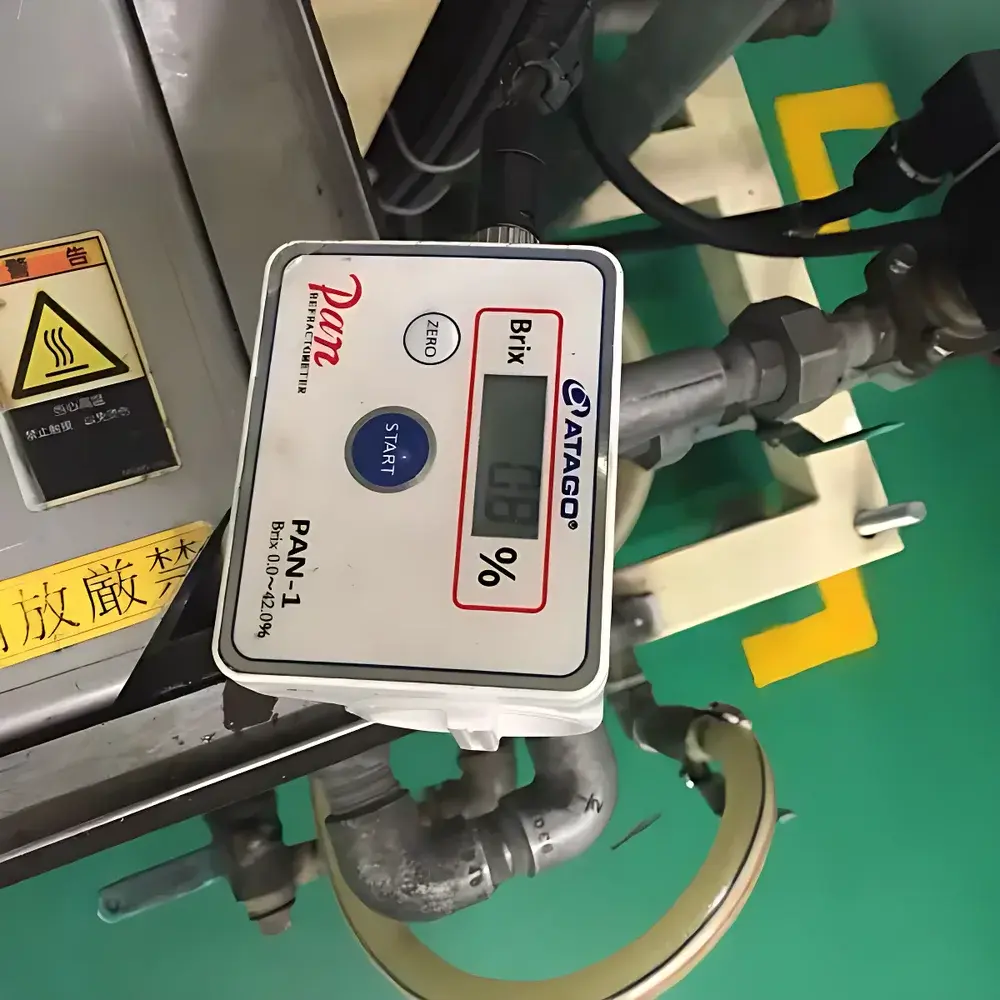
ATAGO PAN-1 DC Online Refractometer for Quenching Fluid Concentration Monitoring
| Brand | ATAGO |
|---|---|
| Origin | Japan |
| Model | PAN-1 DC |
| Measurement Principle | Total Internal Reflection (TIR) Refractometry |
| Output | Brix (%) and Temperature (°C) |
| Sampling Interval | 30 seconds |
| Mounting | Clamp-on, Direct Wall Mounting on Process Vessel |
| Compliance | IP65 Rated Enclosure |
| Power Supply | 24 VDC |
| Analog Output | 4–20 mA (isolated) |
| Digital Interface | RS-485 (Modbus RTU) |
| Operating Temperature Range | 0–60 °C (process fluid) |
| Refractive Index Range | 1.333–1.500 RIU |
| Brix Range | 0–50 % |
| Temperature Compensation | Built-in Pt100 RTD Sensor |
| Material Contact | 316L Stainless Steel Prism & Housing |
Overview
The ATAGO PAN-1 DC Online Refractometer is an industrial-grade, clamp-mounted process analyzer engineered for continuous, real-time monitoring of aqueous polymer-based quenching fluid concentration in heat treatment lines. It operates on the principle of total internal reflection (TIR) refractometry: a collimated LED light beam passes through a sapphire prism in direct contact with the process fluid; the critical angle of refraction is measured with high-resolution photodiode array detection and converted into refractive index (RI), which is linearly correlated to solute concentration—expressed as Brix (% w/w) for polyalkylene glycol (PAG), polyvinyl alcohol (PVA), or other water-soluble quenchant formulations. Unlike offline handheld units requiring manual sampling and calibration drift correction, the PAN-1 DC provides stable, maintenance-minimized measurement under dynamic flow conditions without bypass loops or sample conditioning systems. Its fixed optical path and temperature-compensated algorithm eliminate thermal artifact errors common in unregulated immersion probes, ensuring repeatability better than ±0.1 Brix over extended operational cycles.
Key Features
- Clamp-on mechanical design enables rapid installation directly onto existing stainless steel or carbon steel quench tank walls—no welding, drilling, or process shutdown required.
- Integrated Pt100 RTD sensor ensures automatic temperature compensation across 0–60 °C process temperature range, critical for accurate Brix-to-concentration conversion in thermally variable quench baths.
- 30-second measurement cycle supports responsive closed-loop control integration with PLCs or DCS systems via isolated 4–20 mA analog output and Modbus RTU over RS-485.
- IP65-rated housing with 316L stainless steel wetted parts withstands splash exposure, coolant mist, and incidental chemical contact typical in metalworking environments.
- Factory-calibrated for aqueous PAG-type quenchants; user-adjustable Brix offset available for formulation-specific calibration traceability per ISO 21748 and ASTM D1218.
- No consumables, no reagents, and no moving parts—designed for >5 years of uninterrupted operation under continuous 24/7 duty cycles.
Sample Compatibility & Compliance
The PAN-1 DC is validated for use with water-miscible quenching fluids containing polymeric additives (e.g., PAG, PVP, PEI), glycols, and corrosion inhibitors at operating concentrations from 8–20 % Brix—covering the full functional range specified by major quenchant suppliers (e.g., Houghton International, Quaker Chemical, Master Chemical). It is not suitable for oil-based or emulsified quench media due to non-linear RI response and interfacial fouling risks. The instrument meets CE marking requirements for electromagnetic compatibility (EN 61326-1) and low-voltage directive (2014/35/EU). Its analog and digital outputs support integration into FDA 21 CFR Part 11–compliant data acquisition systems when paired with audit-trail-enabled SCADA software. Calibration verification procedures align with ISO/IEC 17025–accredited laboratory practices for in-process analytical instrumentation.
Software & Data Management
While the PAN-1 DC operates as a standalone sensor, its Modbus RTU interface enables seamless integration into plant-wide MES or LIMS platforms. Raw Brix and temperature values are transmitted at configurable intervals (default: every 30 s) with timestamping support. When connected to ATAGO’s optional PC-based configuration utility (PAN-Config v2.1), users can perform zero-point verification using certified sucrose standards, adjust linear slope coefficients for proprietary quenchant blends, and export CSV logs for trend analysis. All parameter changes are logged with user ID and timestamp—supporting GLP/GMP documentation requirements. No cloud connectivity or proprietary firmware updates are required; field recalibration is performed exclusively via physical standard solution validation—not software-based “digital calibration.”
Applications
This refractometer is deployed at critical control points in heat treatment lines where consistent quench severity directly impacts metallurgical outcomes: at inlet/outlet manifolds of recirculating quench tanks, inline before part immersion zones, or adjacent to temperature-controlled holding reservoirs. It enables automated concentration replenishment via dosing pumps triggered by Brix deviation thresholds, reducing manual titration frequency by >90 %. In automotive crankshaft hardening lines, aerospace landing gear processing, and bearing raceway induction hardening, sustained Brix stability within ±0.3 % minimizes microstructural variability (e.g., martensite/austenite ratio) and mitigates distortion-related scrap. End-users report measurable reductions in post-heat-treatment grinding allowances and improved batch-to-batch hardness uniformity (ASTM E18 Rockwell C repeatability ≤ ±0.5 HRC).
FAQ
How does the PAN-1 DC differ from handheld refractometers in quench bath monitoring?
Handheld units require discrete sampling, introduce thermal lag and operator variability, and lack process integration capability. The PAN-1 DC eliminates sampling error, provides second-by-second trending, and feeds live data to control systems for proactive intervention.
Can it be used with ethylene glycol–based coolants or cutting fluids?
No—it is optimized for PAG/PVA-type quenchants. Glycol-based fluids exhibit nonlinear RI-concentration relationships and may cause prism coating degradation.
What maintenance is required?
Annual visual inspection of the prism surface for scratches or residue buildup; cleaning with deionized water and lint-free cloth if needed. No optical alignment or lamp replacement is necessary.
Is third-party calibration certification available?
Yes—ATAGO-accredited service centers issue ISO/IEC 17025–traceable calibration certificates using NIST-traceable sucrose reference standards.
Does it support alarm relay outputs?
Not natively—but programmable logic controllers can generate alarms based on 4–20 mA signal thresholds or Modbus register status flags.
Related Products