
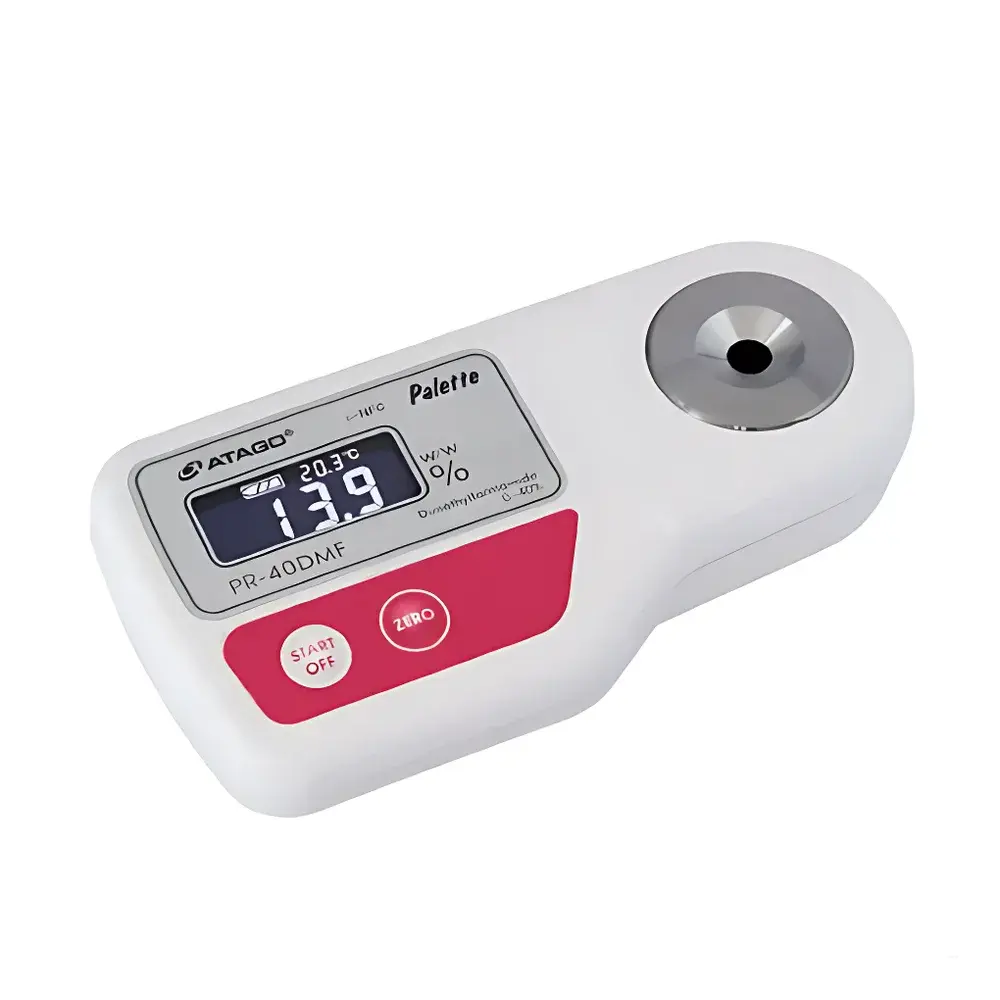
ATAGO PR-40DMF Handheld Digital Refractometer for Dimethylformamide (DMF) Concentration Measurement
| Brand | ATAGO |
|---|---|
| Origin | Japan |
| Model | PR-40DMF |
| Type | Handheld Digital Refractometer |
| Measurement Range | 0.0–40.0% (w/w) DMF |
| Accuracy | ±0.3% |
| Resolution | 0.1% |
| Temperature Compensation | Automatic (5–40°C) |
| Power Supply | 9V battery (006P) |
| IP Rating | IP64 |
| Dimensions | 17 × 9 × 4 cm |
| Weight | 300 g (without accessories) |
Overview
The ATAGO PR-40DMF is a precision handheld digital refractometer engineered specifically for the rapid, on-site quantification of dimethylformamide (DMF) concentration in aqueous and solvent-based industrial process streams. It operates on the principle of critical-angle refractometry: incident light undergoes total internal reflection at the prism-sample interface, with the resulting refraction angle directly correlated to the sample’s refractive index—and thus its DMF mass fraction (w/w). This optical correlation is calibrated against traceable reference standards across the 0.0–40.0% (w/w) DMF range, enabling direct readout without dilution or chemical reagents. Designed for integration into quality control workflows in synthetic leather manufacturing, polyurethane fiber production, and solvent recovery systems, the PR-40DMF delivers repeatable measurements under variable ambient conditions—leveraging built-in automatic temperature compensation (ATC) to correct refractive index drift between 5°C and 40°C. Its solid-state optical architecture eliminates moving parts, ensuring long-term stability and minimal calibration drift.
Key Features
- Application-specific calibration for DMF concentration in water and common organic solvent blends, traceable to NIST-traceable reference materials
- Automatic temperature compensation (ATC) across 5–40°C operating range, eliminating manual correction tables or external thermostats
- Digital LCD display with 0.1% resolution and ±0.3% measurement accuracy (at 20°C, standard calibration condition)
- Robust magnesium alloy body with IP64-rated ingress protection—dust-tight and resistant to water splashes from any direction
- Low sample volume requirement: only 0.3 mL needed per measurement, minimizing material waste and cross-contamination risk
- Single-button operation with auto-power-off after 3 minutes of inactivity, extending 9V battery life to approximately 10,000 measurements
- Ergonomic form factor (17 × 9 × 4 cm, 300 g) optimized for one-handed use in production-line or field environments
Sample Compatibility & Compliance
The PR-40DMF is validated for use with transparent to slightly hazy DMF–water mixtures and DMF–alcohol solutions typical in synthetic leather tanning baths, PU resin preparation, and membrane casting solvents. It is not suitable for highly viscous, opaque, or particulate-laden samples that obstruct light transmission through the sapphire prism surface. The instrument complies with IEC 60529 for IP64 environmental rating and meets electromagnetic compatibility requirements per EN 61326-1:2013 for industrial measurement equipment. While not certified for hazardous area use (e.g., ATEX/IECEx), its non-sparking design and low-voltage operation make it appropriate for general-purpose laboratory and factory floor deployment. Calibration verification aligns with ISO 8655-6 (volumetric instruments) and ASTM D1218 (refractive index of hydrocarbons), supporting GLP-compliant documentation when paired with ATAGO’s optional calibration logbook templates.
Software & Data Management
The PR-40DMF operates as a standalone field instrument with no embedded data logging or Bluetooth connectivity. However, measurement values can be manually recorded into LIMS or ERP systems using standardized reporting formats. For audit readiness, users are advised to maintain calibration logs per ISO/IEC 17025:2017 Clause 6.4.6, documenting date, operator ID, reference standard lot number, and observed deviation. Optional accessories—including a calibration kit (Model CAL-KIT-PR), protective carrying case (CASE-PR), and prism cleaning tissue (TIS-PR)—support consistent operational integrity. Though the device itself does not generate electronic records, its output is fully compatible with 21 CFR Part 11–compliant data capture platforms when integrated via manual entry or barcode-scanned result transfer.
Applications
- Real-time monitoring of DMF concentration in wet-process synthetic leather coagulation baths to ensure consistent pore structure and tensile strength
- Quality assurance of incoming DMF solvent lots prior to use in polyurethane fiber spinning dope preparation
- In-process verification during solvent recovery distillation columns to optimize energy consumption and minimize off-spec fractions
- Batch release testing of adhesive formulations containing DMF as a high-boiling carrier solvent
- Environmental compliance checks for wastewater effluent where DMF discharge limits are regulated under EPA Method 8270D or EU REACH Annex XVII
- Routine maintenance of coating bath stability in automotive interior trim manufacturing lines
FAQ
What is the recommended calibration frequency for the PR-40DMF?
Calibration should be verified before each shift or at least once per 8-hour workday using ATAGO-certified DMF reference standards (e.g., 10.0%, 25.0%, and 35.0% w/w). Full recalibration is required if verification exceeds ±0.3% tolerance.
Can the PR-40DMF measure DMF in mixtures containing other solvents like THF or acetone?
No—the optical calibration is specific to DMF–water and DMF–ethanol systems. Presence of additional solvents alters the refractive index–concentration relationship and invalidates the scale; dedicated models or lab-grade HPLC validation are required.
Is the sapphire prism resistant to DMF-induced degradation?
Yes—the prism is fabricated from monocrystalline sapphire (Al₂O₃), which exhibits exceptional chemical inertness toward DMF, alcohols, and weak acids, ensuring >5-year service life under normal usage conditions.
Does the instrument require user-performed temperature calibration?
No—ATC is factory-programmed using dual thermistor feedback and requires no user intervention; however, thermal equilibrium between sample and prism must be achieved (typically <5 seconds for room-temperature samples).
How is measurement uncertainty quantified for ISO/IEC 17025 reporting?
Combined standard uncertainty includes contributions from instrument accuracy (±0.3%), temperature compensation residual (±0.1%), operator repeatability (±0.05%), and reference standard uncertainty (±0.02%), yielding an expanded uncertainty (k=2) of ±0.62% w/w at 95% confidence.





