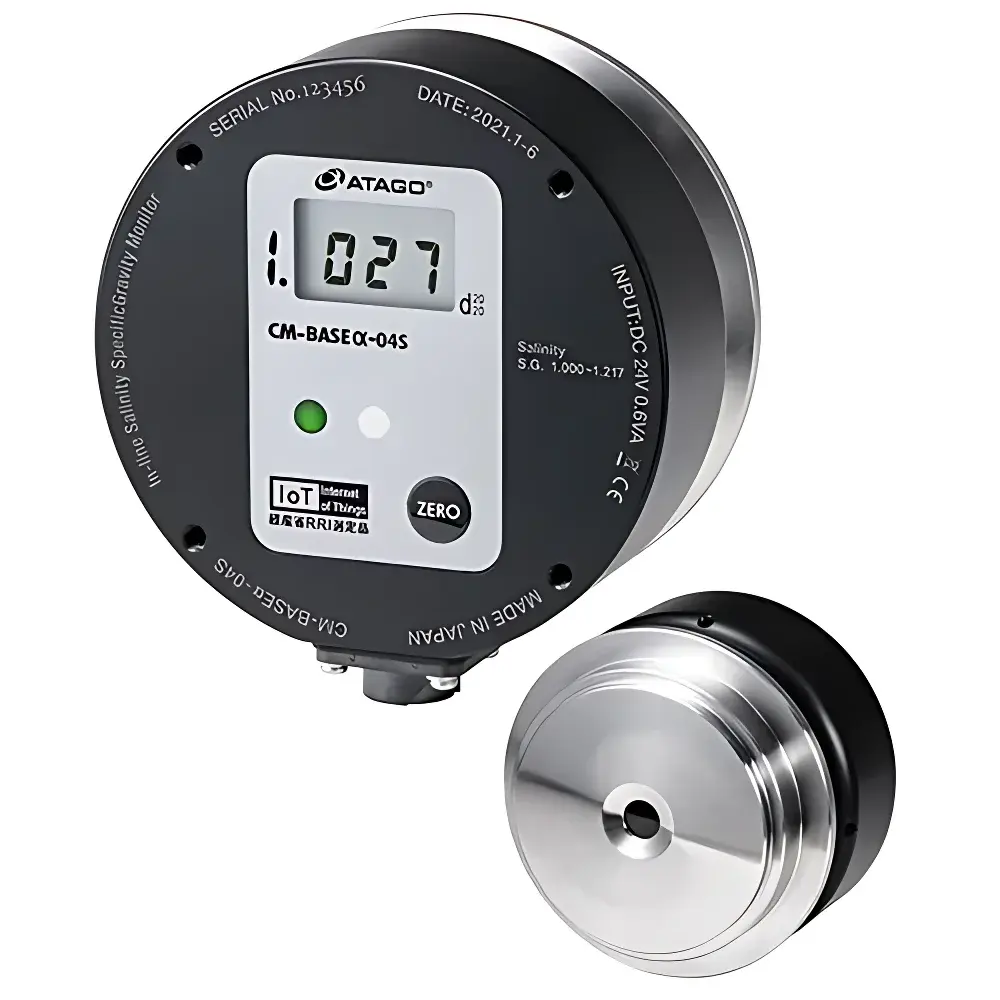
ATAGO CM-BASEα-04S Online Refractometer for Saline Specific Gravity Measurement
| Brand | ATAGO |
|---|---|
| Origin | Japan |
| Model | CM-BASEα-04S |
| Measurement Range | Specific Gravity 1.000–1.217 |
| Resolution | 0.001 |
| Accuracy | ±0.005 |
| Power Supply | DC 24 V |
| Output Signals | RS-232C, 4–20 mA |
Overview
The ATAGO CM-BASEα-04S is a high-stability, industrial-grade online refractometer engineered for continuous, real-time measurement of saline solution specific gravity (SG) in process streams. It operates on the principle of critical-angle refractometry: a collimated LED light source impinges on the prism–sample interface; the resulting refraction angle is detected by a high-resolution linear CCD sensor and converted into a precise specific gravity value via factory-calibrated polynomial algorithms traceable to NIST-certified reference standards. Unlike offline benchtop refractometers or density meters, the CM-BASEα-04S integrates directly into stainless-steel process piping (via sanitary clamp or threaded fittings) with a sapphire measurement prism rated for continuous exposure to aggressive brines, chlorinated solutions, and elevated temperatures up to 80 °C. Its optical design eliminates moving parts, bubble sensitivity, and thermal drift—ensuring long-term repeatability (<0.002 SG over 30 days) without recalibration under stable process conditions. The instrument is purpose-built for closed-loop concentration control in salt-based industrial processes where consistent ionic strength, osmotic pressure, or freezing-point depression must be maintained—such as in metal quenching baths, electroplating rinse tanks, desalination pre-treatment monitoring, and pharmaceutical buffer preparation.
Key Features
- Optically robust sapphire prism with IP67-rated stainless-steel (SUS316L) housing for corrosion resistance in high-chloride environments
- Dual-output interface: isolated 4–20 mA analog signal (HART-compatible) and RS-232C serial communication (ASCII protocol, Modbus RTU optional)
- Real-time temperature compensation using integrated Pt100 RTD (±0.2 °C accuracy), referenced to 20 °C per ISO 21748
- Zero-point verification function enabling field validation without sample removal or external calibration fluids
- Configurable alarm thresholds (high/low limits) with relay output (SPDT, 250 V AC/3 A) for process interlock integration
- CE, RoHS, and ATEX Zone 2/22 (optional) certified for hazardous area installation compliance
Sample Compatibility & Compliance
The CM-BASEα-04S is validated for aqueous sodium chloride solutions within the specified range (SG 1.000–1.217, equivalent to ~0–26 wt% NaCl at 20 °C). It maintains metrological integrity in turbid, mildly viscous, or aerated streams due to its large-diameter optical path (≥8 mm) and anti-fouling prism geometry. While optimized for saline systems, it is not recommended for hydrocarbon-based or highly volatile solvents (e.g., acetone, ethanol >10 vol%). Regulatory alignment includes adherence to ASTM D1152 (standard test method for refractive index of glycerin), ISO 21748 (guidance for refractometer uncertainty estimation), and IEC 61511 (functional safety for SIS applications). For GMP-regulated environments, the device supports audit-trail-enabled configuration logging when paired with ATAGO’s optional CM-Link software (21 CFR Part 11 compliant with electronic signature and user access control).
Software & Data Management
Data acquisition and system integration are supported through ATAGO’s CM-Link PC software (Windows 10/11), which provides real-time graphing, historical trend export (CSV/Excel), and configurable data logging intervals (1 s to 1 hr). The RS-232C interface enables direct SCADA/HMI integration via standard OPC UA drivers or custom Modbus mapping. All calibration parameters, firmware version, and operational logs are stored internally with battery-backed memory (retention >10 years). Remote diagnostics—including prism contamination detection, signal-to-noise ratio monitoring, and temperature deviation alerts—are accessible via ASCII command set (e.g., “READSG”, “READTEMP”, “DIAGNOSTIC”). No cloud dependency or subscription licensing is required; firmware updates are performed locally via USB-to-serial adapter.
Applications
- Continuous monitoring of salt concentration in industrial cooling towers and heat exchanger circuits to prevent scaling and microbiological growth
- Real-time control of brine concentration in food processing (e.g., pickle tank replenishment, seafood preservation brines)
- Quality assurance in chemical manufacturing of sodium hypochlorite, calcium chloride, and magnesium chloride solutions
- In-line verification of de-icing fluid concentration (NaCl/KCl blends) at airport apron dispensing points
- Process validation during sterile filtration of saline-based parenteral solutions in biopharmaceutical cleanrooms
- Feedback control of evaporation rate in multi-effect seawater desalination plants
FAQ
What is the maximum allowable process pressure for the CM-BASEα-04S?
Standard configuration supports up to 1.0 MPa (145 psi); high-pressure variants (up to 3.0 MPa) are available upon request with reinforced prism gasketing.
Can the unit be installed in vertical pipe sections?
Yes—orientation-independent operation is ensured by the symmetrical flow cell design; however, upstream straight-pipe length ≥5× pipe diameter is recommended to stabilize laminar flow across the prism.
Is temperature compensation automatic and adjustable?
Temperature compensation is fully automatic and fixed to the ISO 21748 water-reference curve; manual offset adjustment is not permitted to preserve metrological traceability.
How often does the instrument require verification or recalibration?
Under stable operating conditions, annual verification against a certified SG standard (e.g., NIST SRM 1812) is sufficient; more frequent checks are advised if process chemistry changes significantly (e.g., introduction of co-solutes like Ca²⁺ or Mg²⁺).
Does the CM-BASEα-04S support explosion-proof certification for Class I, Division 1 areas?
No—ATEX Zone 2/22 (equivalent to Class I, Division 2) is the highest intrinsic safety rating available; Class I, Div 1 requires additional purged enclosure integration, which is not offered by ATAGO for this model.