
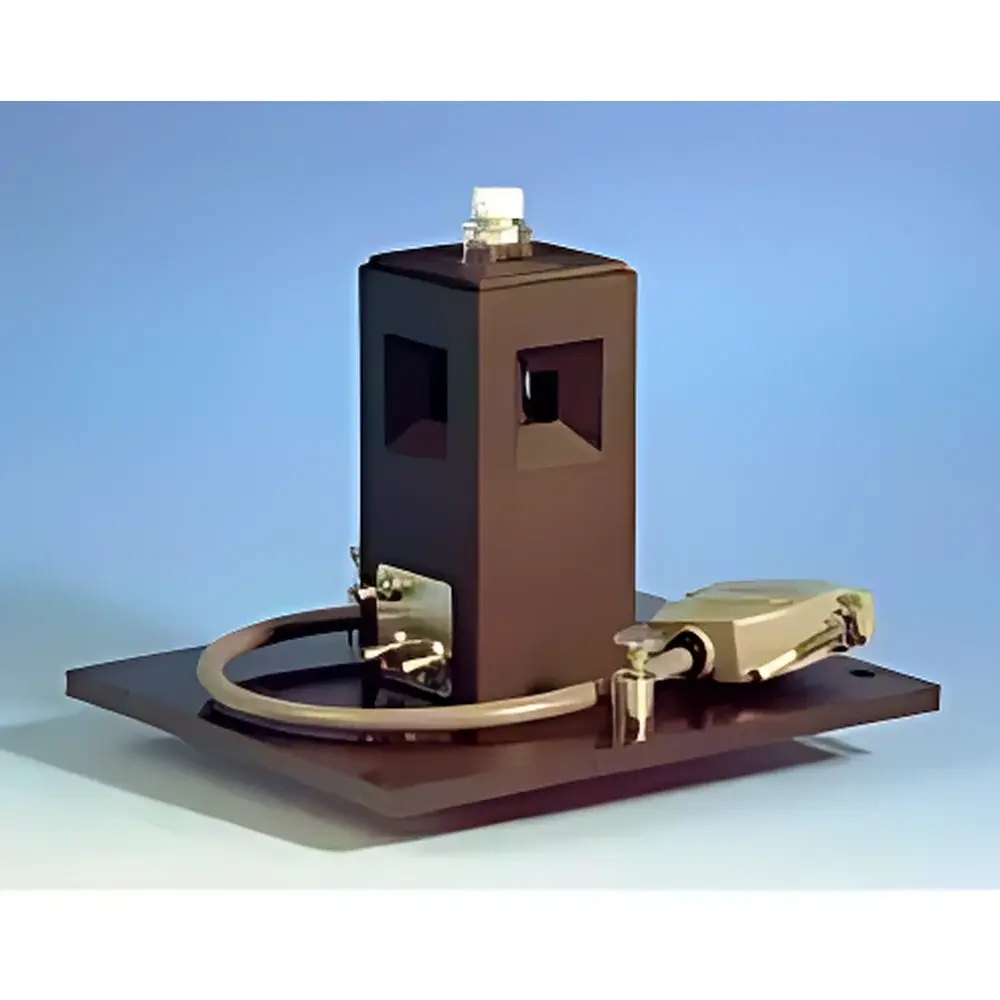
Quantum Northwest TLC50 Single-Cell Temperature-Controlled Cuvette Holder
| Brand | Quantum Northwest |
|---|---|
| Origin | South Korea |
| Model | TLC50 Single-Cell Cuvette Holder |
| Temperature Range (Standard) | −40.00 to +105.00 °C |
| Temperature Range (Custom) | −55.00 to +150.00 °C |
| Temperature Accuracy | ±0.02 °C |
Overview
The Quantum Northwest TLC50 Single-Cell Temperature-Controlled Cuvette Holder is a precision-engineered thermal platform designed for spectroscopic applications requiring high-fidelity temperature regulation of liquid or solution-phase samples in standard 10 mm square cuvettes. Built upon solid-state Peltier thermoelectric technology, the TLC50 delivers rapid, bidirectional thermal response—enabling controlled cooling and heating across an extended operational range. Its core architecture integrates a high-stability thermistor sensor embedded in direct thermal contact with the sample compartment, ensuring real-time, in-situ temperature feedback with ±0.02 °C accuracy. Unlike passive or air-cooled alternatives, the TLC50 maintains thermal equilibrium without external chillers or cryogens, making it suitable for benchtop integration in UV-Vis absorption, steady-state and time-resolved fluorescence, circular dichroism (CD), transient absorption, Raman spectroscopy, and near-infrared (NIR) measurements. The device is fully compatible with commercial spectrometers—including those from Horiba, Edinburgh Instruments, JASCO, PerkinElmer, and Ocean Insight—via standardized optical path alignment and mechanical mounting interfaces.
Key Features
- Peltier-driven thermal control enabling precise, programmable temperature ramping and isothermal hold with sub-0.05 °C stability over 24 hours
- Four orthogonal optical access ports—allowing simultaneous excitation and emission collection at defined angles, critical for front-face fluorescence and polarization-resolved measurements
- Integrated magnetic stirrer with adjustable speed (0–1200 rpm) to eliminate thermal gradients and ensure homogeneous sample temperature distribution
- Thermistor-based closed-loop monitoring located adjacent to the cuvette’s lateral wall for direct measurement of sample thermal state—not ambient chamber temperature
- Modular mechanical design supporting customization for non-standard cuvette geometries (e.g., 5 mm, 2 mm pathlength, or custom quartz cells) and spectrometer-specific beam-height alignment
- Software-controllable via RS-232 or USB interface; supports scripting in LabVIEW, Python, MATLAB, and Igor Pro for automated temperature sweeps synchronized with data acquisition
Sample Compatibility & Compliance
The TLC50 accommodates standard 10 × 10 mm square cuvettes (including UV-grade fused silica, quartz, and IR-transmissive CaF₂ variants) with minimal optical distortion. Its open-top, low-profile housing permits unobstructed beam passage and facilitates rapid sample exchange without thermal shock to the system. All wetted components are chemically inert stainless steel or anodized aluminum, ensuring compatibility with aqueous buffers, organic solvents (e.g., acetonitrile, chloroform, DMSO), and mildly corrosive media. From a regulatory standpoint, the TLC50 meets essential requirements for GLP-compliant laboratories: temperature calibration traceable to NIST standards, audit-ready logging of setpoint vs. actual temperature history, and optional 21 CFR Part 11–compliant software modules for electronic signatures and data integrity assurance. It conforms to IEC 61010-1 for electrical safety and operates within ISO/IEC 17025–recommended environmental tolerances (20–25 °C ambient, <60% RH).
Software & Data Management
Quantum Northwest provides the QNW TempControl Suite—a cross-platform application enabling real-time visualization of temperature profiles, manual setpoint adjustment, and creation of multi-segment thermal protocols (e.g., step-and-hold, linear ramp, sinusoidal modulation). Raw thermistor voltage and Peltier current/voltage telemetry are logged at up to 10 Hz and exported in CSV or HDF5 format for post-acquisition correlation with spectral datasets. API-level access allows integration into existing laboratory information management systems (LIMS) or custom acquisition pipelines. For users operating under regulated quality frameworks, optional firmware upgrades support timestamped, tamper-evident audit trails with user authentication and change logging—fully aligned with FDA and EMA expectations for instrument qualification (IQ/OQ/PQ) documentation.
Applications
- Thermal denaturation studies of proteins and nucleic acids via fluorescence quenching or CD signal loss
- Temperature-dependent quantum yield determination in luminescent materials and OLED precursors
- Phase transition analysis in liquid crystals and polymer solutions using absorbance edge shifts
- Enzyme kinetics profiling across physiological and supra-physiological temperature ranges
- Validation of photostability under accelerated thermal stress per ICH Q1A(R2)
- In situ monitoring of catalytic reactions in flow-cell configurations (with optional adapter kit)
FAQ
What cuvette pathlengths and materials are supported?
The TLC50 is optimized for 10 mm square cuvettes but accepts 5 mm and 2 mm variants with optional alignment shims. Compatible materials include UV-grade fused silica, Suprasil quartz, and CaF₂ for deep-UV to mid-IR applications.
Can the TLC50 be used in vacuum or inert-gas environments?
Yes—its sealed electronics and passive gas exchange port allow operation inside gloveboxes or vacuum chambers (down to 10⁻² mbar) when equipped with optional O-ring–sealed feedthroughs.
Is remote temperature programming possible without proprietary software?
Yes—ASCII command protocol documentation is provided, enabling full control via terminal emulators or custom scripts using standard serial communication libraries.
How is thermal uniformity validated across the cuvette volume?
Quantum Northwest supplies a validation report based on IR thermography and micro-thermocouple mapping at three axial positions (top/mid/bottom) under representative load conditions.
Does the TLC50 meet ASTM E2847 or ISO 11357 standards for thermal analysis instrumentation?
While not a differential scanning calorimeter, its temperature accuracy, stability, and traceability align with the metrological requirements specified in ASTM E2847 Annex A1 for auxiliary thermal control units used in spectroscopic thermal analysis.




