
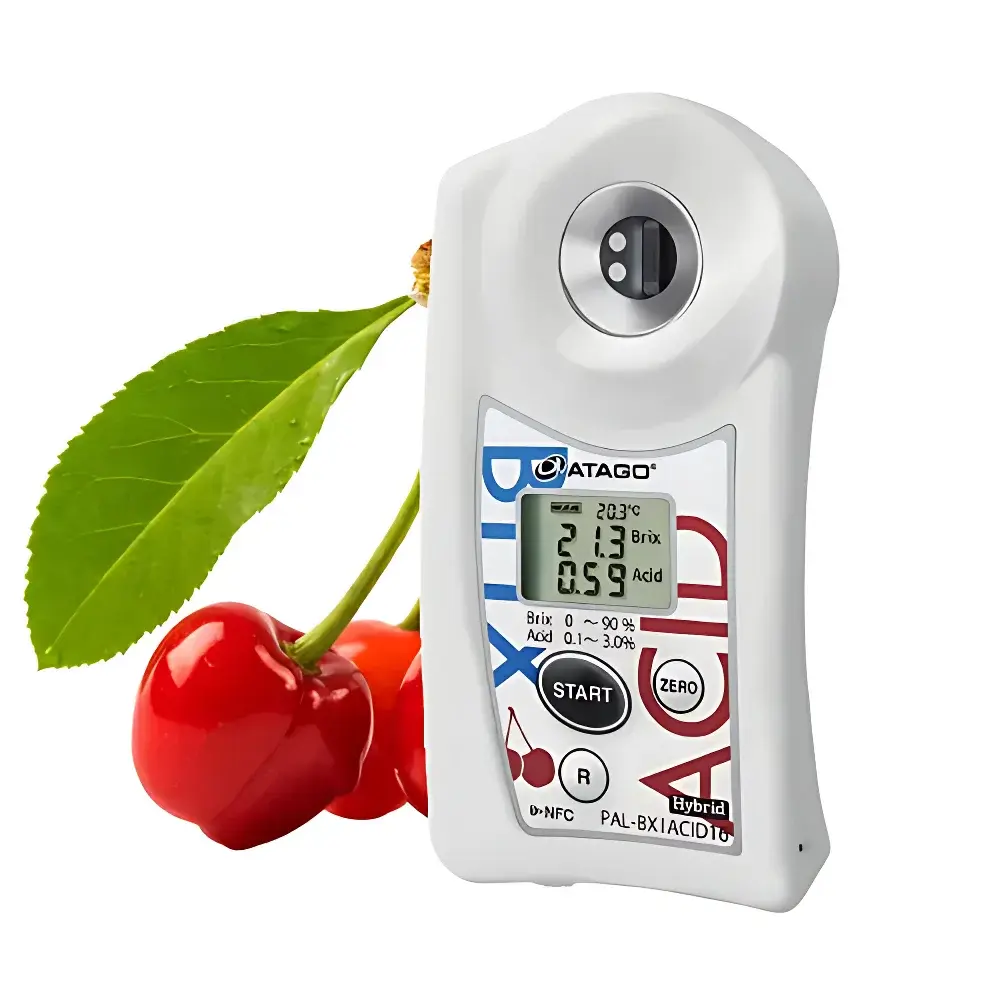
ATAGO PAL-BX/ACID 16 Cherry-Specific Refractometer with Integrated Acidity Measurement
| Brand | ATAGO |
|---|---|
| Origin | Japan |
| Model | PAL-BX/ACID 16 |
| Instrument Type | Destructive Sampling |
| Brix Range | 0.0–90.0% |
| Acid Range (as Malic Acid) | 0.10–3.00% |
| Brix Accuracy | ±0.2% |
| Acid Accuracy | ±0.10% (0.10–1.00%), ±10% rel. (1.01–3.00%) |
| Temp. Compensation | 10–40°C |
| Resolution | Brix 0.1%, Acid 0.01%, Ratio 0.01–1.0 (two decimal), 1–99.9 (one decimal), ≥100 (integer) |
| Dimensions | 5.5 × 3.1 × 10.9 cm |
| Weight | 100 g (body only) |
| Power | 2× AAA alkaline batteries |
Overview
The ATAGO PAL-BX/ACID 16 is a handheld, dual-parameter refractometer engineered specifically for rapid, on-site assessment of sugar-acid balance in fresh cherries (Prunus avium) and cherry-derived products. Unlike conventional benchtop systems requiring laboratory infrastructure, this instrument integrates Abbe-type optical refractometry for Brix measurement with a calibrated electrochemical sensor module optimized for malic acid quantification — the dominant organic acid in sweet cherries. The device computes the Sugar-Acid Ratio (SAR) in real time using the formula SAR = Brix (%) / Total Acidity (% as malic acid), a critical empirical index correlated with sensory perception of sweetness, tartness, and overall flavor harmony. Its design adheres to principles of process analytical technology (PAT), enabling immediate decision-making during harvest, sorting, postharvest handling, and quality assurance workflows without sample destruction beyond minimal juice extraction.
Key Features
- Cherry-optimized optical path and calibration curve, preloaded with offset correction for alignment with titration-based reference methods (e.g., AOAC 942.15 or ISO 750)
- Simultaneous Brix and acidity measurement from a single juice aliquot — no separate instrumentation or method switching required
- Dedicated R-key functionality for instantaneous Sugar-Acid Ratio calculation and display, supporting three dynamic resolution modes based on ratio magnitude (0.00–9.99, 00.0–99.9, 100+)
- Automatic temperature compensation (10–40°C) compliant with ISO 2173:2003 for refractive index correction
- Rugged, IP65-rated enclosure resistant to dust ingress and water jets — suitable for field use in orchards, packinghouses, and cold storage facilities
- Battery-powered operation (2× AAA) with low-power LED illumination and auto-shutdown after 3 minutes of inactivity
- No reagents, no titrants, no glassware — eliminates consumable costs and operator dependency associated with volumetric acid-base titration
Sample Compatibility & Compliance
The PAL-BX/ACID 16 accepts clarified cherry juice obtained via manual press or centrifugation. For acidity measurement, a 1:50 (w/v) dilution with distilled or deionized water (1 mL juice + 50 mL water) is required prior to sampling — a protocol validated against AOAC Official Method 942.15 for total titratable acidity in fruits. The instrument’s acidity scale is traceably calibrated to certified malic acid standards (NIST SRM 392a), ensuring metrological consistency across laboratories. While not intended for regulatory submission under FDA 21 CFR Part 11, its measurement repeatability (RSD < 1.2% for Brix; < 2.8% for acidity at 1.2% level) supports internal quality control, GLP-aligned process monitoring, and QC/QA documentation per ISO/IEC 17025:2017 clause 7.7.
Software & Data Management
This standalone instrument does not feature Bluetooth, USB, or cloud connectivity. All measurements are displayed locally and retained only in volatile memory until the next reading. However, its consistent output format (Brix %, Acid %, SAR value) enables seamless manual transcription into LIMS, Excel-based harvest logs, or statistical process control (SPC) charts. The built-in OFFSET function allows users to apply linear correction factors derived from correlation studies with reference methods — a capability essential for harmonizing field data with central lab results during validation or method transfer activities.
Applications
- Harvest timing optimization: Real-time SAR trends identify peak flavor windows across cultivars (e.g., Bing, Rainier, Lapins)
- Postharvest grading: Objective segregation of fruit lots by SAR thresholds aligned with commercial specifications (e.g., >18 for premium dessert cherries)
- Processing line monitoring: In-line verification of juice concentrate blends, syrup formulations, or frozen cherry pulp consistency
- Varietal screening programs: High-throughput phenotyping of breeding populations for flavor-related QTLs
- Supply chain traceability: Batch-level SAR documentation supporting origin claims and ripeness certification schemes
- Educational use in horticultural science labs for teaching fruit physiology and sensory-quality relationships
FAQ
Is the PAL-BX/ACID 16 suitable for other fruits besides cherries?
It is calibrated and optimized for cherry matrix characteristics (pH ~3.2–4.0, malic acid dominance, pigment profile). While it may yield readings on similar stone fruits (e.g., plums, apricots), accuracy is not guaranteed without revalidation against species-specific reference methods.
Does the device require annual recalibration?
ATAGO recommends verification using certified Brix and malic acid standards before each daily use session. Full recalibration is performed by authorized service centers using factory traceable reference materials — typically every 12–24 months depending on usage frequency and environmental conditions.
Can the acidity reading be converted to citric or tartaric acid equivalents?
No. The instrument reports total acidity exclusively as % malic acid, per its factory calibration. Conversion to other acid bases requires application of stoichiometric equivalence factors and is not supported by the firmware.
What is the minimum juice volume required per measurement?
Approximately 0.3 mL of clarified juice is sufficient for both Brix and diluted acidity testing. Excess sample can be recovered for backup analysis if needed.
How does the OFFSET function improve measurement alignment with titration results?
OFFSET applies a user-defined additive or multiplicative correction to raw sensor output, compensating for systematic bias arising from matrix effects or procedural differences — enabling direct comparability between portable and reference lab datasets without altering underlying calibration curves.






