
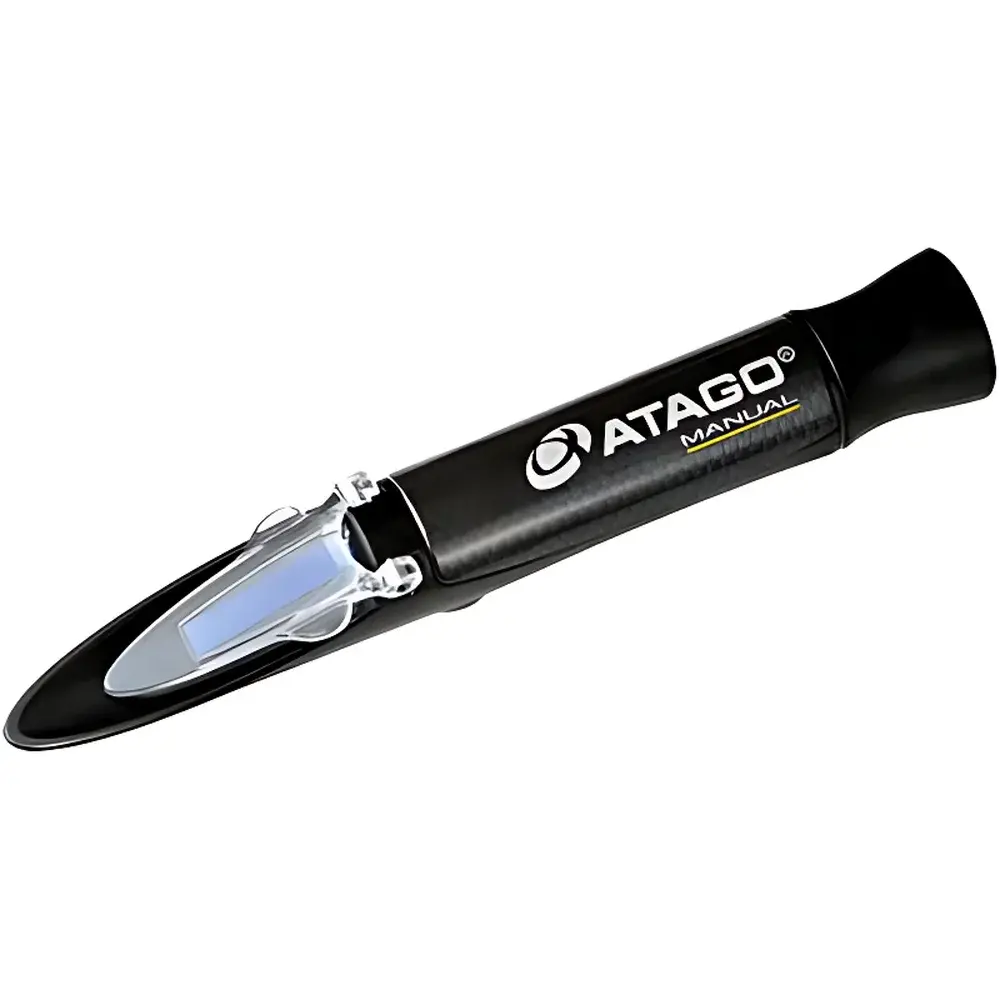
ATAGO MASTER-URC/NM Analog Handheld Urine Specific Gravity Refractometer
| Brand | ATAGO |
|---|---|
| Origin | Japan |
| Model | MASTER-URC/NM |
| Product Type | Analog Handheld Refractometer |
| Temperature Compensation | None (Manual Calibration Required) |
| Display Type | Optical Scale (Non-Digital) |
| Refractive Index Range | nD 1.333–1.356 |
| Urine Specific Gravity Range | 1.000–1.050 |
| Scale Division | 0.001 (both SG and nD) |
| Prism Material | Acid- and Salt-Resistant Optical Resin |
| Dimensions | 3.2 × 3.4 × 20.7 cm |
| Weight | 110 g |
| Compatible Illumination Plate | RE-2471-56M |
Overview
The ATAGO MASTER-URC/NM is a precision-engineered analog handheld refractometer designed specifically for rapid, field-deployable measurement of urine specific gravity (USG) in clinical, veterinary, and point-of-care settings. It operates on the fundamental optical principle of critical angle refraction: when a collimated light beam passes from a high-refractive-index prism into a liquid sample, the angle at which total internal reflection occurs is directly correlated to the sample’s refractive index (nD). This refractive index is empirically calibrated to urine specific gravity using standardized physiological saline solutions, enabling reliable estimation of urinary solute concentration without dilution or reagent addition. Unlike digital or temperature-compensated models, the MASTER-URC/NM relies on manual calibration with distilled water at ambient temperature (typically 20 °C), requiring user awareness of thermal drift effects—making it suitable for controlled environments where operator training and procedural consistency are maintained per CLIA-waived testing protocols.
Key Features
- Compact, lightweight design (110 g) optimized for portability and one-handed operation in mobile clinics, emergency response units, and animal handling facilities.
- Optical scale readout with dual graduated scales: urine specific gravity (1.000–1.050, 0.001 resolution) and refractive index (nD 1.333–1.356, 0.001 resolution), enabling cross-verification and method transparency.
- Prism assembly fabricated from proprietary acid- and salt-resistant optical resin—engineered to withstand repeated exposure to urea-rich, acidic, or alkaline urine samples without degradation or etching.
- No electronic components or batteries: eliminates power dependency, electromagnetic interference concerns, and long-term drift associated with sensor aging.
- Compatible with ATAGO’s RE-2471-56M illumination plate for consistent incident light intensity under variable ambient conditions—enhancing repeatability during visual scale interpretation.
Sample Compatibility & Compliance
The MASTER-URC/NM accepts ≥1 drop (≈0.05 mL) of fresh, uncentrifuged urine. It is validated for use with human and mammalian veterinary specimens exhibiting typical osmolality ranges (300–1200 mOsm/kg). While not FDA-cleared as an IVD device, its measurement principle aligns with ISO 8655-7 (volumetric instruments) and ASTM D1218 (refractive index testing of liquids) for methodological rigor. The instrument supports Good Laboratory Practice (GLP) documentation through manual logbook entries for calibration, sample ID, and observer initials—meeting basic audit requirements for non-regulated urinalysis workflows. Note: It does not comply with USP particulate matter standards or 21 CFR Part 11 due to absence of electronic data capture.
Software & Data Management
This analog refractometer incorporates no embedded firmware, connectivity interfaces, or software. All measurements are recorded manually in laboratory notebooks or LIMS-compatible paper forms. Calibration verification must be performed before each use session using distilled water (nD = 1.3330 at 20 °C); deviation beyond ±0.001 nD requires prism cleaning and recalibration. For traceability, users are advised to maintain a calibration log including date, ambient temperature, operator name, and observed zero-point offset—supporting ISO/IEC 17025 clause 7.7 (measurement traceability) in accredited laboratories performing semi-quantitative urinalysis.
Applications
- Routine assessment of renal concentrating ability in outpatient nephrology and primary care clinics.
- Hydration status screening in athletic training centers and geriatric care facilities.
- Veterinary triage for dehydration evaluation in dogs, cats, and equine patients prior to fluid therapy.
- Quality control of urine collection procedures in multicenter clinical trials where rapid USG stratification is required pre-shipment.
- Educational use in medical and veterinary technician programs to demonstrate optical principles underlying clinical chemistry instrumentation.
FAQ
Does the MASTER-URC/NM include automatic temperature compensation (ATC)?
No. It lacks bimetallic ATC elements and requires manual calibration at ambient temperature. Users must correct readings using published nD-temperature coefficients if ambient conditions deviate significantly from 20 °C.
Can this refractometer measure other biological fluids?
It is calibrated exclusively for urine. Serum, CSF, or saliva require dedicated scales (e.g., MASTER-S/M or PAL-series) due to differing solute composition and refractive index–concentration relationships.
How often should the prism surface be cleaned?
After every sample, using lens tissue and distilled water; avoid alcohol or acetone, which may degrade the resin coating.
Is the RE-2471-56M illumination plate included with the instrument?
No—it is sold separately as a consumable accessory to standardize lighting during scale reading under low-illumination conditions.
What is the expected service life under routine clinical use?
With proper cleaning and storage in the supplied protective case, the optical system maintains accuracy for >10 years, consistent with ATAGO’s published longevity data for MASTER-series analog refractometers.



