
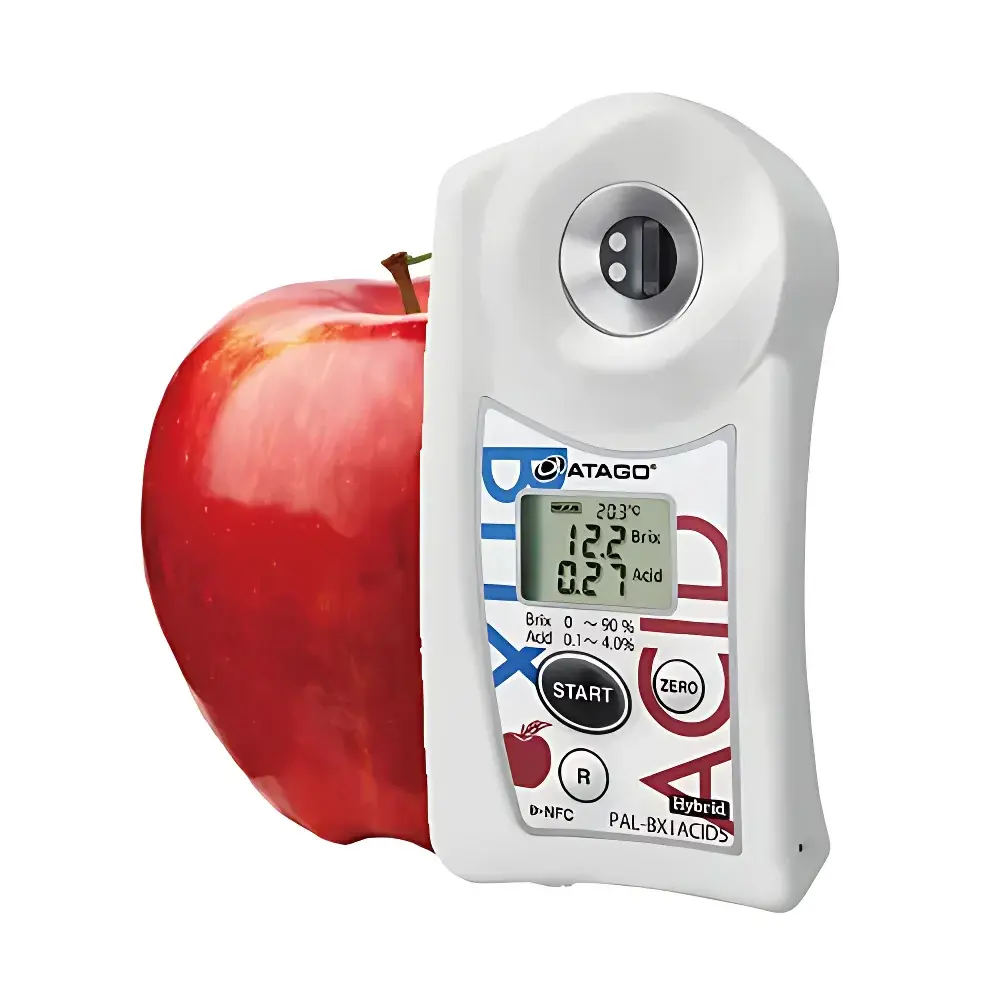
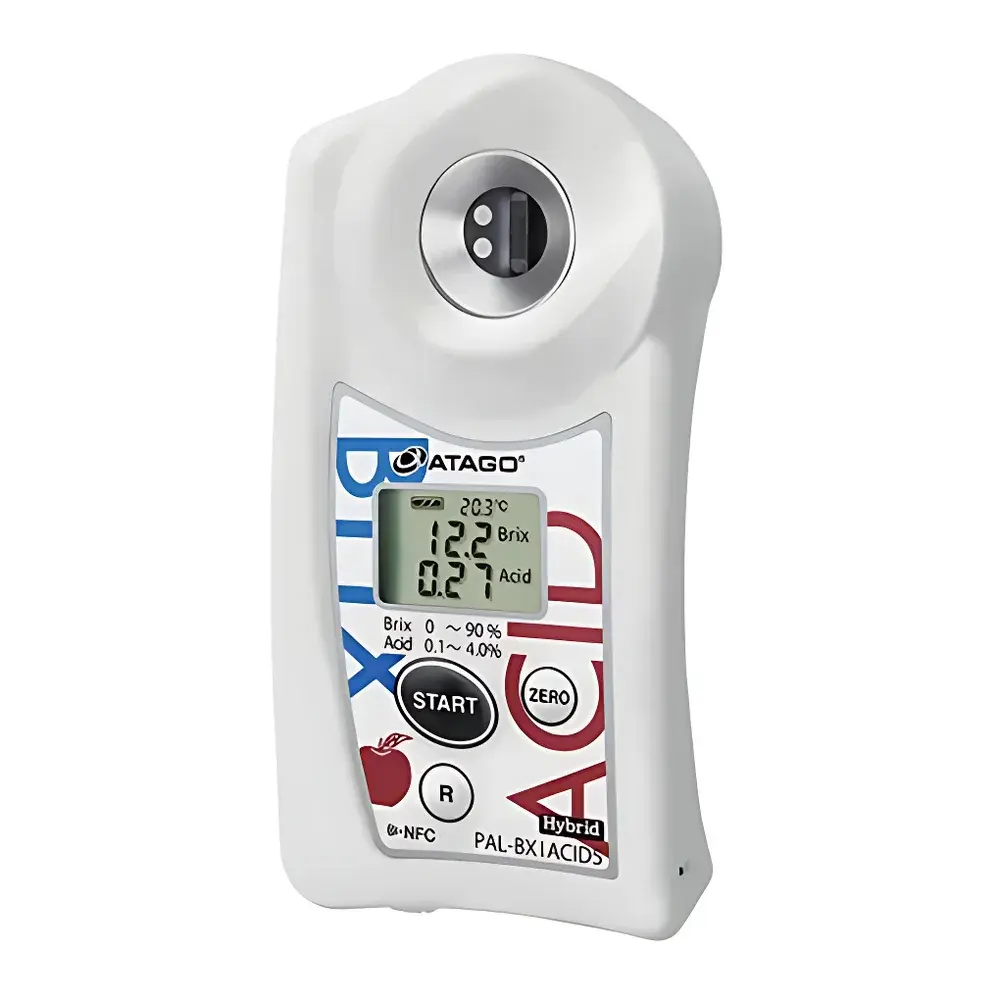
ATAGO PAL-BX/ACID 5 Apple-Specific Brix and Titratable Acidity Refractometer
| Brand | ATAGO |
|---|---|
| Origin | Japan |
| Model | PAL-BX/ACID 5 |
| Product Type | Handheld Digital Refractometer |
| Temperature Compensation Range | 10–40 °C |
| Display | Digital LCD |
| Brix Range | 0.0–60.0 % (w/w) |
| Acid Range | 0.10–4.00 % (as malic acid) |
| Brix Accuracy | ±0.2 % |
| Acid Accuracy | ±0.10 % (0.10–1.00 %), ±10 % relative (1.01–4.00 %) |
| Brix Resolution | 0.1 % |
| Acid Resolution | 0.01 % (0.00–9.99 %), 0.1 % (≥10.0 %) |
| Sugar-Acid Ratio Resolution | 0.01 (0.00–9.99), 0.1 (10.0–99.9), 1 (≥100) |
| IP Rating | IP65 |
| Power | 2 × AAA alkaline batteries |
| Dimensions | 5.5 × 3.1 × 10.9 cm |
| Weight | 100 g (instrument only) |
Overview
The ATAGO PAL-BX/ACID 5 is a dedicated handheld digital refractometer engineered for simultaneous, on-site measurement of soluble solids content (Brix) and titratable acidity (expressed as malic acid concentration) in fresh apples and apple-derived products. Unlike conventional benchtop analyzers or wet-chemistry methods, this instrument leverages Abbe-type optical refraction principles—calibrated specifically for apple matrixes—to deliver rapid, field-deployable quantification without solvent extraction, reagent consumption, or laboratory infrastructure. Its core function centers on calculating the sugar-acid ratio (SAR), a critical organoleptic index defined as Brix (%) divided by titratable acidity (%), widely adopted in pomological research, orchard management, postharvest quality control, and commercial fruit grading protocols. The device incorporates ATAGO’s proprietary OFFSET curve correction algorithm, enabling traceable alignment with reference methods such as AOAC 973.25 (titration-based total acidity) or ISO 2173 (fruit juice Brix), thereby supporting method equivalence validation under GLP-aligned workflows.
Key Features
- Single-instrument dual-parameter analysis: Direct Brix and malic acid-equivalent acidity from one sample aliquot
- Dedicated apple calibration: Factory-optimized optical path and temperature-compensated algorithms for low-pH, high-sugar fruit matrices
- Integrated sugar-acid ratio calculation: Press “R” key to compute and display SAR in real time with configurable resolution (0.01–1 unit)
- Offset correction capability: Apply user-defined offset values to harmonize results with lab-reference titration data or alternate units (e.g., citric vs. malic acid basis)
- Rugged field design: IP65-rated enclosure resists dust ingress and water splashes; operational within 10–40 °C ambient range
- Low-maintenance operation: No moving parts, no consumables beyond standard AAA batteries (typical life: >5,000 measurements)
Sample Compatibility & Compliance
The PAL-BX/ACID 5 is validated for use with clarified apple juice, homogenized pulp supernatants, and commercially processed apple purees and concentrates. Sample preparation requires dilution only for acidity determination: 1.00 g apple juice + 49.00 g distilled water (1:50 w/w), followed by vortex mixing prior to loading onto the prism. Brix measurement uses undiluted sample. The instrument complies with fundamental metrological requirements outlined in ISO 2173 (fruit juice Brix determination) and supports traceability to NIST-traceable sucrose standards. While not certified for regulatory submission per se, its documented repeatability (RSD < 0.8% for Brix, < 1.2% for acidity across 10 replicates) meets internal QC thresholds for pre-screening applications in GMP-aligned packinghouses and breeding programs. It does not replace official titration for statutory labeling but serves as a statistically robust screening tool aligned with ASTM D8103-21 (rapid assessment of fruit quality parameters).
Software & Data Management
This stand-alone instrument operates without external software or connectivity. All measurements are displayed locally on a high-contrast LCD with backlighting for field readability. No onboard memory or USB export is provided; however, the consistent output format (Brix value, acidity value, SAR) enables manual logging into LIMS or Excel-based QA templates. For laboratories requiring audit trails, users may pair the device with ATAGO’s optional RS-232 interface kit (sold separately) and compatible terminal software—supporting timestamped CSV export, batch ID tagging, and basic statistical summaries (mean, SD, CV%). Such configurations satisfy foundational FDA 21 CFR Part 11 expectations for electronic records when combined with organizational SOPs governing instrument calibration, operator training, and result review.
Applications
- Orchard maturity monitoring: Determine optimal harvest windows by tracking seasonal SAR trends across cultivars
- Postharvest sorting: Classify apples into sweetness-acidity tiers (e.g., “dessert” vs. “cooking” grades) prior to storage or processing
- Varietal selection trials: Quantify sensory trait correlations between SAR and consumer preference panels
- Processing line QC: Verify consistency of apple juice blends, cider musts, or baby food formulations
- Educational labs: Demonstrate physicochemical basis of fruit flavor perception in food science curricula
- Research protocol standardization: Serve as a field reference for multi-site pomology studies requiring inter-laboratory comparability
FAQ
Does the PAL-BX/ACID 5 measure pH or free acidity?
No. It reports titratable acidity expressed as % malic acid—a standardized metric reflecting total proton-donating capacity—not pH or dissociated H⁺ concentration.
Can it be used for fruits other than apples?
It is calibrated exclusively for apple matrices. Using it on pears, peaches, or berries introduces unquantified bias due to differing organic acid profiles and refractive index contributions.
Is calibration required before each use?
ATAGO recommends daily verification with distilled water (Brix = 0.0%) and a certified 10.0% sucrose standard; full recalibration is performed annually or after physical impact per manufacturer guidelines.
What does the OFFSET function correct for?
It compensates for systematic deviation between refractometric acidity and reference titration results—e.g., if lab titration yields 1.25% malic acid while the PAL-BX/ACID 5 reads 1.18%, an OFFSET of +0.07 is applied to align future readings.
How is temperature compensation implemented?
An integrated thermistor measures sample temperature at the prism surface and applies a polynomial correction derived from empirical apple-juice refractive index vs. temperature data across 10–40 °C.





