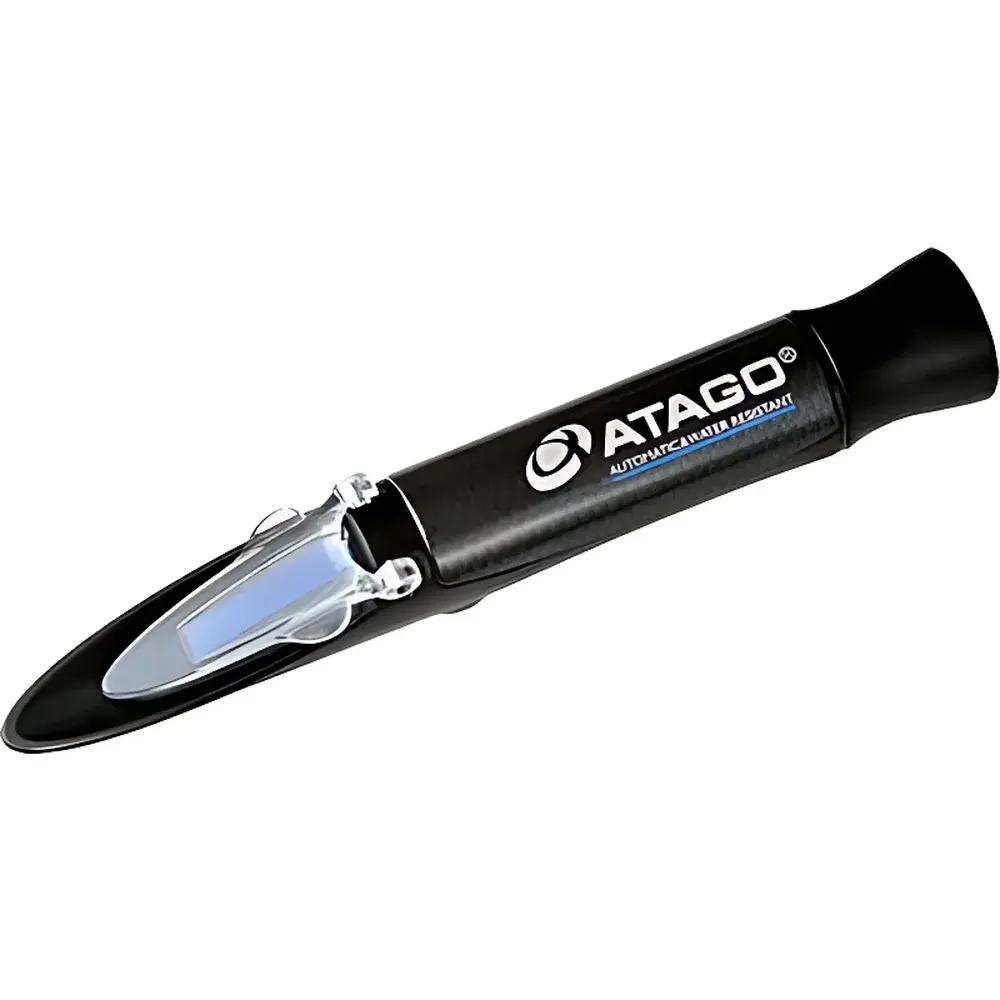
Atago MASTER-URC/Nα Urine Specific Gravity Refractometer
| Origin | Japan |
|---|---|
| Manufacturer Type | Authorized Distributor |
| Origin Category | Imported |
| Model | MASTER-URC/Nα |
| Pricing | Upon Request |
| Scale Range (Urine SG) | 1.000–1.050 |
| Scale Range (Refractive Index nD) | 1.333–1.356 |
| Minimum Scale Division (SG) | 0.001 |
| Minimum Scale Division (nD) | 0.0005 |
| Accuracy (SG) | ±0.001 |
| Accuracy (nD) | ±0.0005 (at 10–30°C) |
| Automatic Temperature Compensation | Yes |
| IP Rating | IP65 (excluding eyepiece) |
| Dimensions | 3.2 × 3.4 × 20.7 cm |
| Weight | 110 g |
| Compatible Accessory | MASTER Series Light Guide Plate RE-2471-56M |
Overview
The Atago MASTER-URC/Nα Urine Specific Gravity Refractometer is a handheld, optical precision instrument engineered for rapid, reliable measurement of urine specific gravity (USG) in clinical and point-of-care settings. It operates on the principle of critical-angle refractometry: light passing through a urine sample undergoes refraction at the interface between the sample and the prism surface; the resulting critical angle is directly correlated to the solute concentration—and thus the specific gravity—of the urine. The device incorporates a high-stability borosilicate glass prism coupled with a temperature-compensated optical system calibrated to the standard USG scale (1.000–1.050), eliminating manual correction across the physiologically relevant ambient range of 10–30°C. Its compact, ergonomic design enables one-handed operation, requiring only a single 0.05 mL drop of uncentrifuged, room-temperature urine—making it ideal for bedside assessment, outpatient clinics, veterinary practices, and mobile health units where speed, portability, and minimal sample volume are critical.
Key Features
- Integrated automatic temperature compensation (ATC) ensures consistent accuracy without external calibration or manual correction across 10–30°C ambient conditions.
- IP65-rated housing (excluding eyepiece) provides dust-tight protection and resistance to low-pressure water jets—suitable for use in humid laboratory environments, emergency departments, and field deployments.
- Durable, chemically resistant resin body exhibits proven tolerance to acidic and saline biological fluids, minimizing degradation from repeated exposure to urine, disinfectants, and cleaning agents.
- High-resolution dual-scale reticle displays both urine specific gravity (to 0.001 resolution) and refractive index (nD, to 0.0005 resolution), enabling cross-referencing with established clinical correlation tables.
- Lightweight (110 g) and pocket-sized (3.2 × 3.4 × 20.7 cm) construction supports extended daily use without operator fatigue.
- Optimized prism geometry and anti-reflective coating maximize signal-to-noise ratio, ensuring sharp, parallax-free readings under varied ambient lighting conditions.
Sample Compatibility & Compliance
The MASTER-URC/Nα accepts native, unprocessed urine specimens—including those containing moderate levels of protein, glucose, or bilirubin—without interference from common interferents that affect chemical dipstick methods. It is not intended for use with highly viscous, turbid, or heavily pigmented samples (e.g., grossly hemolyzed or myoglobinuric urine), which may require centrifugation or alternative methodology per CLSI GP16-A3 guidelines. The instrument complies with IEC 60529 for ingress protection (IP65), meets RoHS Directive 2011/65/EU material restrictions, and is validated per manufacturer’s internal quality protocol QM-REF-007 for clinical refractometry performance. While not FDA 510(k)-cleared as a standalone diagnostic device, its measurement methodology aligns with ISO 15197:2013 principles for quantitative point-of-care testing and supports GLP-compliant documentation when used within a defined SOP framework.
Software & Data Management
As a fully analog, optical instrument, the MASTER-URC/Nα does not incorporate digital electronics, firmware, or onboard data storage. Consequently, it requires no software installation, network connectivity, or cybersecurity validation. All measurements are visually interpreted via the calibrated ocular scale and manually recorded—supporting audit-ready traceability in environments where electronic systems are restricted (e.g., certain ISO 13485-certified QC labs or resource-limited settings). For laboratories implementing digital workflows, integration is achieved externally via standardized documentation protocols: users may log readings into LIMS or ELN platforms using structured templates compliant with ISO/IEC 17025:2017 clause 7.5.2 (control of records). Optional accessories—including the RE-2471-56M light guide plate—facilitate consistent illumination during low-light assessments without altering optical path integrity.
Applications
- Routine assessment of renal concentrating ability in ambulatory and hospitalized patients.
- Monitoring hydration status in athletic training, geriatric care, and preoperative evaluation.
- Supporting differential diagnosis in acute kidney injury (AKI), diabetes insipidus, and syndrome of inappropriate antidiuretic hormone secretion (SIADH).
- Veterinary urinalysis for dogs, cats, and equine species where portable, non-invasive tools are prioritized.
- Quality control verification of automated urine analyzers (e.g., comparing USG values against benchtop refractometers per CLIA requirements).
- Educational use in medical, nursing, and biomedical technology training programs to demonstrate fundamental principles of optical densitometry and renal physiology.
FAQ
Does the MASTER-URC/Nα require periodic recalibration?
No—this instrument is factory-calibrated using NIST-traceable reference standards and contains no user-adjustable calibration screws. Verification should be performed before each shift using a certified calibration solution (e.g., 1.020 SG standard), per CLSI EP15-A3 guidelines.
Can it measure specific gravity of other bodily fluids, such as CSF or ascites?
It is specifically optimized and scaled for human urine. Use with other fluids is off-label and not supported by clinical validation data; results may lack diagnostic reliability due to differing solute composition and refractive behavior.
Is the prism surface scratch-resistant?
The prism is made of optical-grade borosilicate glass with a hard-coated surface; however, contact with abrasive particles (e.g., dried crystals, lint, or improper cleaning tools) can cause micro-scratches. Always clean with lens tissue and distilled water—never alcohol or acetone.
What maintenance is required beyond routine cleaning?
No scheduled maintenance is required. Replace the light guide plate (RE-2471-56M) only if visibly degraded or damaged. Store in the supplied protective case with desiccant to prevent moisture-induced fogging.
Does IP65 certification apply to the entire unit?
No—the IP65 rating covers the main body and prism housing only. The eyepiece assembly is not sealed and must be protected from direct water spray or submersion.