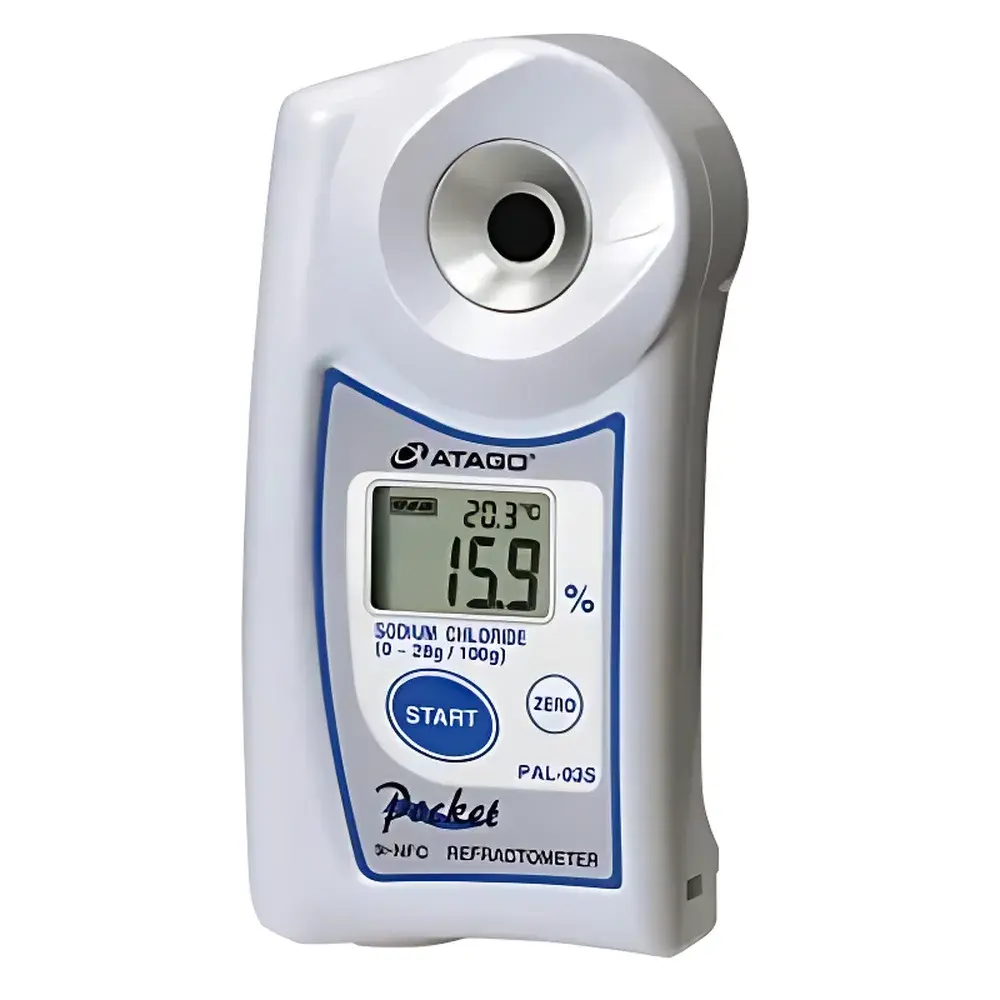
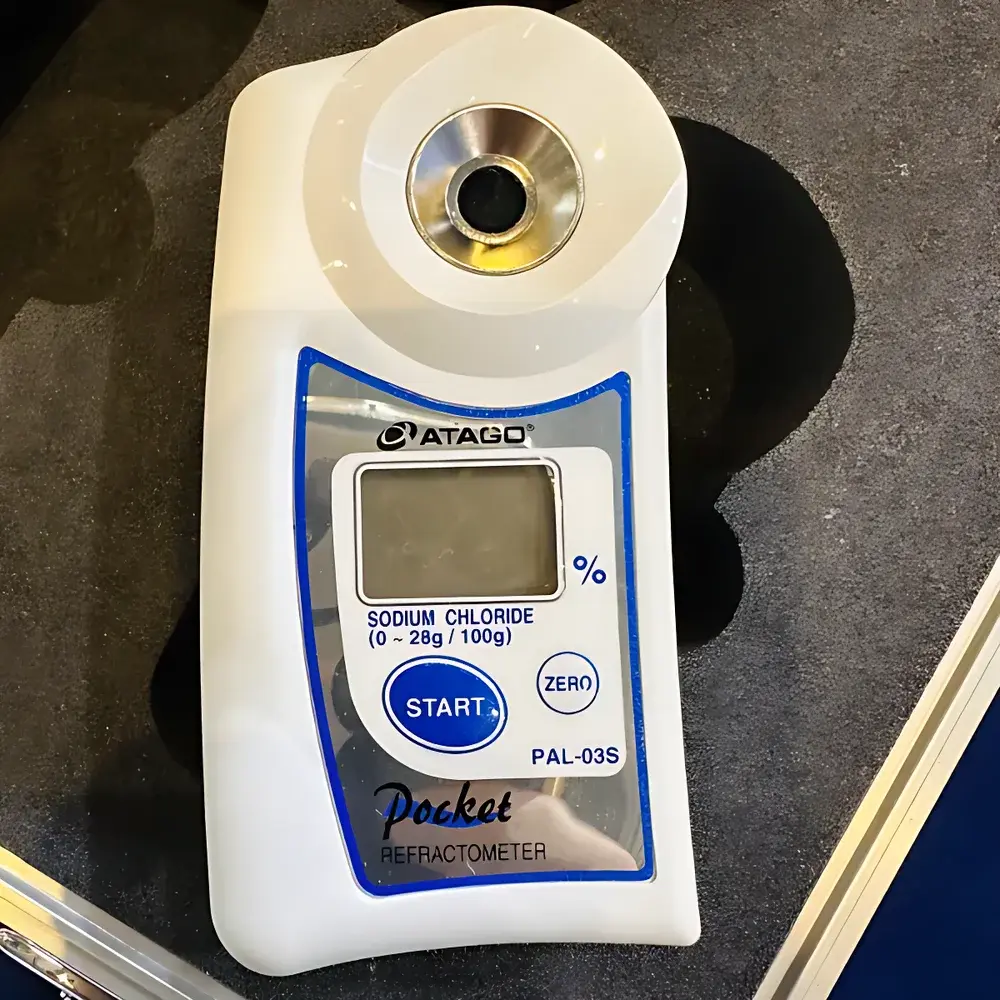
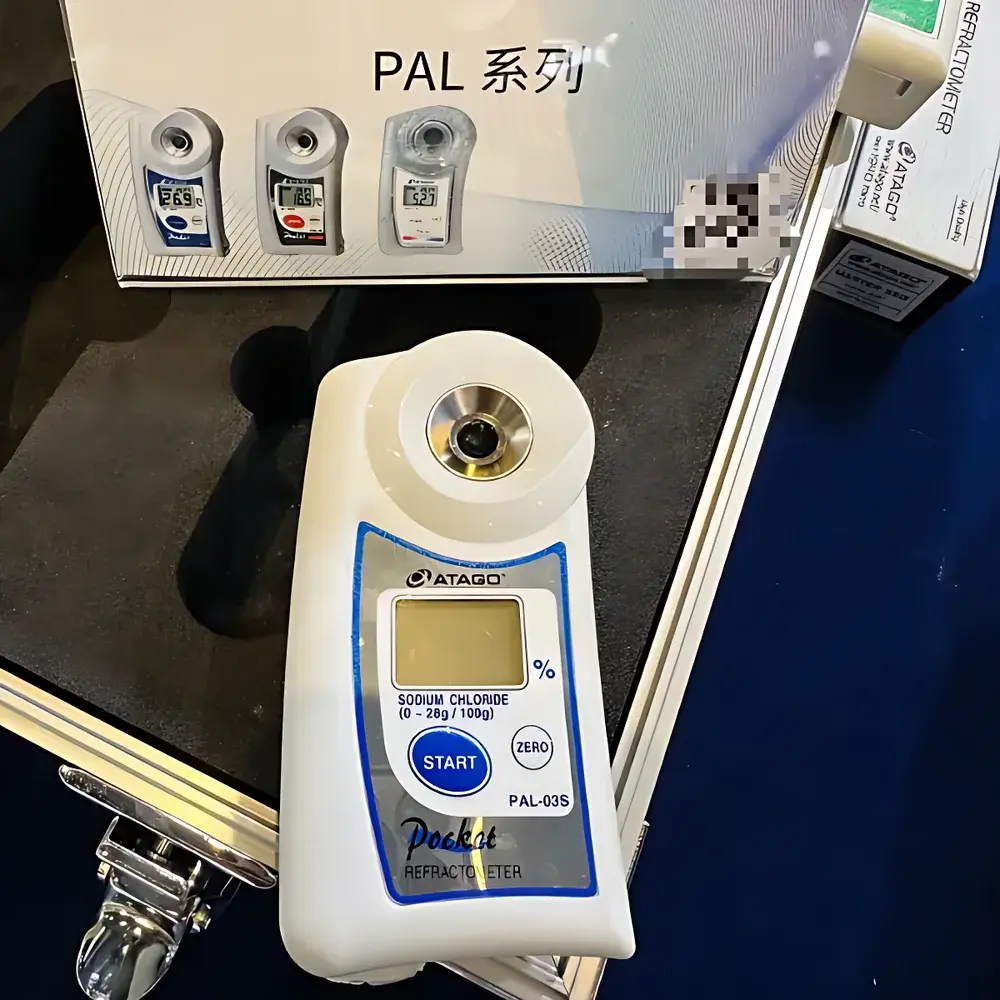
ATAGO PAL-03S Sodium Chloride Refractometer
| Brand | ATAGO |
|---|---|
| Origin | Japan |
| Model | PAL-03S |
| Product Type | Handheld Refractometer |
| Temperature Control | None |
| Digital Display | Yes |
| Measurement Range | NaCl 0.0–28.0% (w/w) |
| Accuracy | ±0.2% (w/w) |
Overview
The ATAGO PAL-03S Sodium Chloride Refractometer is a compact, handheld optical instrument engineered for rapid, field-deployable quantification of sodium chloride concentration in aqueous solutions. It operates on the fundamental principle of refractometry—measuring the refractive index of a sample and converting it to NaCl mass fraction (%) via a pre-calibrated polynomial algorithm traceable to NIST-standard reference solutions. Designed specifically for industrial and laboratory environments where speed, portability, and repeatability are critical, the PAL-03S delivers direct readout in % (g/100 g) without dilution or chemical reagents. Its optical path utilizes high-stability Abbe-type prisms with temperature-compensated optics (automatic compensation range: 10–30 °C), ensuring consistent performance across typical ambient operating conditions despite the absence of active thermoregulation.
Key Features
- Direct digital readout of NaCl concentration in 0.1% increments across 0.0–28.0% (w/w) range
- High-precision optical system with sapphire-coated measuring prism for scratch resistance and long-term calibration stability
- Battery-powered operation (2 × AAA batteries) enabling >10,000 measurements per set; auto-power-off after 3 minutes of inactivity
- Ergonomic, IP65-rated housing resistant to dust, splashes, and incidental contact with saline solutions
- No warm-up time required; measurement completed in <2 seconds after sample application
- Calibration verified using certified 0% and 10.0% NaCl standard solutions (included with instrument)
Sample Compatibility & Compliance
The PAL-03S is validated for use with clear to mildly turbid aqueous NaCl solutions—including brines, seawater, artificial marine media, physiological saline (0.9% w/w), de-icing solutions, and food-grade salt brines. It is not intended for non-aqueous solvents, highly viscous fluids (>100 mPa·s), or suspensions containing particulates >5 µm. While the instrument itself does not carry CE or FDA 510(k) certification as a medical device, its measurement methodology aligns with ASTM D1141-98 (Standard Practice for Marine Water Simulated) and ISO 8502-9 (Surface cleanliness — Part 9: Field test methods for soluble salts). In GMP-regulated environments, users may document calibration, usage, and verification per internal SOPs referencing USP “Refractometry” and ISO/IEC 17025:2017 clause 7.7 on measurement traceability.
Software & Data Management
The PAL-03S is a standalone, firmware-based instrument with no embedded memory or data export capability. All measurements are displayed in real time only; no logging, USB connectivity, or Bluetooth interface is provided. For quality systems requiring audit trails, users integrate the device into manual data capture workflows—recording results alongside operator ID, timestamp, sample ID, and environmental notes in paper-based or LIMS-managed electronic batch records. Calibration verification logs must be retained per GLP/GMP requirements, with frequency determined by risk assessment (typically daily pre-use check recommended for QC-critical applications).
Applications
- Food & Beverage Processing: Monitoring brine strength during vegetable fermentation (e.g., kimchi, sauerkraut), canned seafood, soy sauce brewing, and ready-to-eat meal seasoning consistency
- Aquaculture & Marine Biology: Routine salinity verification in recirculating aquaculture systems (RAS), coral propagation tanks, and oceanographic field surveys
- Pharmaceutical Manufacturing: Final verification of 0.9% (w/w) isotonic saline solution prior to sterilization and filling
- Winter Road Maintenance: On-site validation of NaCl-based de-icer concentration to optimize freezing-point depression while minimizing infrastructure corrosion
- Chemical Process Control: In-situ monitoring of halite dissolution endpoints in lithium extraction brine circuits and oilfield completion fluid preparation
FAQ
Does the PAL-03S require temperature stabilization before use?
No. The instrument incorporates automatic temperature compensation (ATC) for samples between 10 °C and 30 °C, eliminating the need for external thermostating.
Can it measure other salts like KCl or CaCl₂?
No. The scale is factory-calibrated exclusively for NaCl/water systems. Cross-sensitivity to other electrolytes introduces systematic error exceeding ±1.5%.
How often should calibration be performed?
Perform zero-point verification with distilled water and span verification with 10.0% NaCl standard before each shift or after every 20 measurements in high-accuracy applications.
Is cleaning the prism necessary between samples?
Yes. Wipe gently with lens tissue moistened with distilled water after each measurement to prevent residue buildup and refractive index drift.
What is the expected service life of the optical prism?
With proper handling and cleaning, the sapphire-coated prism maintains calibration integrity for ≥5 years under routine industrial use.