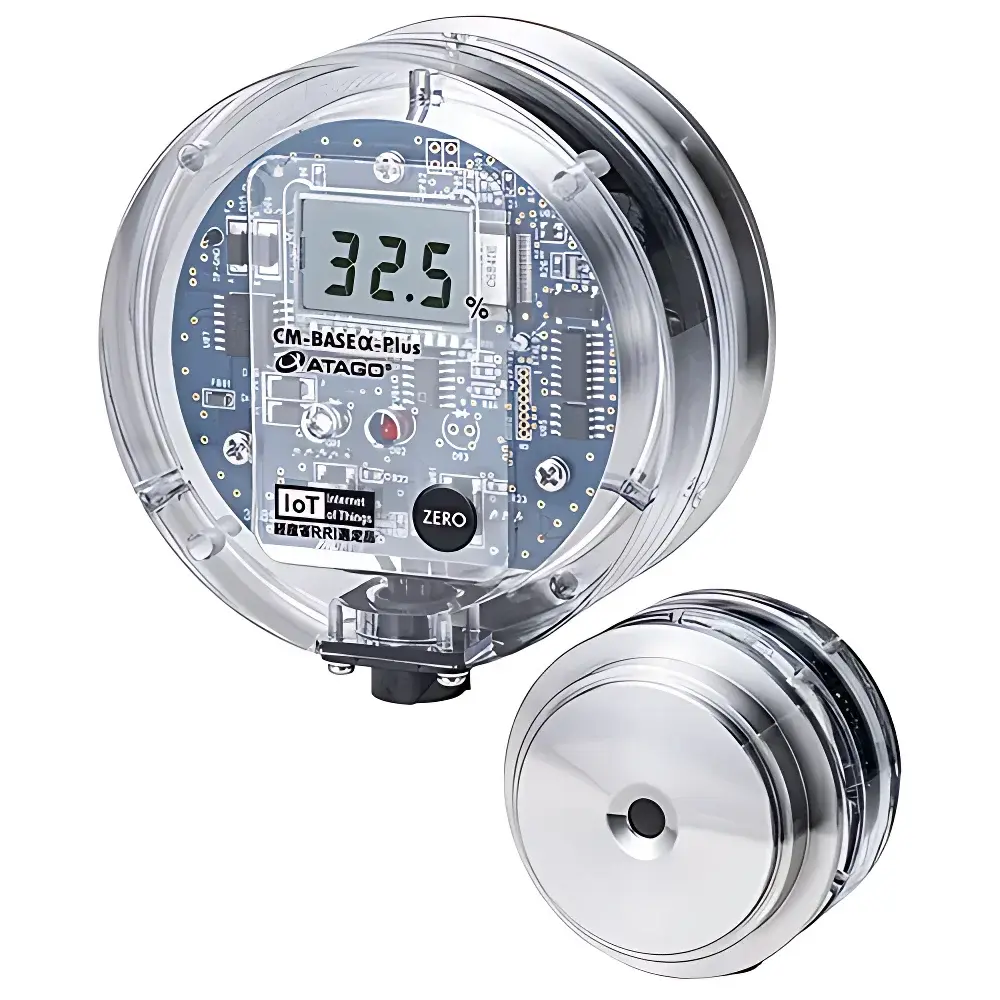
ATAGO CM-Baseα-Plus Inline Refractometer
| Brand | ATAGO |
|---|---|
| Origin | Japan |
| Model | CM-Baseα-Plus (Wide-Range) |
| Measurement Range | 0.0–93.0% Brix |
| Resolution | 0.1% Brix |
| Accuracy | ±0.5% Brix |
| Temperature Range | 10–95°C (ATC) |
| Output | RS-232C / 4–20 mA |
| IP Rating | IP67 |
| Power Supply | DC 24 V |
| Dimensions | 90 × 90 × 58 mm |
| Weight | 830 g (main unit only) |
Overview
The ATAGO CM-Baseα-Plus is a high-stability inline refractometer engineered for continuous, real-time measurement of liquid concentration in industrial process streams. Based on the fundamental optical principle of critical-angle refractometry, the instrument determines concentration by precisely measuring the refractive index (nD) of flowing liquids and converting it to standardized units—including Brix (% w/w sucrose equivalent), refractive index, or user-defined concentration scales. Unlike offline sampling methods, the CM-Baseα-Plus integrates directly into pipe manifolds or bypass loops, enabling non-invasive, flow-independent measurement without moving parts or consumables. Its temperature-compensated optical design incorporates an integrated Pt1000 sensor for Automatic Temperature Compensation (ATC), ensuring metrological consistency across dynamic process conditions from 10 °C to 95 °C. Designed for long-term deployment in harsh environments, the device meets IP67 ingress protection standards and operates reliably under continuous 24 V DC power—making it suitable for unattended operation in GMP-compliant food processing lines, chemical synthesis reactors, and electroplating baths.
Key Features
- Optically stable sapphire prism interface with corrosion-resistant 316L stainless steel wetted parts, rated for pressures up to 10 bar (145 psi)
- Wide linear measurement range: 0.0–93.0% Brix, optimized for high-solids applications including syrup, brine, glycol, and battery electrolyte solutions
- High-resolution digital output: 0.1% Brix resolution with ±0.5% Brix accuracy traceable to NIST-traceable sucrose reference standards
- Dual analog/digital output architecture: isolated 4–20 mA current loop (HART-compatible) + RS-232C serial interface for SCADA/DCS integration
- Low-maintenance optical path: no calibration drift due to absence of light-source aging or detector saturation; factory-calibrated with documented uncertainty budget
- Compact form factor (90 × 90 × 58 mm) enables retrofit installation in space-constrained piping configurations without flow disruption
Sample Compatibility & Compliance
The CM-Baseα-Plus is validated for use with aqueous and organic solutions exhibiting Newtonian behavior and optical clarity within the visible spectrum (400–700 nm). It supports routine monitoring of sugar syrups, acid/base solutions, alcohol-water mixtures, coolant concentrates, and cleaning-in-place (CIP) agents. The instrument complies with IEC 61000-6-2 (EMC immunity) and IEC 61000-6-4 (EMC emissions) standards. Its construction adheres to FDA 21 CFR Part 11 requirements for electronic records when paired with compliant data acquisition software. While not intrinsically safe, it may be installed in Zone 2 hazardous locations when used with appropriate barrier systems per ATEX/IECEx guidelines. All materials contacting process fluid conform to USP Class VI and EC 1935/2004 food-contact regulations.
Software & Data Management
The CM-Baseα-Plus communicates via ASCII protocol over RS-232C, supporting direct integration with PLCs (Siemens S7, Allen-Bradley ControlLogix), DCS platforms (Yokogawa CENTUM VP, Honeywell Experion), and MES systems. Optional ATAGO RefracLink™ PC software provides real-time trend visualization, alarm threshold configuration (high/low deviation, rate-of-change), and automated CSV log export with time-stamped metadata. Audit trails include operator ID, timestamp, and measurement status flags (e.g., “ATC active”, “prism fouling warning”). Data integrity is preserved through cyclic redundancy check (CRC) validation on all transmitted frames, and configuration changes are logged with immutable timestamps—supporting GLP/GMP documentation requirements.
Applications
- Food & Beverage: Real-time Brix control during juice concentration, jam cooking, dairy evaporation, and fermentation broth monitoring
- Automotive: Electrolyte concentration verification in lead-acid battery manufacturing and antifreeze (ethylene glycol) blending
- Chemical Processing: Acid strength titration replacement in H2SO4, NaOH, and HCl dosing loops; solvent recovery system optimization
- Pharmaceutical: Excipient solution concentration in oral liquid formulation; cleaning validation endpoint detection (e.g., NaOH rinse concentration ≥ 1.5% w/w)
- Electroplating: Metal salt bath density control (e.g., NiSO4, CuSO4) to maintain deposit uniformity and reduce scrap rates
FAQ
Does the CM-Baseα-Plus require periodic recalibration?
No—its optical design eliminates zero drift and gain drift. Verification against certified sucrose standards is recommended annually or after mechanical shock.
Can it measure opaque or particulate-laden fluids?
No. The instrument requires optically transparent media; suspended solids >5 µm or turbidity >5 NTU will impair measurement accuracy.
Is temperature compensation automatic and configurable?
Yes. ATC is enabled by default using the built-in Pt1000 sensor; manual offset adjustment (±5.0°C) is available via serial command for specialized calibration protocols.
What is the maximum allowable flow velocity at the sensor port?
Up to 3 m/s is permissible; higher velocities may induce cavitation noise but do not affect optical measurement integrity.
How is prism fouling detected and managed?
Signal-to-noise ratio degradation triggers a diagnostic flag; optional ultrasonic cleaning modules can be synchronized via relay output.
Related Products