
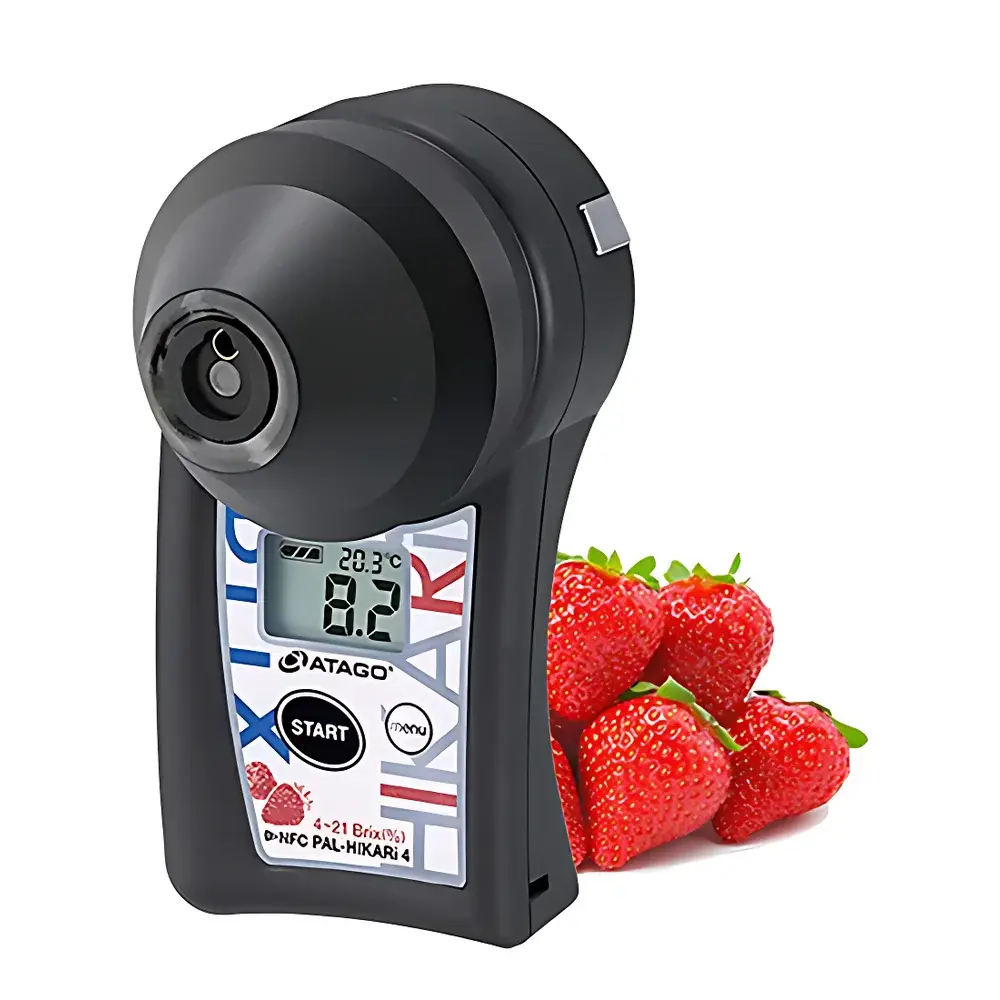
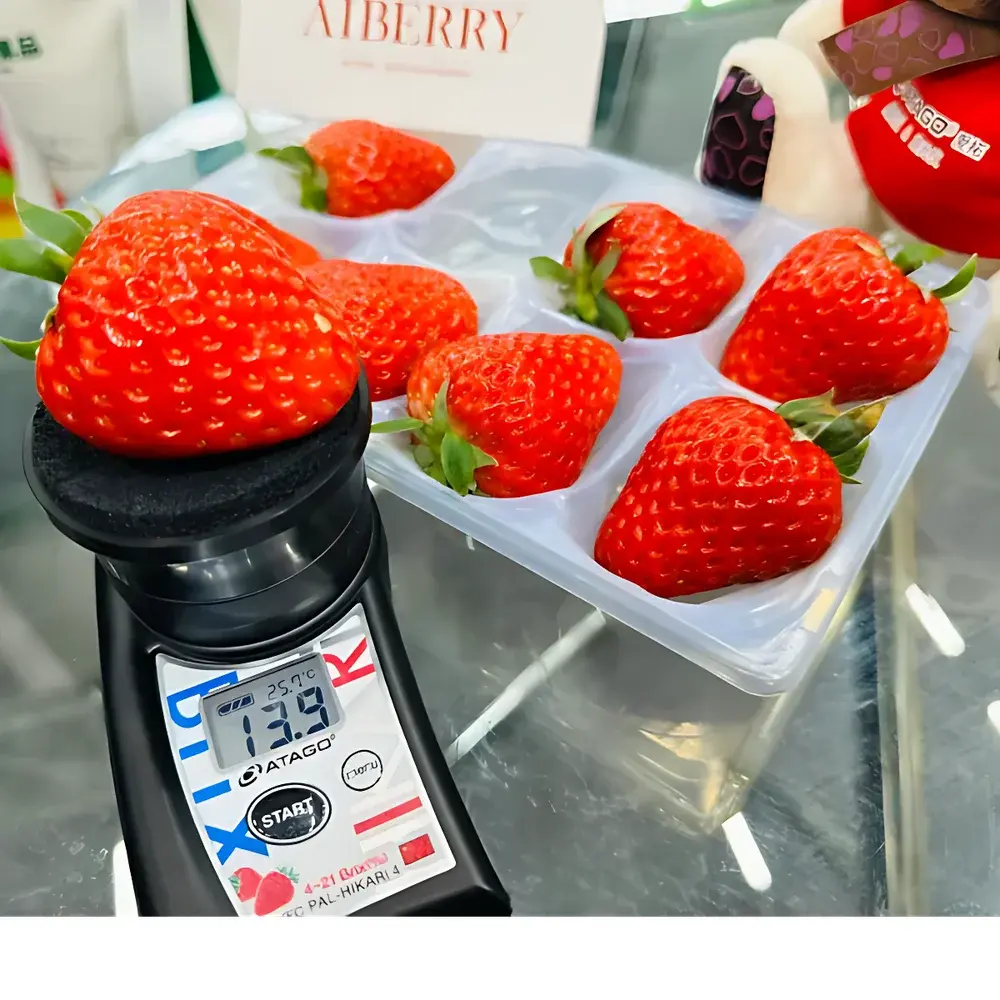
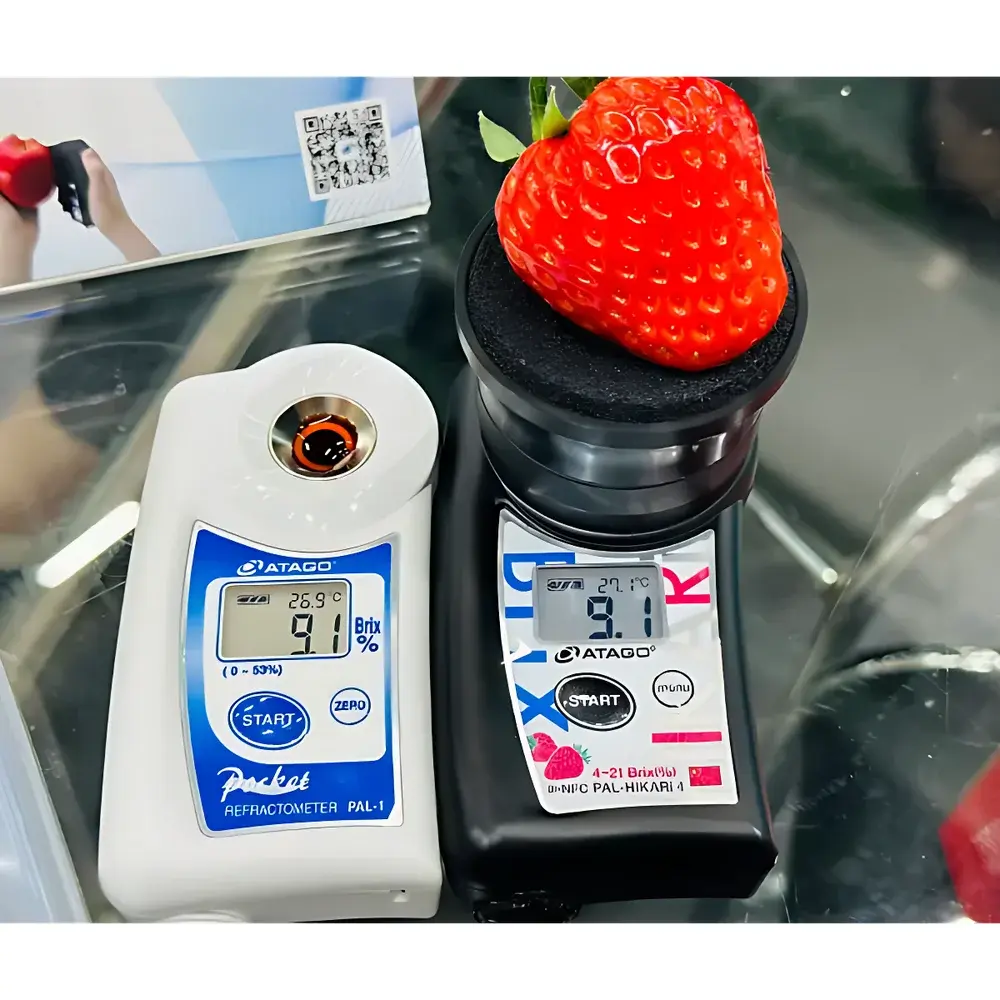
ATAGO PAL-HIKARi 4 Non-Destructive Strawberry Refractometer
| Brand | ATAGO |
|---|---|
| Origin | Japan |
| Instrument Type | Non-Destructive |
| Model | PAL-HIKARi 4 |
| Measurement Principle | Near-Infrared (NIR) Reflectance Spectroscopy |
| Brix Range | 4.0–21.0% |
| Target Sample | Intact Strawberry Fruit (Surface Measurement) |
| Compliance | Designed for Agricultural & Food Quality Control Environments |
Overview
The ATAGO PAL-HIKARi 4 is a handheld, non-destructive refractometer engineered specifically for in-situ Brix measurement of intact strawberries. Unlike conventional refractometers requiring juice extraction, the PAL-HIKARi 4 employs near-infrared (NIR) reflectance spectroscopy to quantify soluble solids concentration based on optical interaction between incident NIR light and internal fruit tissue. The instrument directs a calibrated NIR beam onto the strawberry surface—typically the calyx-adjacent shoulder or dorsal convex region—and analyzes the spectral signature of backscattered radiation. This optical interrogation enables rapid estimation of sugar content without compromising structural integrity, making it suitable for repeated longitudinal monitoring of individual fruits across developmental stages. Its design reflects ATAGO’s 80+ years of expertise in optical metrology for food quality assessment, with emphasis on field-deployable precision, repeatability under ambient horticultural conditions, and minimal operator dependency.
Key Features
- Non-invasive measurement: No skin puncture, no juice expression, no sample preparation—preserves fruit viability for post-assessment ripening studies or commercial resale.
- Strawberry-optimized optical path: Custom NIR wavelength band and sensor geometry calibrated for anthocyanin-rich epidermis and heterogeneous mesocarp structure typical of Fragaria × ananassa cultivars.
- Real-time Brix readout: Displays % Brix value within 3 seconds of contact; automatic temperature compensation (10–40 °C) integrated via built-in thermistor.
- Ergonomic handheld form factor: IP54-rated enclosure; rubberized grip; single-button operation; battery life exceeding 10,000 measurements per charge (rechargeable Li-ion).
- Traceable calibration: Factory-calibrated against NIST-traceable sucrose reference standards; optional user calibration verification using ATAGO-certified Brix verification solutions (PAL-CAL series).
Sample Compatibility & Compliance
The PAL-HIKARi 4 is validated exclusively for intact, unblemished strawberries at ambient storage or field temperatures (10–35 °C). It is not intended for frozen, waxed, bruised, or overripe specimens exhibiting surface exudates or significant cuticle cracking. While not certified to ISO/IEC 17025 or ASTM D7420 (standard for destructive Brix methods), its performance aligns with internal validation protocols used by agricultural extension services and commercial packinghouses for rapid lot screening. Data output meets basic GLP documentation requirements when paired with ATAGO’s optional USB data logger (PAL-USB-LOG), enabling timestamped measurement records compatible with farm management software (e.g., FarmLogs, AgriWebb). Regulatory compliance for export certification (e.g., USDA-APHIS, EU Regulation (EC) No 178/2002) requires supplementary destructive validation per official inspection protocols.
Software & Data Management
The PAL-HIKARi 4 operates as a standalone instrument with no embedded firmware-based data storage. However, it supports external data capture via ATAGO’s proprietary PAL-USB-LOG interface module, which converts analog sensor output into ASCII-formatted CSV files. These files contain measurement ID, date/time stamp, Brix value, sample temperature, and instrument serial number—enabling traceability in QA/QC workflows. Exported datasets are compatible with Microsoft Excel, JMP, and R statistical environments for trend analysis, harvest timing optimization, or correlation modeling with climatic variables (e.g., GDD accumulation, soil moisture index). For regulated environments, the PAL-USB-LOG module supports audit trail generation compliant with FDA 21 CFR Part 11 when deployed with validated third-party LIMS platforms.
Applications
- On-farm phenotyping: Enables growers to map spatial Brix variability across fields, correlate sweetness with irrigation regimes or nutrient applications, and refine harvest windows for premium market segments.
- Postharvest quality assurance: Used by packhouses for pre-sorting lots prior to cold chain entry, reducing downstream rejection rates during retailer inspections.
- Cultivar development: Supports breeding programs in evaluating sugar accumulation kinetics across generations under controlled-environment trials.
- Supply chain traceability: Integrated into blockchain-enabled fruit provenance systems where real-time Brix serves as a verifiable freshness proxy.
- Academic research: Applied in plant physiology labs studying source-sink relationships, carbohydrate partitioning, or abiotic stress impacts on fruit metabolism.
FAQ
Can the PAL-HIKARi 4 measure other fruits?
No. Its optical model and calibration matrix are specific to strawberry morphology, skin optical density, and internal scattering properties. Cross-species use yields non-representative Brix estimates.
Does surface moisture affect accuracy?
Yes. Excess condensation or field-wet surfaces must be gently blotted prior to measurement; residual water film alters NIR reflectance and introduces systematic bias.
Is calibration required before each use?
Factory calibration remains stable under normal handling; however, ATAGO recommends daily verification using PAL-CAL-05 (5.0% Brix) and PAL-CAL-15 (15.0% Brix) reference solutions when operating in variable thermal environments.
What is the measurement repeatability?
Under controlled conditions (25 °C, consistent probe pressure, same fruit location), standard deviation across 10 replicate measurements is ≤ ±0.2% Brix.
How does it differ from ATAGO’s PAL-BX series?
The PAL-BX instruments are traditional destructive refractometers requiring juice extraction; the PAL-HIKARi 4 eliminates sample preparation entirely and targets intact fruit evaluation—representing a distinct metrological approach rather than a product-line variant.




