
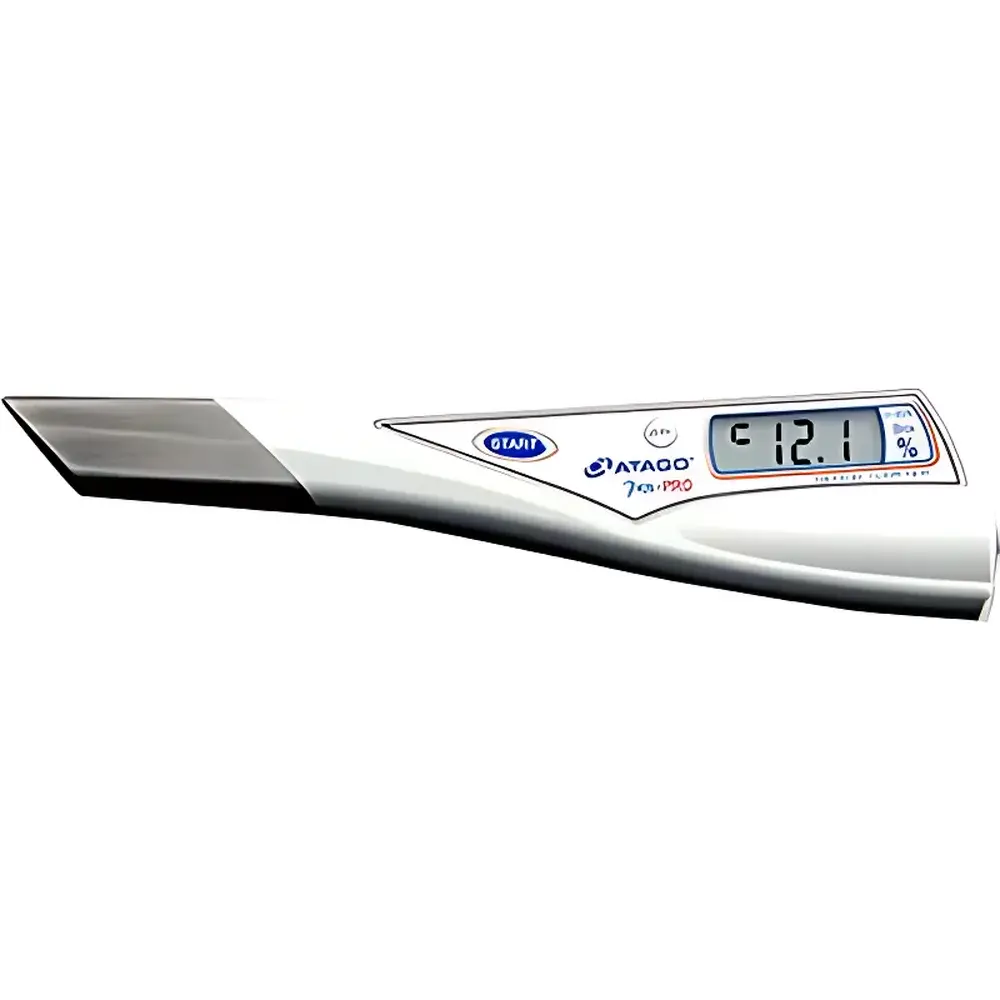
ATAGO PEN-PRO3730 Pocket Digital Refractometer for Wine and Alcoholic Beverages
| Brand | ATAGO |
|---|---|
| Origin | Japan |
| Model | PEN-PRO3730 |
| Brix Range | 0.0–85.0% |
| Brix Resolution | 0.1% |
| Brix Accuracy | ±0.2% |
| Measurement Time | 2 seconds |
| Sample Volume | 0.3 mL |
| Operating Temperature | 10–40°C |
| Measured Sample Temperature Range | 10–100°C (with Automatic Temperature Compensation, ATC) |
| IP Rating | IP65 (Prism Head: IP67) |
| Dimensions | 16(W) × 3.8(D) × 1.8(H) cm |
| Weight | 70 g (without accessories) |
| Power Supply | 1 × AAA alkaline battery |
Overview
The ATAGO PEN-PRO3730 is a compact, ergonomic, pocket-sized digital refractometer engineered specifically for rapid, field-deployable Brix measurement in wine production, craft brewing, distillery QC, and beverage R&D environments. Based on the fundamental optical principle of critical angle refraction, the instrument determines soluble solids concentration by measuring the refractive index of liquid samples—directly correlating to sugar content (°Brix) in must, juice, fermenting wort, finished wine, and fortified spirits. Its solid-state prism optics, coupled with a high-precision photodiode array and real-time signal processing, deliver repeatable measurements without moving parts or calibration drift under routine use. Designed for single-hand operation, the PEN-PRO3730 integrates Automatic Temperature Compensation (ATC) across a 10–100°C sample temperature range, eliminating manual correction and ensuring metrological consistency regardless of ambient lab or cellar conditions.
Key Features
- Ergonomic pen-style form factor (16 × 3.8 × 1.8 cm, 70 g) optimized for prolonged handheld use and glove-compatible operation in cold rooms or wet processing areas.
- IP65-rated main body and IP67-rated prism head—enabling safe rinsing under running water and resistance to dust ingress, critical for hygiene-sensitive food & beverage facilities.
- Dual-start measurement protocol: initiate reading either before or after sample immersion—ideal for viscous musts, foamy fermentations, or low-volume sampling where drip control is essential.
- Continuous measurement mode enables real-time monitoring during blending, racking, or chaptalization adjustments—supporting dynamic process decision-making.
- Electroluminescent illumination (ELI) ensures stable, glare-free display visibility under direct sunlight, warehouse lighting, or dim cellar conditions—no external light source required.
- ATC algorithm compliant with ISO 2173:2003 and AOAC Official Method 932.12, referencing the standard sucrose/water refractive index–temperature relationship.
Sample Compatibility & Compliance
The PEN-PRO3730 is validated for aqueous solutions containing sucrose, glucose, fructose, and invert sugar—covering grape must, apple cider, malt extract, honey dilutions, and post-fermentation wine matrices. It is not intended for highly turbid, emulsified, or suspended-particle-laden samples without prior filtration (e.g., unclarified lees or pectin-rich juice). The device meets CE marking requirements for electrical safety and electromagnetic compatibility (EMC Directive 2014/30/EU). Its materials comply with EU Regulation (EC) No. 1935/2004 for food contact surfaces. While not a GLP/GMP-certified instrument per se, its traceable accuracy (±0.2% Brix), ATC validation documentation, and audit-ready measurement logs (via optional PC interface) support alignment with internal quality procedures aligned with ISO/IEC 17025 and HACCP-based controls.
Software & Data Management
The PEN-PRO3730 operates as a standalone instrument with no embedded memory or onboard data logging. However, when paired with the optional RE-34801 USB charging cradle (sold separately), it supports firmware updates and connectivity to ATAGO’s proprietary LogMaster software (Windows only) via virtual COM port emulation. This enables timestamped export of sequential Brix readings—including sample ID tagging, operator annotation, and ATC-corrected values—to CSV or Excel formats. All exported data retain full metrological context: measurement time, ambient temperature, sample temperature (if externally logged), and instrument serial number—facilitating traceability in batch release documentation and internal audit trails.
Applications
- Vineyard pre-harvest ripeness assessment: rapid Brix screening of berry clusters in situ.
- Crush pad quality control: real-time must sugar verification prior to fermentation initiation.
- Fermentation monitoring: periodic Brix tracking to estimate residual sugar and projected alcohol potential (in conjunction with hydrometer or densitometer cross-checks).
- Blending optimization: comparative Brix analysis of component lots to achieve target sweetness or balance.
- Distillery wash testing: initial gravity estimation of fermented mash prior to distillation.
- Educational labs: hands-on instruction in optical metrology, solution thermodynamics, and enological analytics.
FAQ
Does the PEN-PRO3730 measure alcohol content directly?
No. It measures °Brix (soluble solids), which correlates indirectly to potential alcohol only when combined with pre-fermentation density data and yeast attenuation assumptions. For direct ethanol quantification, gas chromatography (GC) or near-infrared (NIR) analyzers are required.
Can I calibrate the instrument myself?
Yes—using distilled water (0.0% Brix) at 20°C as the zero point. ATAGO recommends daily verification before first use; calibration is performed via the dedicated CAL button and requires no tools or service intervention.
Is the prism surface scratch-resistant?
The sapphire-coated prism provides exceptional hardness (Mohs 9) and chemical inertness—resistant to abrasion from cleaning cloths, mild detergents, and typical wine acids—but remains vulnerable to impact damage or abrasive particles (e.g., grape skins, sediment). Always rinse with distilled or deionized water before wiping with lens-grade tissue.
What battery life can be expected under normal use?
Approximately 10,000 measurements per AAA alkaline battery, assuming average ambient temperature (23°C) and ELI usage <5 sec per reading. Battery status is indicated via icon on the LCD display.
Is the device suitable for regulatory submission or third-party audit?
While the PEN-PRO3730 itself does not generate 21 CFR Part 11-compliant electronic records, its measurement outputs—when documented manually or via validated LogMaster workflows—may serve as supporting evidence in internal quality reviews. Formal compliance depends on site-specific SOPs, calibration frequency, and traceability documentation.






