
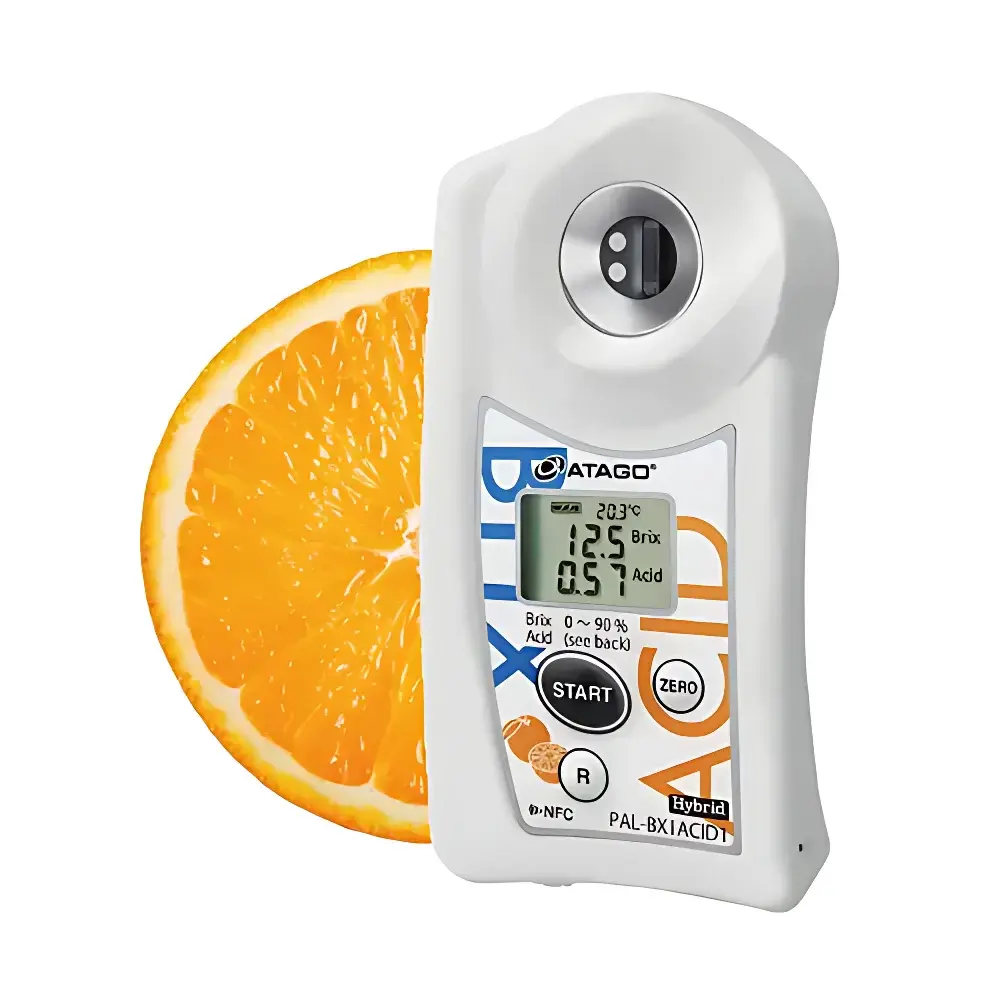
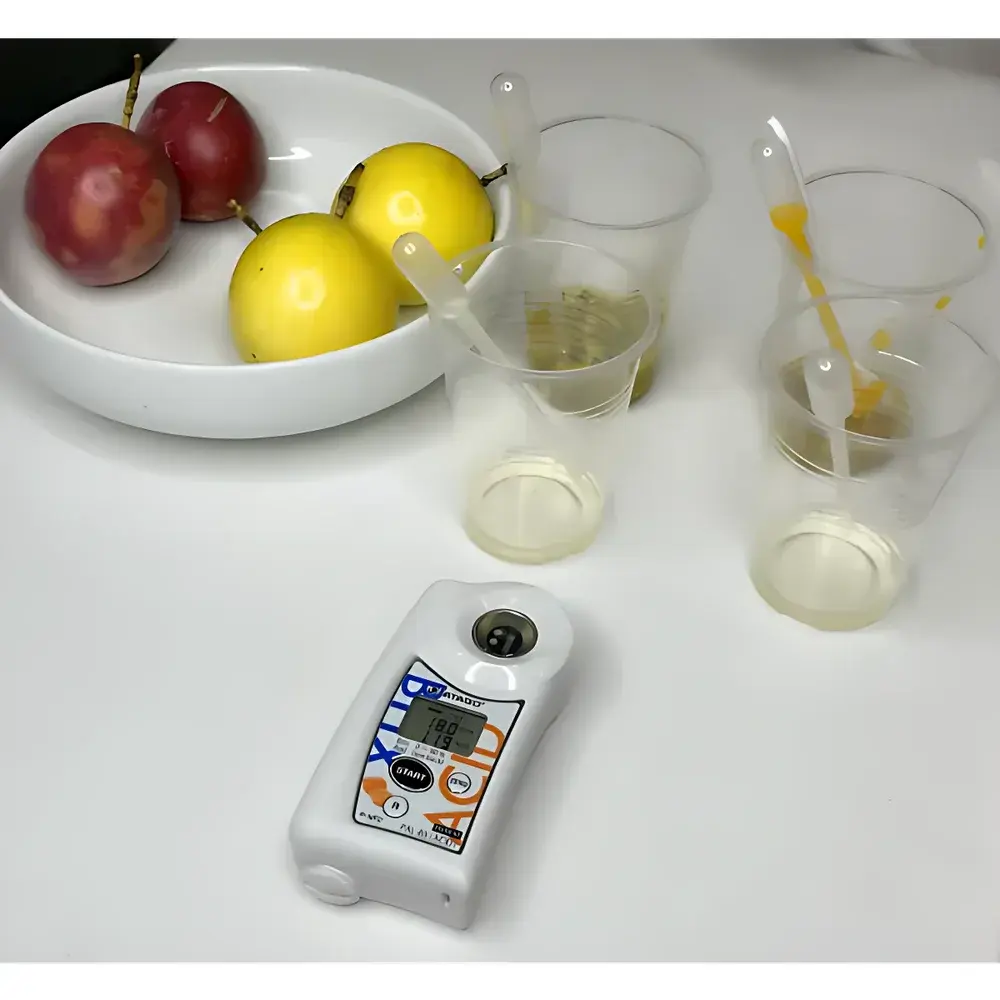
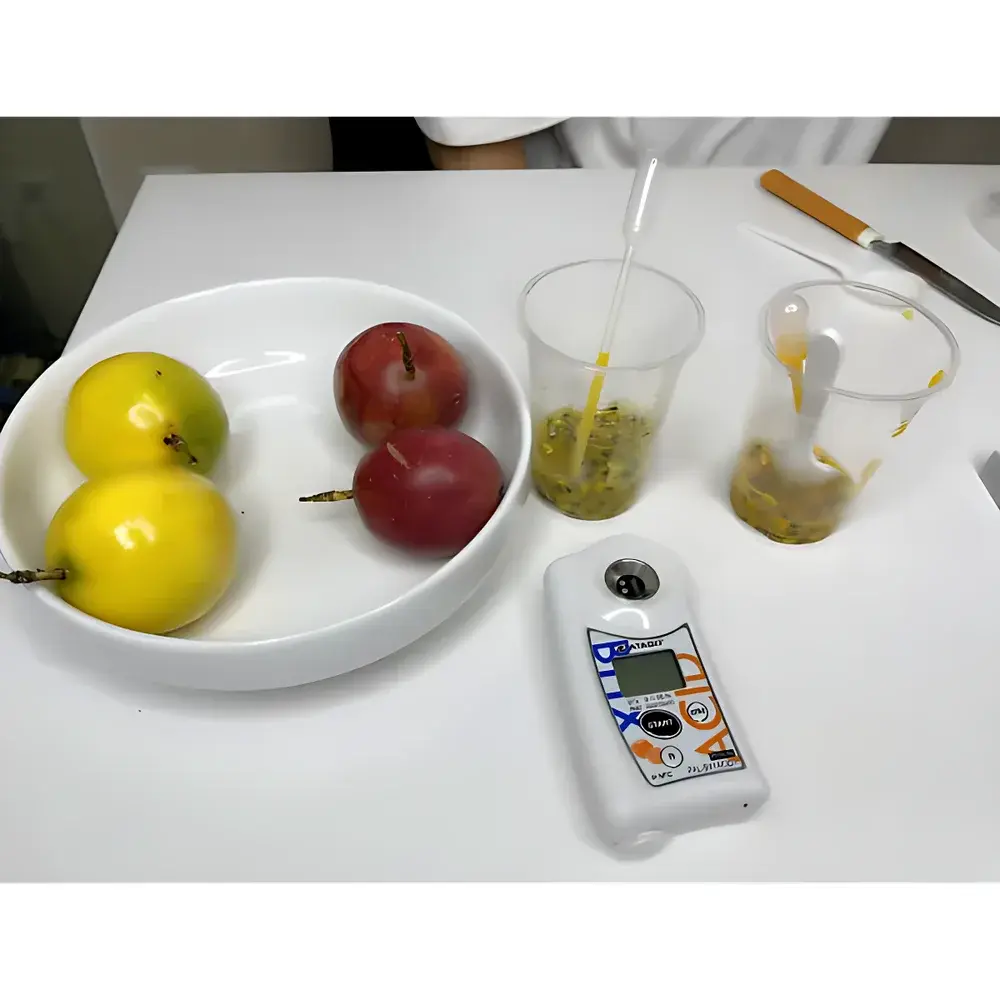
ATAGO PAL-BX/ACID 1 Citrus Sugar-Acid Ratio Meter
| Brand | ATAGO |
|---|---|
| Origin | Japan |
| Model | PAL-BX/ACID 1 (Sugar-Acid Ratio) |
| Instrument Type | Destructive Sampling |
| Compliance | Designed for ISO 2173, AOAC 932.12, and JIS K 0065 referenced methods |
| Measurement Principle | Refractive Index (Brix) + Potentiometric Titration (Titratable Acidity as Citric Acid) |
| Output Units | °Brix, g/100mL Citric Acid, Sugar/Acid Ratio (dimensionless) |
| Sample Volume | ~0.3 mL |
| Calibration | Factory-calibrated with NIST-traceable sucrose and citric acid standards |
| Operating Temperature | 10–40 °C |
| IP Rating | IP65 |
| Power | CR2032 lithium battery (approx. 10,000 measurements) |
Overview
The ATAGO PAL-BX/ACID 1 Citrus Sugar-Acid Ratio Meter is a handheld, dual-parameter optical-electrochemical analyzer engineered for rapid, field-deployable assessment of soluble solids content (°Brix) and titratable acidity (as citric acid) in citrus fruits and their processed derivatives—including fresh juice, concentrate, puree, and reconstituted products. Unlike conventional refractometers or standalone pH/titrators, the PAL-BX/ACID 1 integrates Abbe-type prism-based refractometry with micro-volume potentiometric titration logic to compute the sugar-acid ratio—a critical sensory and quality index defined as °Brix divided by grams of citric acid per 100 mL. This ratio correlates strongly with perceived sweetness, tartness balance, and overall palatability in citrus varieties such as orange, mandarin, grapefruit, and lemon. The instrument operates on a destructive sampling principle: a small volume (~0.3 mL) of expressed juice is placed directly onto the temperature-controlled sapphire prism, enabling simultaneous optical density measurement and automated acid quantification via embedded titration algorithm. Its design adheres to foundational metrological frameworks referenced in ISO 2173 (fruit juice Brix determination), AOAC Official Method 932.12 (titratable acidity in citrus), and JIS K 0065 (refractometric analysis), ensuring traceability and inter-laboratory comparability.
Key Features
- Integrated dual-mode sensing: Simultaneous refractive index (°Brix) and potentiometric acid quantification in a single 3-second measurement cycle
- OFFSET curve correction function: Enables alignment of instrument output with reference titration data or alternative acid expression units (e.g., malic or tartaric acid equivalents), supporting method harmonization across QC labs
- Temperature-compensated sapphire prism: Maintains ±0.1 °C thermal stability during measurement; automatic compensation applied per JIS Z 8013
- Dedicated citrus calibration profile: Preloaded algorithm optimized for citric acid dissociation behavior and typical °Brix–acidity ranges in orange, tangerine, and grapefruit matrices
- Robust industrial housing: IP65-rated enclosure resistant to juice splashes, ambient humidity, and routine cleaning agents used in food processing environments
- GLP-compliant data handling: Timestamped readings stored internally (up to 1,000 records); exportable via USB-C to CSV-compatible systems for audit trail generation
Sample Compatibility & Compliance
The PAL-BX/ACID 1 is validated for use with clarified or unfiltered citrus juices, concentrates (including those meeting GH/T 1158–2017 specifications), pulps, and homogenized fruit tissue extracts. It accommodates viscosity ranges up to 50 mPa·s—covering typical values observed in Brix 25–50% concentrates produced via membrane or freeze concentration. While not intended for high-pulp or fiber-rich suspensions without prior centrifugation/filtration, it performs reliably on samples compliant with ISO 2173 preparation protocols. Regulatory alignment includes support for FDA 21 CFR Part 11–ready documentation workflows when paired with ATAGO’s optional Data Management Software (DMS v3.2+). All factory calibrations are traceable to NIST Standard Reference Materials (SRMs) 84d (sucrose solution) and SRM 1960 (citric acid monohydrate), satisfying ISO/IEC 17025 clause 6.6 requirements for measurement uncertainty management.
Software & Data Management
Internal memory stores measurement ID, date/time stamp, °Brix, citric acid (g/100mL), sugar-acid ratio, and operator code. Data export occurs via USB-C interface to Windows-based ATAGO DMS software, which generates PDF reports compliant with GLP/GMP record-keeping standards—including electronic signatures, version-controlled calibration logs, and audit trails per FDA 21 CFR Part 11 Subpart B. The software enables batch statistical analysis (mean, SD, CV%), trend charting across harvest seasons or processing lines, and export to LIMS platforms via .csv or ODBC drivers. No cloud connectivity or remote firmware updates are implemented—ensuring data sovereignty and cybersecurity compliance in regulated food manufacturing settings.
Applications
- Harvest timing decisions: Real-time sugar-acid ratio evaluation to determine optimal picking windows for Valencia oranges or Navel varieties
- Concentrate process control: Monitoring Brix and acidity drift during vacuum, freeze, or membrane concentration to maintain GH/T 1158–2017 compliance (e.g., ≥20% for orange concentrate; ≥15% for lemon)
- Cultivar screening: Objective comparison of sugar-acid profiles across breeding lines or rootstock trials under standardized extraction protocols
- QC release testing: Verification of finished product specifications per Codex Alimentarius STAN 247–2005 and national standards (e.g., total acid ≥0.5% in 10%-diluted orange concentrate)
- R&D formulation: Rapid iteration of blending ratios for nectar, isotonic beverages, or functional citrus extracts where flavor balance dictates consumer acceptance
FAQ
Is the PAL-BX/ACID 1 suitable for non-citrus fruits?
No—the instrument’s acid quantification algorithm is specifically parameterized for citric acid dissociation kinetics and matrix interference profiles typical of citrus. Use of PAL-BX/ACID series models designated for apple (PAL-BX/ACID 5), strawberry (PAL-BX/ACID 4), or vinegar (PAL-BX/ACID 181) is required for accurate results in other matrices.
Does it require daily recalibration?
Factory calibration remains stable for ≥6 months under normal usage. Daily verification using ATAGO’s certified Brix 10.00% and citric acid 1.00 g/100mL reference solutions is recommended before first use each shift.
Can it measure frozen concentrate directly?
Samples must be fully thawed and equilibrated to 20–25 °C prior to analysis. Ice crystals or thermal gradients will compromise prism contact and titration accuracy.
What maintenance is required?
Wipe prism surface with lint-free cloth and distilled water after each use; avoid alcohol or abrasive cleaners. Annual verification at an ATAGO-certified service center is advised for ISO/IEC 17025 traceability renewal.





