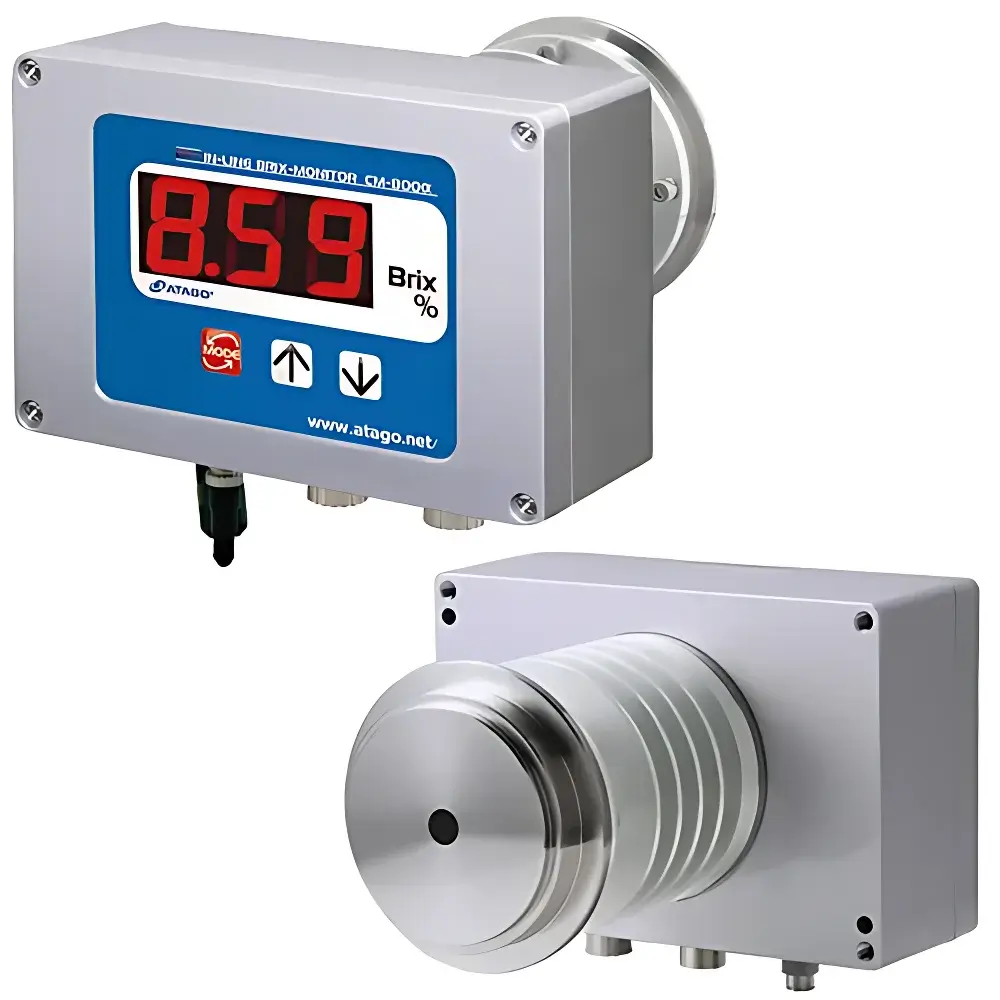
ATAGO CM-800α Online Refractometer for Beverage Production Lines
| Brand | ATAGO |
|---|---|
| Origin | Japan |
| Model | CM-800α |
| Measurement | Brix (ATC) & Temperature |
| Accuracy | ±0.1% Brix, ±1°C/°F |
| Range | 0.00–80.00% Brix (ATC), -15–160.0°C |
| ATC Range | 5–100°C |
| Resolution | 0.01% (≤9.99%), 0.1% (>10.0%), 1°C/°F |
| Output | 4–20 mA DC, RS-232C |
| Sampling Interval | ~1 sec (configurable up to 5 intervals) |
| IP Rating | IP67 |
| Light Source | LED (≈589 nm, D-line equivalent) |
| Power | DC 24 V (AC 100 V optional with AD-32 adapter) |
| Prism Material | Synthetic Sapphire |
| Body Material | SUS316L Stainless Steel |
| Dimensions | 160 × 167 × 110 mm |
| Weight | 2.4 kg |
Overview
The ATAGO CM-800α Online Refractometer is an industrial-grade, in-line process analyzer engineered for continuous, real-time measurement of soluble solids concentration—expressed as Brix—in liquid streams across beverage production lines and related food & pharmaceutical manufacturing processes. Based on the principle of critical-angle refractometry, the instrument measures the refractive index of flowing media and converts it to Brix values using built-in calibration algorithms compliant with international sugar standard references (e.g., ISO 21527, AOAC 932.12). Its integrated Automatic Temperature Compensation (ATC) ensures stable readings across a wide process temperature range (5–100°C), eliminating manual correction and minimizing drift during thermal transients. Designed for permanent installation in sanitary or industrial piping systems, the CM-800α operates without sample extraction, flow diversion, or reagent consumption—making it suitable for hygienic, high-reliability applications where zero downtime and regulatory traceability are essential.
Key Features
- High-precision optical sensing with synthetic sapphire prism (Vickers hardness >2000 HV) and corrosion-resistant SUS316L wetted parts, ensuring long-term stability in aggressive aqueous and mildly acidic environments.
- Real-time measurement cycle of approximately 1 second (factory default), configurable to five user-defined sampling intervals for synchronization with PLC-controlled process steps.
- Dual analog (4–20 mA) and digital (RS-232C) outputs: analog signal supports direct integration into DCS/SCADA systems; RS-232C enables bidirectional communication for configuration, diagnostics, and raw refractive index data logging.
- IP67-rated enclosure rated for humid, washdown-prone environments; compatible with CIP (Clean-in-Place) validation when installed per ATAGO’s recommended mounting orientation and gasket specifications.
- LED light source emitting near-monochromatic radiation centered at ~589 nm—optically aligned to match the sodium D-line reference wavelength used in classical refractometric standards—ensuring metrological consistency with laboratory-grade benchtop instruments.
- On-device Brix resolution dynamically adapts to concentration level (0.01% for ≤9.99%, 0.1% above), supporting both low-concentration dilution control and high-Brix syrup monitoring with appropriate digit precision.
Sample Compatibility & Compliance
The CM-800α is validated for use with clear to moderately turbid aqueous solutions containing sugars, organic acids, salts, and water-soluble polymers—typical of juice concentrates, soft drink syrups, malt extracts, pharmaceutical excipient solutions, and industrial coolants. It is not intended for opaque suspensions, emulsions, or highly viscous fluids (>500 cP) without inline homogenization. Regulatory alignment includes support for GLP/GMP documentation workflows: audit trails for calibration events, user-access logs (via RS-232C), and timestamped output records facilitate compliance with FDA 21 CFR Part 11 requirements when integrated with validated data acquisition software. The device conforms to IEC 61000-6-2 (immunity) and IEC 61000-6-4 (emissions) for industrial electromagnetic environments, and its materials comply with FDA 21 CFR 177.2400 for repeated food contact.
Software & Data Management
While the CM-800α operates autonomously as a standalone sensor, its RS-232C interface allows connection to ATAGO’s optional PC-based configuration utility (CM-PC Software) for parameter setup, firmware updates, and historical data export in CSV format. When deployed in automated plants, the 4–20 mA output is typically routed to a programmable logic controller (PLC) or distributed control system (DCS) for closed-loop feedback control—e.g., modulating dilution water valves based on real-time Brix deviation from setpoint. For enterprise-level traceability, third-party SCADA platforms (e.g., Ignition, Siemens WinCC) can ingest and archive CM-800α data alongside batch IDs, timestamps, and operator annotations—enabling full-process correlation for root cause analysis and quality incident investigations.
Applications
- Continuous Brix monitoring during juice blending, carbonated beverage mixing, and dairy-based drink formulation to maintain flavor consistency and label claim accuracy.
- In-line verification of concentration in evaporation and concentration stages—such as in fruit concentrate production—reducing over-evaporation energy waste and preventing thermal degradation.
- Real-time tracking of dilution ratios in syrup-to-water proportioning systems, supporting HACCP Critical Control Point (CCP) documentation.
- Monitoring of cleaning solution strength during CIP cycles to verify minimum required concentration for microbial efficacy (e.g., caustic soda ≥1.5% w/w).
- Process validation support for pharmaceutical oral solution manufacturing, where Brix serves as a surrogate for active ingredient concentration in simple syrup vehicles per USP verification protocols.
FAQ
Is the CM-800α suitable for sterile processing environments?
Yes—when installed with tri-clamp sanitary fittings and validated CIP/SIP protocols, and provided the sapphire prism surface remains free of biofilm accumulation through proper flow velocity (>1.5 m/s recommended).
Can the instrument measure non-sugar solutes accurately?
Brix is a sucrose-equivalent scale; for non-sugar solutions (e.g., glycerol, ethanol), a custom calibration curve must be established using known reference standards—ATAGO provides application support for such method development.
What maintenance is required beyond routine cleaning?
No consumables or recalibration are needed under normal operation; annual verification against NIST-traceable sucrose standards is recommended for GMP-regulated sites.
Does the CM-800α support Modbus or Profibus communication?
No—only 4–20 mA analog and RS-232C serial interfaces are natively supported; protocol conversion requires external gateways.
How is temperature compensation implemented?
A platinum RTD (Pt1000) embedded adjacent to the prism measures fluid temperature in real time; compensation uses a polynomial algorithm derived from ATAGO’s proprietary Brix–RI–temperature database, referenced to ISO 21527 Annex A.