
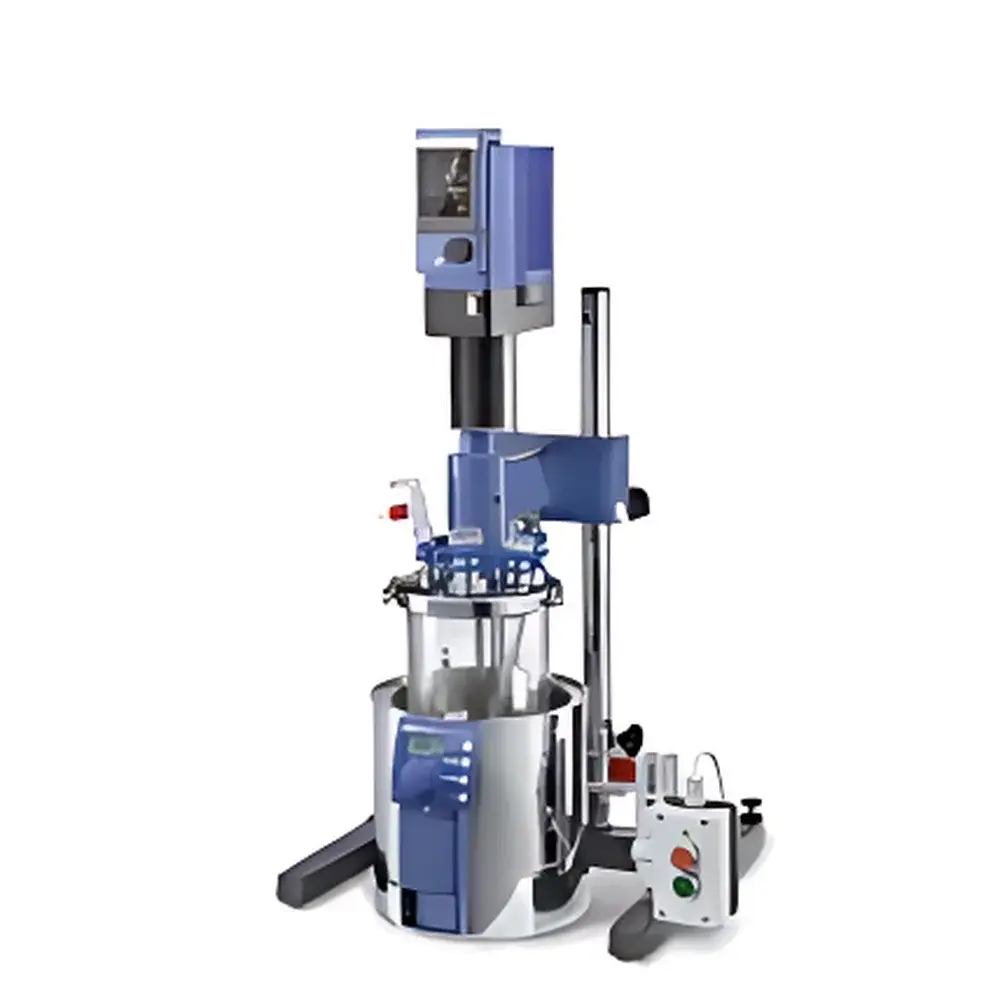
IKA LR-2.ST Configuration 1 Modular Laboratory Reactor System
| Brand | IKA |
|---|---|
| Origin | Germany |
| Model | LR-2.ST Configuration 1 |
| Vessel Capacity | 2000 mL |
| Construction Material | Borosilicate Glass 3.3 |
| Operating Pressure Range | Up to 6 bar (gauge) / Full Vacuum (≤ 25 mbar abs) |
| Stirring System | EUROSTAR 200 control P4 High-Torque Digital Stirrer |
| Agitator Type | LR 2000.11 Anchor Impeller with Flow-Through Orifices |
| Sealing Material | FFPM (Perfluoroelastomer) for Solvent & Thermal Resistance |
| Speed Control | Continuously Variable (0–250 rpm), Microprocessor-Controlled with Real-Time Relative Torque Monitoring |
| Safety Features | Integrated Safety Switch, Interlocked Lid Actuation |
Overview
The IKA LR-2.ST Configuration 1 is a modular, scalable laboratory reactor system engineered for precise process development and reaction engineering under controlled temperature, pressure, and agitation conditions. Based on Couette-type mixing principles and designed for batch-mode operation, it enables reproducible simulation of chemical synthesis, catalytic reactions, crystallization, hydrogenation, and polymerization at laboratory scale (up to 2 L working volume). Its all-glass construction—using DIN ISO 3585-certified borosilicate glass 3.3—ensures optical clarity, chemical inertness toward aggressive reagents (e.g., strong acids, halogenated solvents, organometallics), and thermal shock resistance up to ΔT = 100 °C. The system operates across a wide process envelope: from full vacuum (≤ 25 mbar absolute) to elevated pressure (up to +6 bar gauge), making it suitable for low-boiling point solvent handling, degassing, moisture-sensitive chemistry, and exothermic reaction control.
Key Features
- Modular architecture supporting seamless integration of temperature control (via external circulator), gas dosing (inert or reactive), reflux condensation, and inline pH or conductivity probes.
- EUROSTAR 200 control P4 digital stirrer delivering up to 20 N·cm nominal torque, with closed-loop speed regulation ensuring ±1 rpm stability even under variable viscosity loads.
- LR 2000.11 anchor impeller featuring flow-through orifices to enhance radial mixing and heat transfer efficiency in viscous or heterogeneous media—critical for suspension polymerization or precipitative reactions.
- FFPM (perfluoroelastomer) sealing system compliant with ASTM D1418 and ISO 1629, rated for continuous service between –20 °C and +200 °C and resistant to swelling in THF, DMF, chlorinated solvents, and peroxides.
- Interlocked safety switch deactivates stirring and heating when the reactor lid is unlatched—meeting EN 61000-6-2/6-4 electromagnetic compatibility and EN 61010-1 electrical safety requirements.
- Single-wall glass vessel (LR 2.1, 2000 mL) with standardized ISO-KF 25 and ISO-KF 40 ports for vacuum, temperature probe, and auxiliary instrumentation.
Sample Compatibility & Compliance
The LR-2.ST Configuration 1 accommodates liquid, slurry, and paste-phase samples—including air/moisture-sensitive reagents when operated under nitrogen or argon blanket. Its glass-wetted path eliminates metal ion leaching, supporting USP compounding protocols and catalyst screening where trace metal contamination must be avoided. All mechanical and electrical components comply with CE marking directives (2014/30/EU EMC, 2014/35/EU LVD) and are validated for GLP environments. Documentation includes Factory Acceptance Test (FAT) reports, material certificates for glass and seals, and traceable calibration records for torque and speed sensors.
Software & Data Management
While the base Configuration 1 operates via front-panel controls, optional IKA Labworldsoft connectivity enables RS232/USB data logging of speed, relative torque, temperature (via external Pt100 probe), and elapsed time. Logged datasets are timestamped and exportable as CSV for trend analysis in MATLAB, JMP, or electronic lab notebooks (ELN). When integrated into regulated workflows, the system supports 21 CFR Part 11-compliant audit trails through third-party ELN platforms—provided user-defined roles, electronic signatures, and change-control procedures are implemented externally.
Applications
- Kinetic profiling of Grignard or lithium–halogen exchange reactions under anhydrous, oxygen-free conditions.
- Scale-down validation of industrial hydrogenation processes using Pd/C or Raney Ni catalysts under controlled H₂ pressure.
- Crystallization endpoint detection via real-time torque deviation during antisolvent addition.
- Emulsion polymerization studies requiring high-shear dispersion (via optional ULTRA-TURRAX® T25 digital) combined with low-shear bulk mixing.
- Thermal hazard assessment (e.g., RC1-style calorimetry) when coupled with a reaction calorimeter jacket and thermocouple tree.
FAQ
Can the LR-2.ST Configuration 1 be upgraded to a double-jacketed vessel for active temperature control?
Yes—vessels LR 2.2 (double-jacketed) and LR 2.3 (double-jacketed with bottom discharge) are mechanically and dimensionally compatible; retrofit requires only replacement of the vessel and associated circulation fittings.
Is the FFPM seal certified for use with hydrofluoric acid (HF)?
No—FFPM exhibits limited resistance to HF; alternative sealing solutions (e.g., Kalrez® 6375) require custom engineering consultation and are not covered under standard Configuration 1 warranty.
What is the maximum allowable viscosity range for stable torque measurement?
The relative torque sensor is calibrated for viscosities from 10 mPa·s to 50,000 mPa·s (at 25 °C); beyond this, accuracy degrades due to non-linear strain gauge response and should be verified with Newtonian reference fluids.
Does the system include documentation for IQ/OQ qualification?
Yes—Factory-supplied IQ/OQ templates aligned with ISO/IEC 17025 and ASTM E2500 are provided; final protocol execution and evidence generation remain the responsibility of the end-user’s QA department.



