
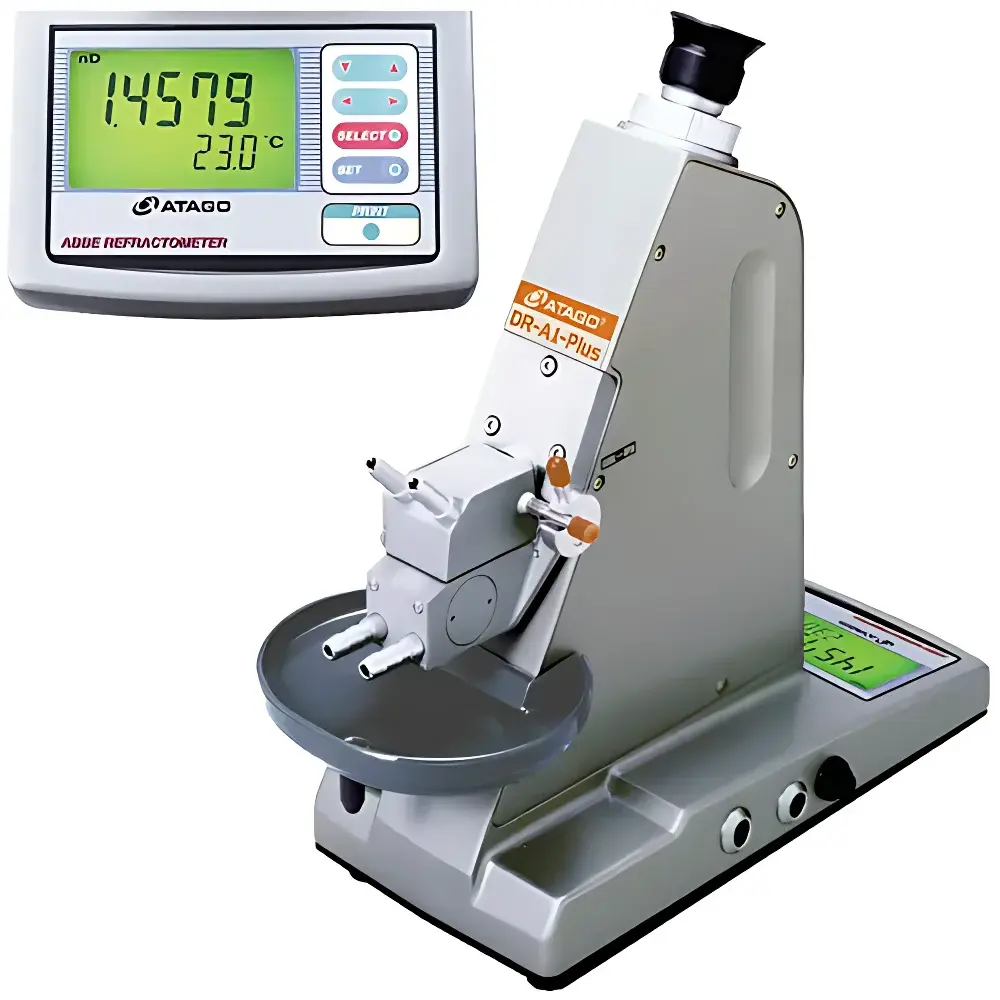
ATAGO DR-A1-Plus Digital Abbe Refractometer
| Brand | ATAGO |
|---|---|
| Origin | Japan |
| Model | DR-A1-Plus |
| Type | Benchtop Refractometer |
| Display | Digital LCD |
| Temperature Control | None |
| Refractive Index Range | 1.3000–1.7100 (nD) |
| Brix Range | 0.0–100.00% |
| Resolution | ±0.0002 (nD), ±0.1% (Brix) |
| Dual-Scale Display | nD and %Brix |
| Sample Volume | < 0.1 mL |
| Interface | RS-232 for Printer/PC Connectivity |
Overview
The ATAGO DR-A1-Plus Digital Abbe Refractometer is a precision benchtop optical instrument engineered for accurate, rapid determination of refractive index (nD) and mass concentration (expressed as %Brix) in transparent or semi-transparent liquid samples. Based on the classical Abbe principle—where light undergoes total internal reflection at the prism-sample interface—the instrument measures the critical angle of refraction to derive nD with high reproducibility. Its optical design incorporates a high-stability sodium D-line (589.3 nm) light source and precision-ground glass prisms calibrated to JIS B 7021 and ISO 21748 standards. Unlike analog Abbe refractometers, the DR-A1-Plus eliminates parallax error and subjective scale reading through its high-contrast digital LCD display, delivering objective, operator-independent results essential for regulated laboratory environments.
Key Features
- Dual-scale digital readout simultaneously displaying refractive index (nD) and %Brix—enabling direct correlation without manual conversion or external lookup tables.
- High-resolution measurement capability: ±0.0002 for nD and ±0.1% for Brix across the full operational range (nD: 1.3000–1.7100; Brix: 0.0–100.00%).
- Minimal sample requirement: less than 0.1 mL per measurement—critical for precious biological samples such as gradient fractions from density centrifugation.
- RS-232 serial interface supporting direct data export to printers or PCs for audit-trail-compliant recordkeeping; compatible with standard terminal emulation software.
- Robust mechanical architecture with temperature-stable optical housing, designed for continuous use in QC labs and research facilities without active thermal regulation.
- Pre-programmed calibration curves for common gradient media—including sucrose (up to 60% w/w, nD = 1.44193) and cesium chloride (CsCl, up to 56% w/w, nD = 1.39943)—eliminating reliance on printed reference tables.
Sample Compatibility & Compliance
The DR-A1-Plus is validated for use with aqueous solutions, organic solvents, glycerol-based formulations, and high-density salt gradients used in analytical ultracentrifugation. It supports applications requiring traceable, repeatable concentration verification under GLP and GMP-aligned workflows. While the instrument itself does not incorporate active temperature control, its built-in temperature compensation algorithm (based on user-input ambient temperature) corrects nD values per ISO 21748 Annex A, ensuring comparability across laboratories. The device conforms to IEC 61010-1 safety requirements for electrical equipment used in laboratory settings and meets CE marking directives for electromagnetic compatibility (EMC) and low-voltage operation.
Software & Data Management
Data acquisition is facilitated via ASCII-formatted RS-232 output at 9600 baud, enabling seamless integration with LIMS platforms, Excel-based tracking sheets, or custom LabVIEW applications. Each measurement packet includes timestamp (user-entered), nD, %Brix, and instrument ID—supporting 21 CFR Part 11–compliant electronic records when paired with validated PC software featuring audit trail, user authentication, and data integrity safeguards. No proprietary drivers are required; standard COM port configuration suffices for immediate deployment.
Applications
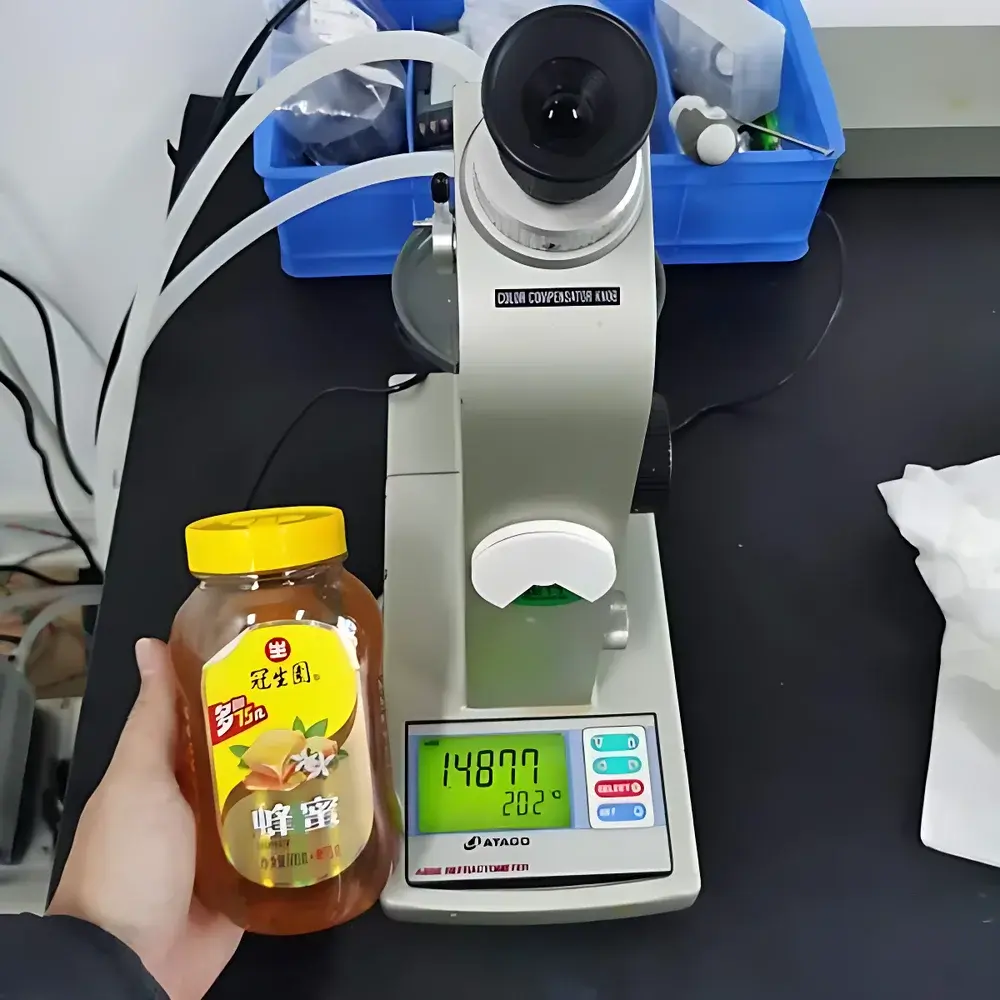
This refractometer serves critical roles in biomolecular separation workflows—including sucrose and CsCl density gradient preparation and post-centrifugation fraction analysis for nucleic acid purification, ribosomal subunit isolation, and viral particle characterization. It is routinely employed in biopharmaceutical process development for buffer concentration verification, fermentation broth monitoring, and excipient quality control. Additional applications span food science (sugar content in syrups and juices), chemical manufacturing (solvent purity assessment), and materials science (polymer solution concentration profiling).
FAQ
Does the DR-A1-Plus support automatic temperature correction?
No—it lacks an integrated Peltier thermostat, but provides manual temperature input (°C) for algorithmic nD compensation per ISO 21748.
Can it measure non-aqueous samples like ethanol or acetone?
Yes, provided they are optically clear and do not corrode the prism surface; users must verify compatibility with the supplied quartz prism.
Is calibration traceable to NIST or other national standards?
Calibration uses certified ATAGO reference fluids (e.g., distilled water, bromonaphthalene) with documented uncertainty; full traceability requires third-party metrology lab validation.
What is the typical warm-up time before stable readings?
Less than 3 minutes after power-on, as confirmed by internal lamp stabilization circuitry.
How frequently should calibration be performed?
Daily verification with water (nD = 1.3330 at 20°C) is recommended; full two-point calibration every 8 hours during extended operation.





