
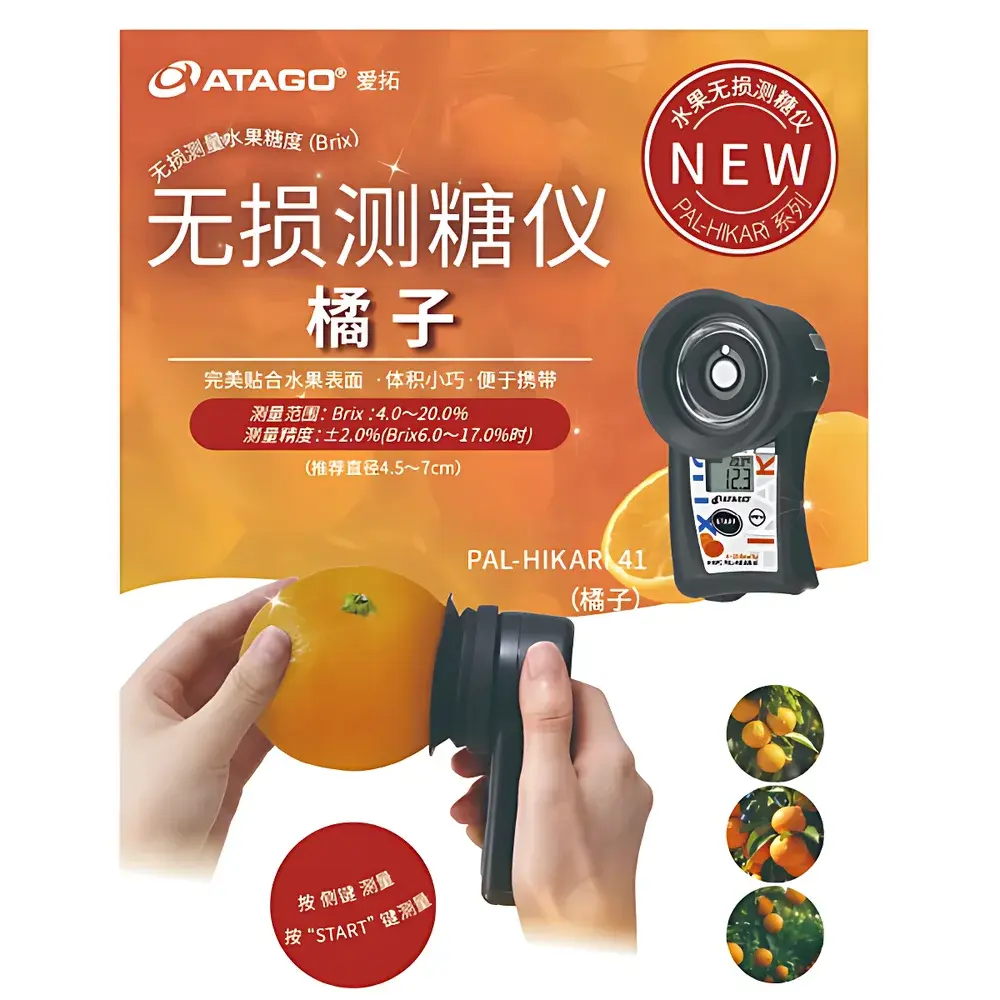
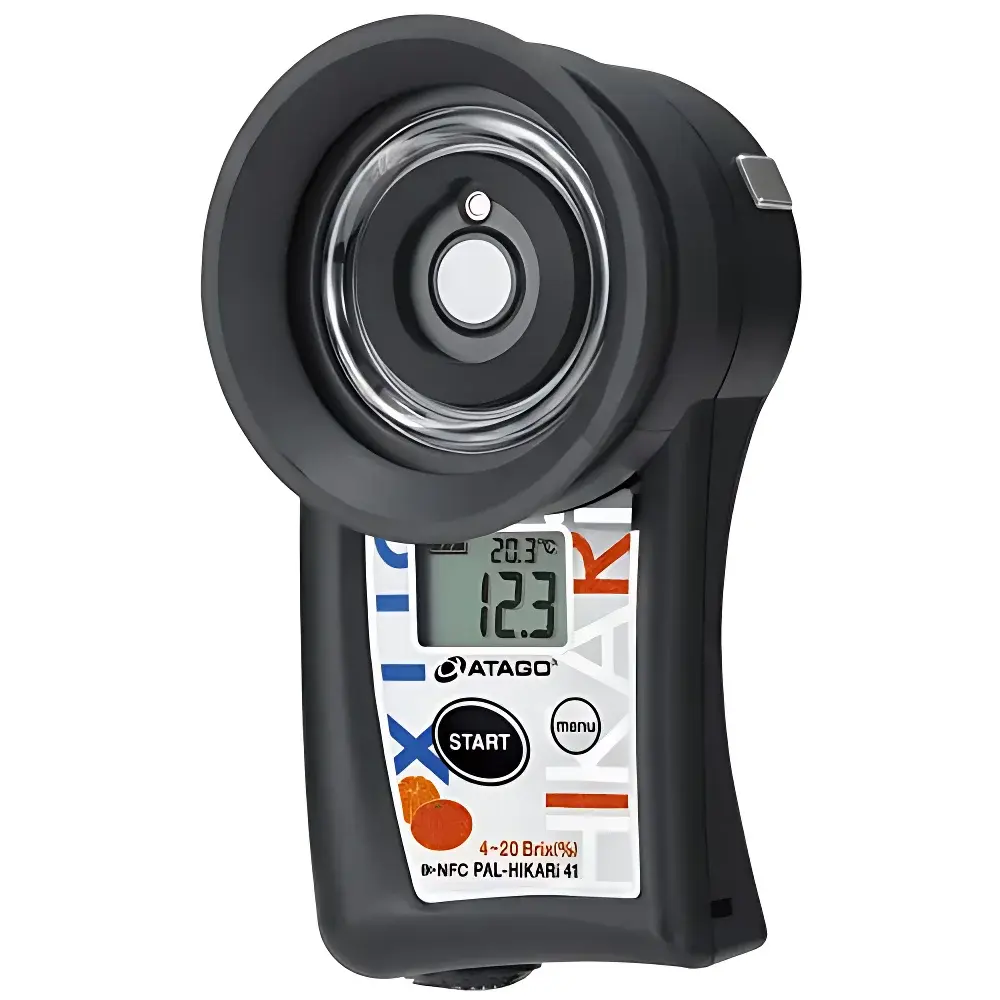
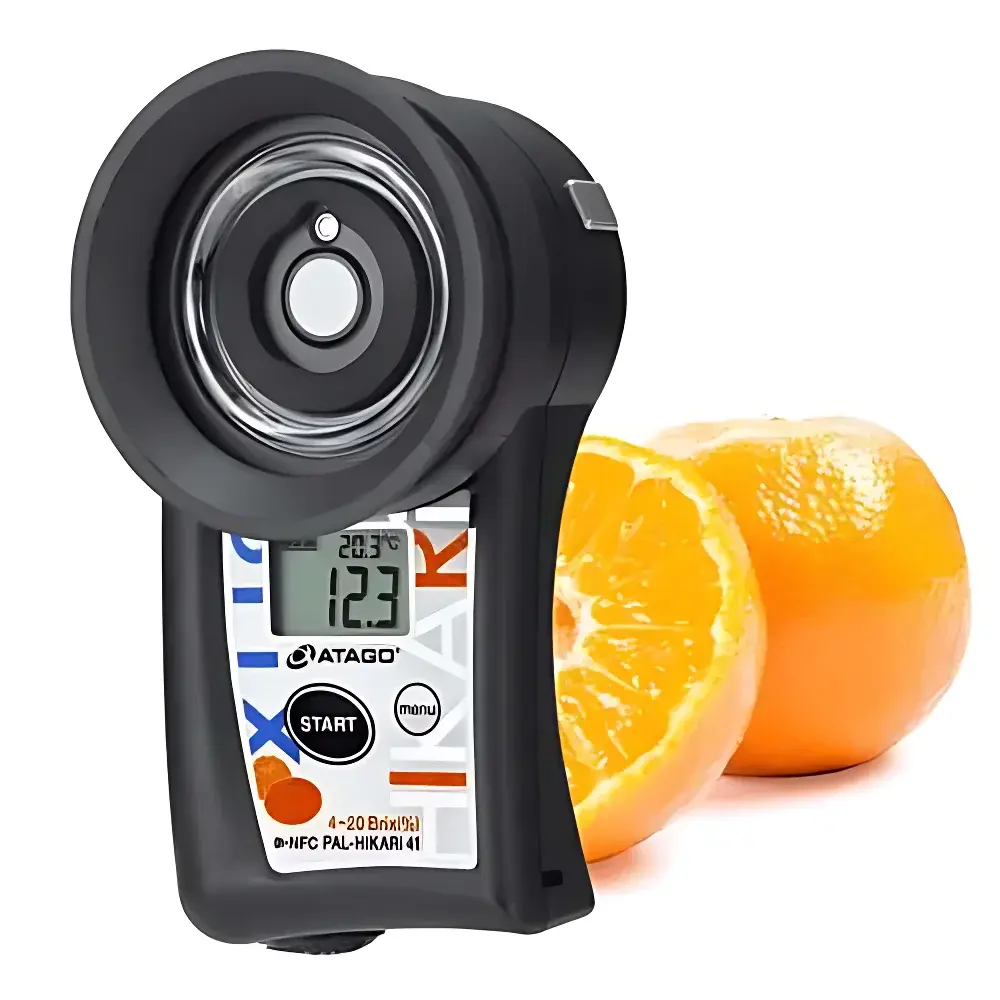
ATAGO PAL-HIKARi 41 Non-Destructive Orange Brix Meter
| Brand | ATAGO |
|---|---|
| Origin | Japan |
| Model | PAL-HIKARi 41 |
| Instrument Type | Non-Destructive Saccharimeter |
| Measurement Principle | Near-Infrared (NIR) Reflectance |
| Measuring Range | 4.0–20.0% Brix |
| Accuracy | ±2.0% Brix (within 6.0–17.0% Brix) |
| Resolution | 0.1% Brix |
| Automatic Temperature Compensation | 5.0–35.0°C |
| IP Rating | IP64 |
| Power Supply | Two AAA Alkaline Batteries |
| Dimensions | 6.1 × 4.4 × 11.5 cm |
| Weight | 120 g (main unit only) |
| Recommended Fruit Diameter | 4.5–7.0 cm (for oranges) |
Overview
The ATAGO PAL-HIKARi 41 is a handheld, non-destructive near-infrared (NIR) saccharimeter engineered specifically for rapid, in-situ Brix measurement of intact citrus fruit—primarily oranges—without physical sampling or surface damage. Unlike traditional refractometers requiring juice extraction, or destructive NIR spectrometers requiring calibration against homogenized samples, the PAL-HIKARi 41 employs a proprietary optical architecture that directs NIR light (typically centered at ~940 nm, sensitive to C–H and O–H vibrational overtones in sucrose and water) into the fruit epidermis and subcutaneous tissue. The instrument analyzes time-resolved reflectance profiles and spectral absorption signatures from the subsurface layer (penetration depth ≈ 1–3 mm), correlating them with validated Brix reference models derived from extensive empirical calibration across multiple orange cultivars (e.g., Navel, Valencia, Cara Cara). This principle enables field-deployable, operator-independent assessment aligned with ISO 2173:2003 (fruit juice Brix determination) and supports Good Agricultural Practice (GAP) and post-harvest quality control protocols.
Key Features
- True non-destructive operation: No fruit puncture, peeling, or juice expression required—preserves marketability and enables longitudinal monitoring of individual fruit
- Dedicated orange-optimized optical path and calibration algorithm, validated for fruit diameters between 4.5 cm and 7.0 cm
- Integrated automatic temperature compensation (5.0–35.0°C), minimizing drift caused by ambient or fruit thermal variance
- Rugged, ergonomic housing rated IP64 for dust resistance and protection against water splashes during orchard or packing-line use
- High-resolution display with 0.1% Brix resolution and real-time measurement stabilization indicator
- Low-power design powered by two standard AAA alkaline batteries, supporting >5,000 measurements per set under typical field conditions
- Factory-calibrated traceable to NIST-traceable sucrose reference standards; no user recalibration required under normal operating conditions
Sample Compatibility & Compliance
The PAL-HIKARi 41 is validated exclusively for mature, commercially grown oranges with smooth, unblemished rinds and minimal wax coating. It is not intended for lemons, mandarins, grapefruits, or hybrid citrus without revalidation. Performance assumes fruit surface cleanliness (free of excessive dirt, dew, or residual harvest aids) and thermal equilibrium with ambient air (≥15 min acclimation recommended prior to measurement). The device complies with IEC 61000-6-3 (EMC emission limits) and IEC 61000-6-2 (immunity requirements). While not certified for GLP or FDA 21 CFR Part 11 environments, its measurement repeatability (RSD < 2.5% within homogeneous lots) meets internal QC thresholds for pre-harvest maturity scheduling and sorting-line pass/fail screening per ISO 8587:2017 (sensory analysis — general guidance).
Software & Data Management
The PAL-HIKARi 41 operates as a standalone instrument with no embedded Bluetooth, USB, or cloud connectivity. All measurements are displayed in real time and retained in volatile memory only for immediate review (last 20 readings). For traceable data logging, users must manually record values alongside metadata (e.g., tree ID, harvest date, location) in external LIMS or Excel-based QA templates. ATAGO provides optional PC software (PAL-Link v3.2, sold separately) compatible with Windows OS for batch export of measurement logs via RS-232 serial interface (cable included). Exported CSV files contain timestamp, Brix value, temperature reading, and instrument ID—enabling alignment with HACCP critical control point documentation and internal audit trails.
Applications
- Orchard maturity mapping: Quantify spatial Brix gradients across groves to optimize harvest timing and reduce yield loss from premature or delayed picking
- Packing house sorting: Enable real-time, non-contact grading of incoming fruit lots into Brix-based quality tiers (e.g., “Premium” ≥12.5%, “Standard” 10.0–12.4%)
- Post-harvest storage monitoring: Track Brix stability during cold storage or controlled-atmosphere transport to assess shelf-life potential
- Varietal performance evaluation: Compare sugar accumulation kinetics across rootstock/scion combinations in breeding trials
- Extension and education: Demonstrate objective ripeness metrics during grower workshops and university horticulture labs
FAQ
Can the PAL-HIKARi 41 measure fruits other than oranges?
No—the optical path length, wavelength selection, and calibration model are optimized exclusively for oranges meeting the specified size and rind characteristics. Use on other fruit types yields unreliable Brix estimates.
Does surface wax or pesticide residue affect accuracy?
Yes—excessive wax buildup or dried spray residues may attenuate NIR signal penetration. Wipe fruit surface gently with a lint-free cloth before measurement.
Is the ±2.0% Brix accuracy specification guaranteed across the full 4.0–20.0% range?
No—this tolerance applies only within the validated linear range of 6.0–17.0% Brix. Outside this interval, systematic deviation increases due to nonlinear optical response and reduced signal-to-noise ratio.
How often does the instrument require recalibration?
ATAGO recommends annual verification using certified sucrose reference standards (e.g., 10.0% and 15.0% w/w aqueous solutions measured via benchtop refractometer). Field recalibration is not supported.
What environmental conditions limit operational reliability?
Measurements taken below 5.0°C or above 35.0°C fall outside the ATC range and introduce uncorrected thermal bias; direct sunlight exposure during measurement may cause sensor overheating and transient drift.




