
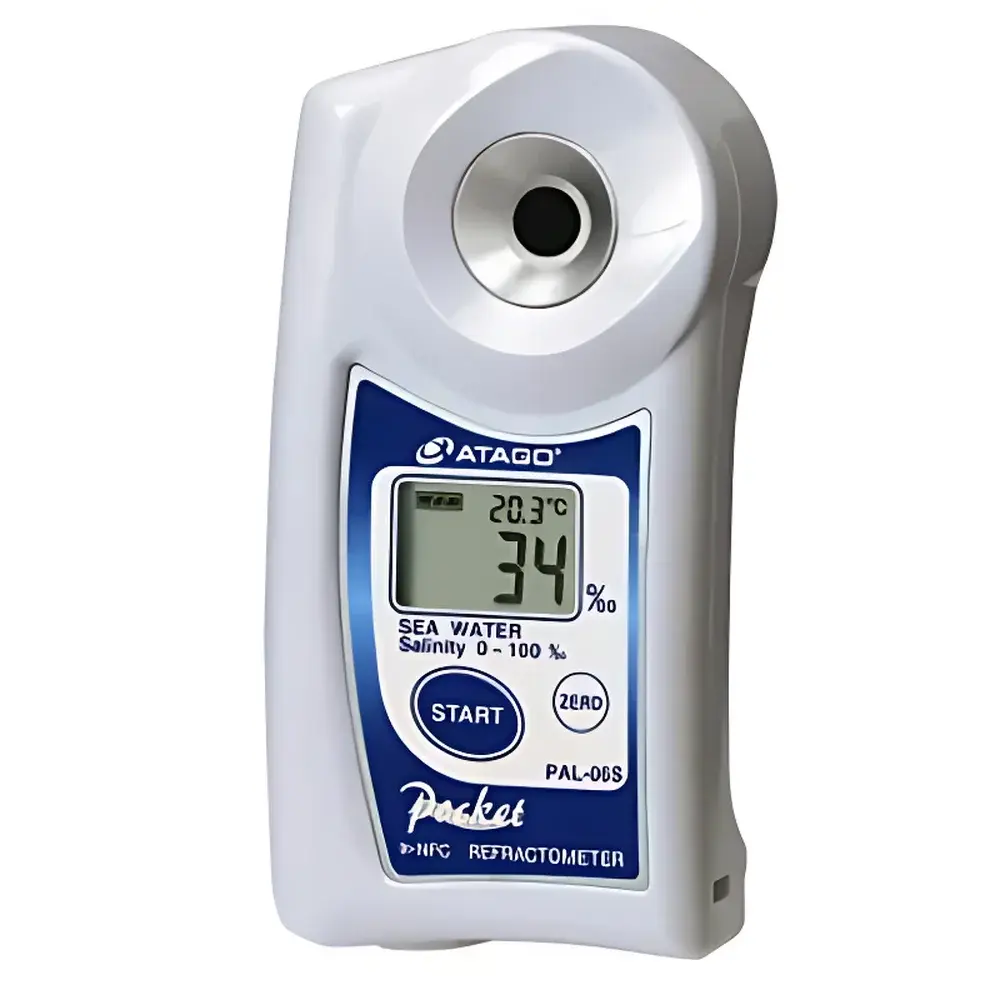
ATAGO PAL-06S Digital Handheld Salinity Refractometer
| Brand | ATAGO |
|---|---|
| Origin | Japan |
| Model | PAL-06S |
| Product Type | Handheld Refractometer |
| Temperature Control | None |
| Digital Display | Yes |
| Measurement Range | 0–100‰ (parts per thousand, ppt) |
| Accuracy | ±2‰ |
Overview
The ATAGO PAL-06S Digital Handheld Salinity Refractometer is a precision optical instrument engineered for rapid, field-deployable measurement of salinity in aqueous solutions—specifically optimized for agricultural research, aquaculture management, and saline soil irrigation monitoring. Based on the principle of critical-angle refractometry, the PAL-06S determines salt concentration by measuring the refractive index of a small liquid sample (typically 0.3 mL) at ambient temperature. Its optical path is calibrated to correlate refractive index shifts with sodium chloride (NaCl) equivalent salinity in parts per thousand (‰), conforming to standard seawater calibration protocols. Unlike conductivity-based meters, this optical method eliminates interference from non-ionic solutes, temperature drift (within typical field operating ranges), or electrode fouling—making it especially reliable for long-term monitoring in coastal farms, rice breeding trials, and brackish water recirculation systems.
Key Features
- Compact, ergonomic handheld design with rubberized grip for extended field use and resistance to accidental drops
- High-contrast LCD digital display with automatic backlight for low-light conditions (e.g., early-morning field sampling)
- No external power source required beyond two AAA batteries (included); average battery life exceeds 10,000 measurements
- Optical system features high-stability Abbe prism and precision-ground glass optics manufactured in Japan to ISO 9001-certified production standards
- Auto-zero function with distilled water calibration routine; single-point calibration supported via included calibration screwdriver and reference solution vial
- IP65-rated enclosure provides protection against dust ingress and water splashes during outdoor operation
Sample Compatibility & Compliance
The PAL-06S is validated for direct measurement of NaCl-dominated aqueous solutions—including seawater, brackish irrigation water, pond effluents, and nutrient solutions used in halophyte cultivation. It is not intended for highly viscous, turbid, or strongly colored samples without prior filtration or dilution. While the device itself does not carry CE or FDA certification as a medical or diagnostic instrument, its measurement methodology aligns with ASTM D1141-98 (Standard Practice for Preparation of Substitute Ocean Water) and supports data collection workflows compliant with GLP (Good Laboratory Practice) documentation requirements when paired with traceable calibration records. For agricultural R&D applications—such as evaluating irrigation water suitability for salt-tolerant rice varieties—the PAL-06S delivers repeatable results within ±2‰ tolerance across its full 0–100‰ range, meeting the minimum resolution threshold specified in national saline agriculture guidelines (e.g., China’s NY/T 2772–2015 for saline soil water quality assessment).
Software & Data Management
The PAL-06S operates as a standalone optical instrument with no embedded Bluetooth, USB, or software connectivity. All measurements are displayed in real time on the integrated LCD screen and must be manually recorded. This architecture ensures operational simplicity, electromagnetic immunity in farm environments with variable power infrastructure, and zero risk of firmware obsolescence or cybersecurity exposure. For laboratories requiring digital traceability, users may integrate the PAL-06S into structured data capture protocols using external tools: field notebooks with standardized templates, barcode-scanned sample logbooks, or mobile apps configured for manual entry with timestamp and GPS metadata. Calibration logs—including date, operator ID, reference solution lot number, and observed deviation—should be retained for audit readiness under internal QA procedures or third-party certification schemes (e.g., ISO/IEC 17025 accredited testing labs).
Applications
- Salinity screening of irrigation sources for salt-tolerant crop breeding programs (e.g., Oryza sativa var. “seawater rice” cultivars requiring ≥3‰ irrigation water)
- Routine monitoring of evaporation-induced salinity buildup in paddy fields, aquaculture ponds, and greenhouse hydroponic reservoirs
- Field validation of desalination unit output or freshwater dilution ratios in coastal farming cooperatives
- Quality control of brine solutions used in seafood processing and marine hatchery larval rearing
- Educational demonstration of osmotic stress principles in plant physiology and environmental science curricula
FAQ
Does the PAL-06S require temperature compensation?
No. The instrument operates at ambient temperature and is calibrated at 20 °C. For measurements outside 10–30 °C, users should apply correction factors based on published NaCl refractive index–temperature tables or perform in situ calibration using temperature-matched reference standards.
Can it measure salinity in soil extracts?
Yes—provided the extract is filtered to remove particulates (≤0.45 µm) and free of suspended solids that could scatter light or adhere to the prism surface.
Is the PAL-06S suitable for measuring seawater with high organic load?
It provides accurate NaCl-equivalent readings only if organic content is low. High concentrations of dissolved organic carbon (DOC) or humic substances may cause minor positive bias; confirm with comparative conductivity measurements where DOC > 10 mg/L.
How often should calibration be performed?
Before each measurement session, or after every 10–15 samples in variable-field conditions. Daily calibration is recommended for regulatory reporting or multi-operator studies.
What maintenance is required?
Wipe the prism surface with lens tissue and distilled water after each use; avoid alcohol or abrasive cleaners. Store in the supplied protective case with silica gel desiccant to prevent condensation-related optical haze.




