
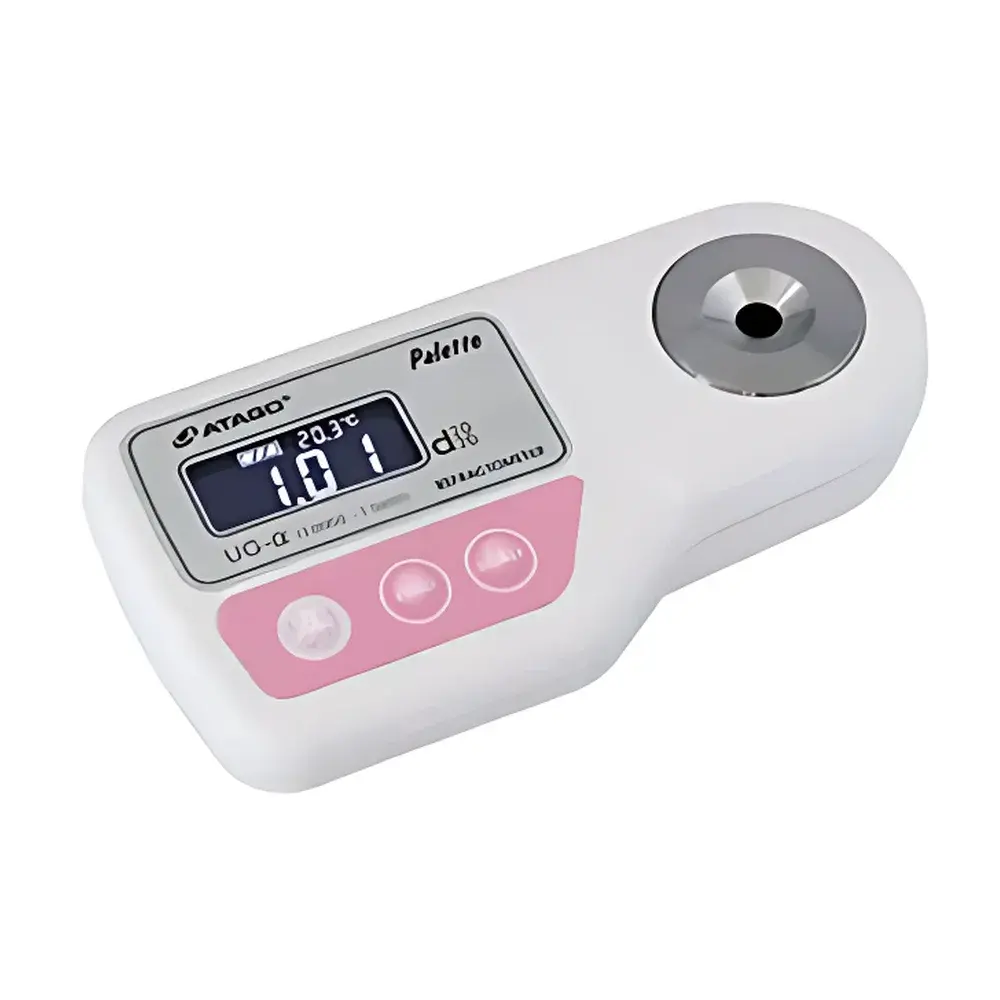
ATAGO UG-α Handheld Urine Specific Gravity Refractometer
| Brand | ATAGO |
|---|---|
| Origin | Japan |
| Model | UG-α (Urine Specific Gravity) |
| Product Type | Handheld Refractometer |
| Temperature Control | None |
| Digital Display | Yes |
| Measurement Range | 1.0000–1.0600 |
| Accuracy | ±0.0010 |
Overview
The ATAGO UG-α Handheld Urine Specific Gravity Refractometer is a precision optical instrument engineered for rapid, reliable, and repeatable determination of urine specific gravity (USG) in clinical, point-of-care, and sports medicine settings. Based on the fundamental principle of refractometry—measuring the refractive index of a liquid sample and correlating it to specific gravity via a calibrated, empirically validated conversion curve—the UG-α delivers direct digital readouts without manual interpolation or temperature correction. Unlike traditional analog refractometers, the UG-α features an enhanced optical path and high-resolution prism assembly optimized for low-concentration aqueous biological fluids, enabling resolution down to 0.0001 units across its clinically relevant range (1.0000–1.0600). Its design adheres to ISO 11540:2017 (Refractometers — Specification and verification) and supports traceable measurement practices aligned with CLIA and CAP laboratory standards.
Key Features
- Digital LCD display with 0.0001 resolution for precise USG quantification
- High-stability Abbe-type prism system fabricated from optical-grade BK7 glass, ensuring long-term calibration integrity
- No external power supply required beyond standard AAA batteries; operational life exceeds 10,000 measurements per set
- Ergonomic, non-slip rubberized housing rated IP65 for resistance to splashes, disinfectants, and routine clinical handling
- Auto-zero function with built-in distilled water reference mode for daily verification
- Calibration traceable to NIST-traceable sucrose solutions; factory calibration certificate included
Sample Compatibility & Compliance
The UG-α is validated for use with fresh, uncentrifuged human urine samples—including those containing moderate levels of glucose (<300 mg/dL), protein (<10 g/L), or bilirubin—without significant interference. It is not intended for use with highly viscous, turbid, or hemolyzed specimens unless pre-filtered. The instrument complies with IEC 61010-1:2010 for electrical safety in laboratory equipment and meets the essential requirements of the EU In Vitro Diagnostic Medical Devices Regulation (IVDR 2017/746) as a Class A device. Its measurement methodology is referenced in CLSI EP10-A3 (Preliminary Evaluation of Quantitative Clinical Laboratory Measurement Procedures) and supports documentation requirements for GLP-compliant urinalysis workflows.
Software & Data Management
While the UG-α operates as a standalone instrument with no onboard data logging, its digital output format enables seamless integration with external clinical information systems (CIS) and laboratory information management systems (LIMS) via optional RS-232 or USB-to-serial adapters (sold separately). When connected, measurement timestamps, operator IDs, and result values can be transmitted in HL7 v2.5.1-compatible ASCII format. All firmware updates and calibration logs are managed through ATAGO’s proprietary PC-based configuration utility, which maintains full audit trails compliant with FDA 21 CFR Part 11 for electronic records and signatures when deployed in regulated environments.
Applications
- Routine renal function assessment: Monitoring concentrating ability in patients with suspected nephrogenic diabetes insipidus, acute kidney injury, or chronic kidney disease
- Hepatic evaluation: Supporting serum protein estimation in conjunction with total protein assays where albumin/globulin ratios inform synthetic liver capacity
- Sports medicine hydration monitoring: Objective tracking of urinary concentration trends before, during, and after endurance events; typical baseline values range from 1.015–1.020 in euhydrated athletes
- Veterinary diagnostics: Validated for canine and feline urine analysis per AAHA Urinalysis Guidelines (2022)
- Emergency department triage: Rapid bedside assessment of volume status in trauma, sepsis, or diabetic ketoacidosis cases
FAQ
Does the UG-α require temperature compensation?
No. The instrument incorporates a thermally stable optical design and is calibrated at 20 °C. For optimal accuracy, samples should be equilibrated to ambient temperature (15–30 °C) prior to measurement.
Can the UG-α measure serum protein directly?
No. It estimates total protein concentration indirectly using a secondary scale calibrated against refractive index–protein correlation curves; results must be confirmed by electrophoresis or immunoassay in diagnostic contexts.
Is calibration verification required before each use?
Daily verification using distilled water (expected reading: 1.0000 ±0.0005) is recommended per CLSI GP19-A4 guidelines; full recalibration is advised every 6 months or after mechanical shock.
What cleaning protocol is recommended between samples?
Wipe the prism surface with lens tissue moistened with distilled water, followed by dry tissue; avoid alcohol or acetone, which may degrade the anti-reflective coating.
Is the UG-α suitable for pediatric or neonatal urine samples?
Yes—its low sample volume requirement (0.3 mL) and high sensitivity make it appropriate for small-volume specimens; however, interpretation must account for age-specific reference intervals (e.g., neonates typically exhibit lower USG due to immature tubular function).





