
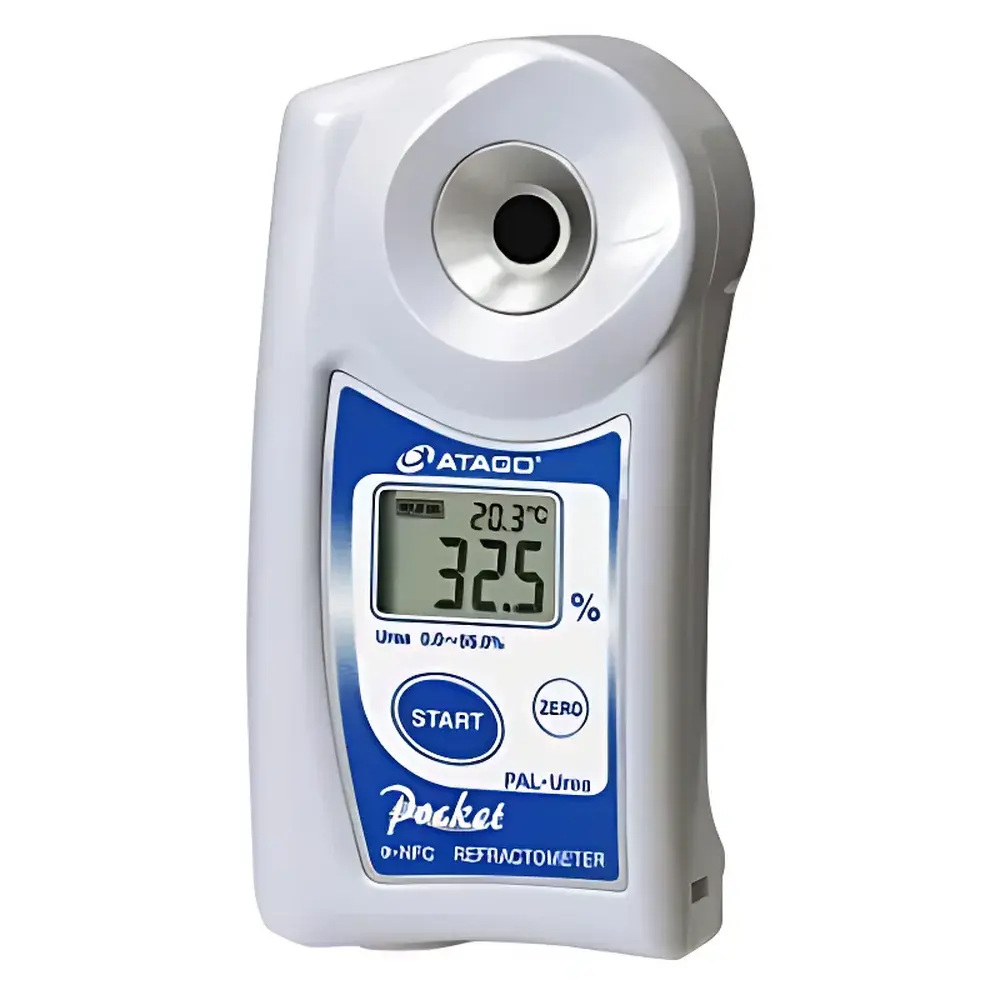
ATAGO PAL-Urea Portable Diesel Exhaust Fluid (DEF) Refractometer
| Brand | ATAGO |
|---|---|
| Model | PAL-Urea |
| Origin | Japan |
| Measurement Range | 0.0–55.0% w/w urea |
| Accuracy | ±0.2% |
| Resolution | 0.1% |
| Temperature Range (with ATC) | 10–40°C |
| Power | 2×AAA batteries |
| IP Rating | IP65 |
| Dimensions | 5.5 × 3.1 × 10.9 cm |
| Weight | 100 g (instrument only) |
Overview
The ATAGO PAL-Urea is a handheld, optical refractometer specifically engineered for the rapid, on-site quantification of aqueous urea concentration in Diesel Exhaust Fluid (DEF)—a critical AdBlue®-compliant solution used in Selective Catalytic Reduction (SCR) systems. DEF must maintain a precise 32.5% (±0.5%) w/w urea concentration to ensure optimal NOx conversion efficiency and prevent catalyst poisoning or crystallization in exhaust aftertreatment hardware. The PAL-Urea operates on the principle of critical-angle refractometry: incident light passes through a prism-sample interface, and the resulting refraction angle—directly correlated to solution density and solute concentration—is converted into a calibrated % w/w urea reading via an internal temperature-compensated algorithm. Its compact, ruggedized design enables deployment across mobile monitoring vehicles, roadside inspection stations, fleet maintenance bays, and OEM service centers where environmental robustness and measurement repeatability are essential.
Key Features
- Optical refractometry with built-in Automatic Temperature Compensation (ATC) across 10–40°C, eliminating manual correction and ensuring traceable accuracy under variable field conditions.
- High-resolution digital display (0.1% resolution) with ±0.2% full-scale accuracy—validated per ISO 21748 and ASTM D1152 for aqueous urea solutions.
- IP65-rated enclosure provides dust-tight integrity and protection against low-pressure water jets, supporting reliable operation in humid, oily, or outdoor environments.
- Minimal sample requirement: <100 µL placed directly onto the sapphire-coated measuring prism; no consumables, reagents, or calibration fluids required.
- Low-power architecture powered by two standard AAA batteries (typical life >10,000 measurements), enabling continuous use during multi-site mobile monitoring campaigns.
- Ergonomic, one-handed operation with instant measurement (<3 seconds), zero warm-up time, and automatic shut-off after 3 minutes of inactivity.
Sample Compatibility & Compliance
The PAL-Urea is validated exclusively for aqueous urea solutions meeting ISO 22241-1 specifications—including commercial DEF formulations containing 32.5% urea, deionized water, and approved stabilizers. It is not intended for use with contaminated, turbid, or non-aqueous samples (e.g., glycol blends or diesel fuel). Instrument performance complies with ISO 22241-2 for DEF testing equipment and supports adherence to EPA Heavy-Duty Engine Certification requirements (40 CFR Part 1065) and EU Regulation (EC) No 692/2008. Data integrity meets GLP principles for field-deployed instrumentation, with no electronic data storage or audit trail functionality—consistent with portable refractometer classification under FDA 21 CFR Part 11 exemptions.
Software & Data Management
As a standalone optical instrument, the PAL-Urea does not incorporate embedded software, Bluetooth, USB, or cloud connectivity. All measurement results are displayed locally and transient—no data logging, export, or remote transmission capabilities are provided. This architecture ensures electromagnetic compatibility (EMC) in vehicle-mounted applications and eliminates cybersecurity vulnerabilities associated with connected field devices. For traceable recordkeeping, users are advised to manually document readings alongside batch ID, date/time, operator ID, and ambient conditions in accordance with site-specific SOPs or ISO/IEC 17025 documentation protocols.
Applications
- On-vehicle DEF quality verification prior to SCR system refilling at depots or fueling stations.
- Routine inspection of DEF tanks in mobile monitoring vehicles to detect dilution, contamination, or degradation during extended deployments.
- Fleet maintenance QA/QC: confirming DEF concentration before dispatch to avoid SCR fault codes and non-compliance penalties.
- OEM and Tier-1 supplier field service: troubleshooting NOx emission excursions linked to suboptimal DEF concentration.
- Regulatory roadside checks by environmental enforcement agencies verifying DEF conformity per ISO 22241 and national air quality mandates.
FAQ
Does the PAL-Urea require calibration with standard solutions?
No—factory-calibrated using NIST-traceable urea standards; periodic verification with 32.5% reference solution is recommended every 30 days or after exposure to extreme temperatures.
Can it measure DEF concentration in frozen or partially crystallized samples?
No—samples must be fully liquid and homogenized at ≥10°C prior to measurement; crystallization alters optical path integrity and invalidates refractive index correlation.
Is the prism surface resistant to urea residue buildup?
Yes—the sapphire-coated prism resists abrasion and chemical etching; cleaning with distilled water and lens tissue is sufficient between measurements.
Does ATC compensate for both sample and ambient temperature gradients?
ATC corrects based on prism temperature only, which equilibrates rapidly with the applied sample; it does not model ambient air convection effects.
What is the expected service life under daily field use?
With proper prism care and battery replacement, operational lifespan exceeds 5 years; no scheduled recalibration or component replacement is specified by ATAGO.







