
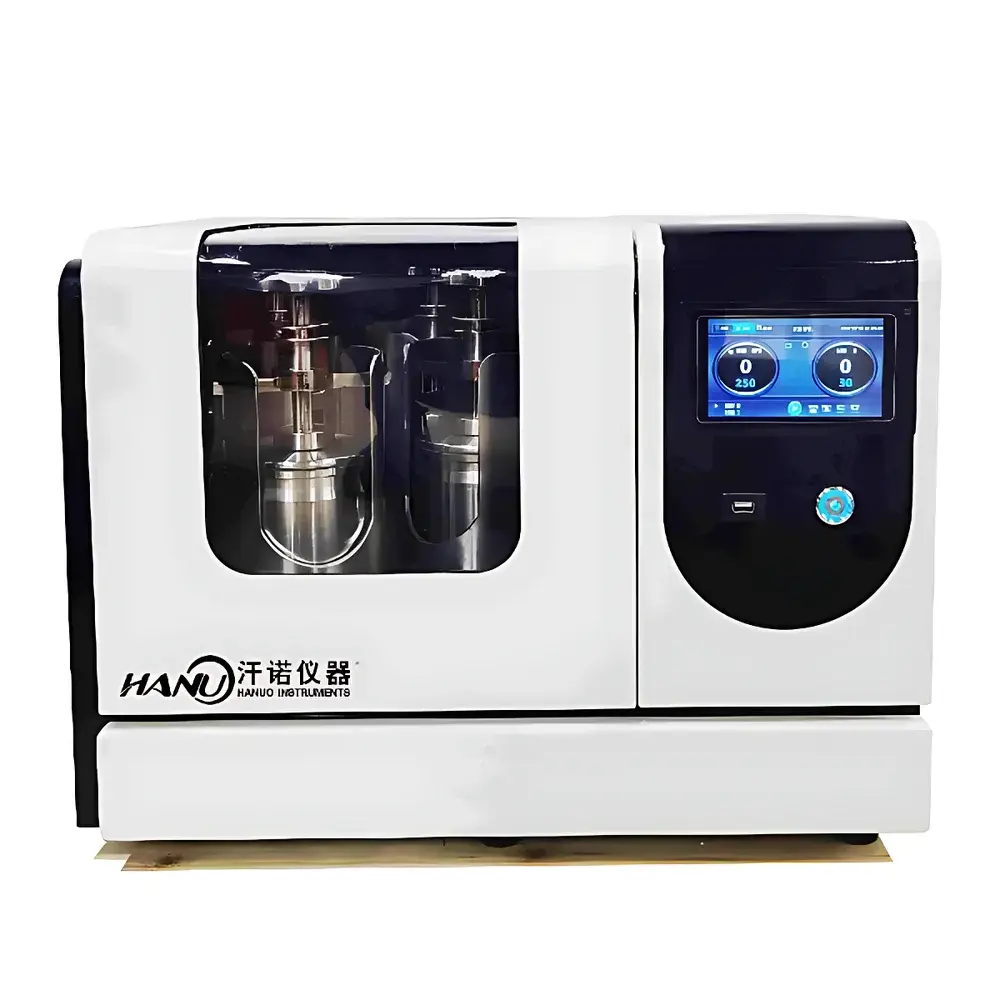
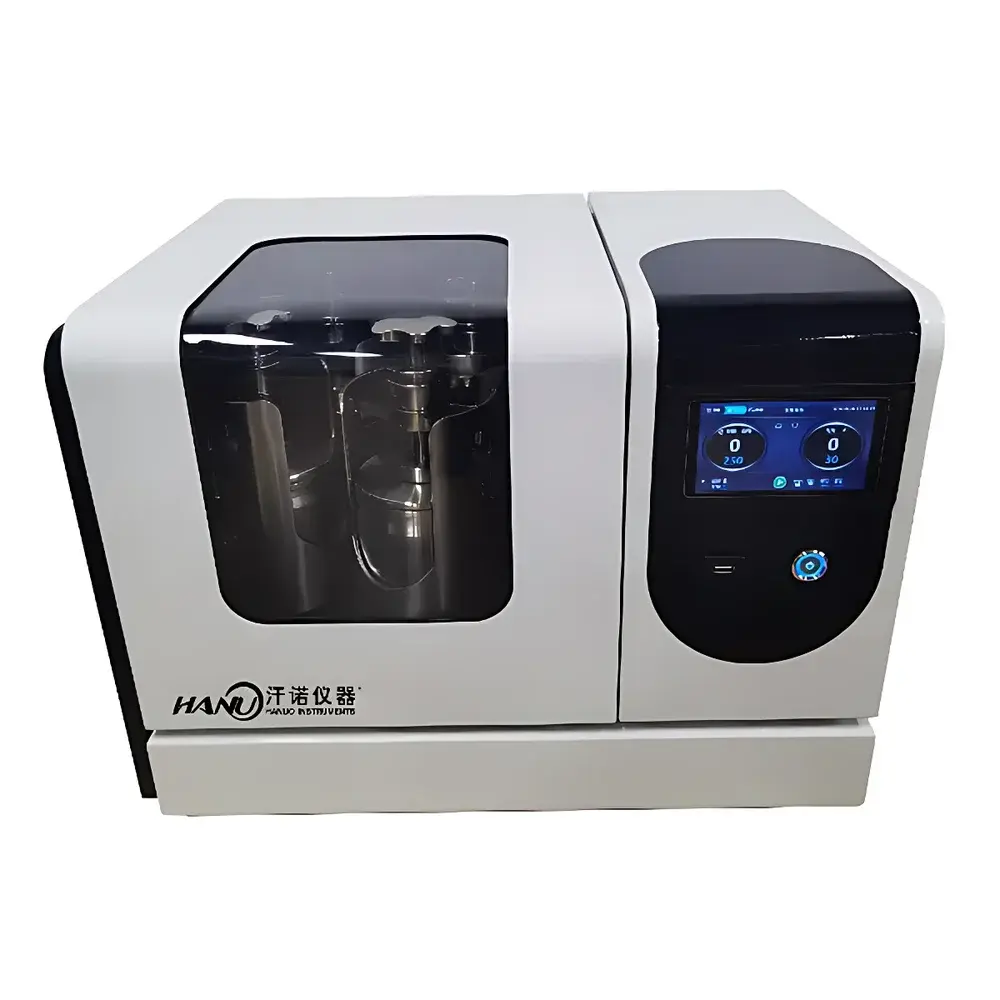
Hanuo Daxluot-Q500 Intelligent Planetary Ball Mill
| Brand | Hanuo |
|---|---|
| Origin | Shanghai, China |
| Model | Daxluot-Q500 |
| Sample Capacity | 4 × 500 mL jars |
| Feed Size | ≤10 mm (soil), ≤3 mm (other materials) |
| Final Particle Size | down to 0.1 µm |
| Batch Grinding Volume | up to 2000 mL total |
| Jar Rotation Speed | 100–800 rpm |
| Main Disc Rotation Speed | 50–400 rpm |
| Programmable Cycles | 30-segment multi-step protocol |
| Continuous Operation Time | 1–9999 min |
| Pause Interval | 1–999 min |
| Motor Power | 400 W |
| Drive Type | Electric lid actuation |
| Bidirectional Rotation | Yes |
| Emergency Stop | Yes |
| Jar Volume Options | 100–1500 mL |
| Jar & Media Materials | Stainless steel, agate, zirconia, alumina, tungsten carbide, polyurethane, PTFE, nylon |
| Media Diameter | 3/5/10/15/20 mm |
| Media Mass per Jar | 200–1000 g |
| Grinding Modes | Dry or wet grinding |
| Inert Gas Purging | Supported |
| Optional Cryogenic Cooling | Available |
Overview
The Hanuo Daxluot-Q500 Intelligent Planetary Ball Mill is an engineered solution for high-energy, high-reproducibility comminution of heterogeneous solid samples across research and quality control laboratories. Operating on the principle of planetary motion—where grinding jars rotate around their own axis while simultaneously revolving around a central sun wheel—the system generates centrifugal accelerations up to 40 g, enabling efficient size reduction through impact, shear, and friction forces. Designed for rigorous daily use, the Q500 delivers consistent sub-micron particle size distribution (down to 0.1 µm) without thermal runaway, making it suitable for heat-sensitive biological matrices (e.g., plant tissues, microbial cells, frozen animal organs) as well as inorganic compounds (e.g., ceramics, ores, construction materials). Its modular architecture supports inert atmosphere processing and optional cryogenic integration—critical for preserving labile biomolecules (DNA, RNA, proteins) during mechanical lysis.
Key Features
- Intelligent 30-segment programmable control: Enables precise replication of complex grinding protocols—including alternating speed ramps, directional reversal, timed pauses, and cooling intervals—to optimize cell disruption or crystallite refinement.
- Four independent 500 mL grinding stations: Allows parallel processing of up to four distinct samples under identical or individually configured conditions, improving throughput and inter-batch comparability.
- Electrically actuated safety lid with integrated position sensing: Ensures full mechanical interlock before operation initiation; prevents accidental jar ejection during high-speed rotation.
- Bi-directional rotational capability: Alternating clockwise/counterclockwise motion minimizes media stratification and improves homogeneity of energy transfer across the sample bed.
- Dual-speed independent control: Independent adjustment of main disc (50–400 rpm) and jar rotation (100–800 rpm) permits fine-tuning of kinetic energy input for brittle vs. ductile materials.
- Comprehensive material compatibility: Standardized mounting interfaces accommodate interchangeable jars and grinding media fabricated from stainless steel, agate, zirconia, alumina, tungsten carbide, PTFE, nylon, and polyurethane—ensuring chemical inertness and wear resistance across pH and solvent environments.
Sample Compatibility & Compliance
The Daxluot-Q500 accommodates a broad spectrum of sample types: hard and brittle minerals (e.g., quartz, feldspar), soft organic tissues (e.g., leaf, liver, yeast pellets), fibrous botanicals, hydrated soils, pharmaceutical excipients, and composite powders. Feed size limitations (≤10 mm for soil; ≤3 mm for all other materials) ensure uniform loading and prevent jar jamming. Final particle size distribution meets requirements for downstream analytical techniques including XRD, SEM-EDS, laser diffraction particle sizing, and elemental analysis (ICP-OES/MS). The instrument complies with IEC 61000-6-2 (EMC immunity) and IEC 61000-6-4 (EMC emission) standards. When operated with validated SOPs and audit-trail-enabled software (see below), it supports GLP/GMP-aligned workflows compliant with ISO/IEC 17025, USP , and FDA 21 CFR Part 11 data integrity principles.
Software & Data Management
The integrated 7-inch capacitive touch interface provides real-time monitoring of rotational speed, elapsed time, direction status, and thermal alerts. All operational parameters—including program sequence, speed profiles, pause intervals, and emergency stop events—are logged with timestamped entries and stored internally for ≥10,000 cycles. Optional USB export enables traceable data transfer to LIMS or ELN platforms. For regulated environments, the system supports external PC-based control via RS-232 or Ethernet (TCP/IP), enabling integration into centralized laboratory informatics systems with electronic signature, user access levels, and change-control logging—fully aligned with ALCOA+ data governance criteria.
Applications
- Biomolecular extraction: Mechanical lysis of Gram-positive bacteria, fungal spores, plant seeds, and frozen mammalian tissues for genomic DNA, total RNA, and native protein isolation—without enzymatic or chemical bias.
- Geochemical sample preparation: Homogenization of heterogeneous soil cores, sediment composites, and rock powders for multi-element analysis by ICP-MS or XRF.
- Pharmaceutical development: Milling of active pharmaceutical ingredients (APIs) and excipients to achieve controlled polymorphic transformation or amorphization prior to tablet formulation.
- Advanced materials synthesis: High-energy milling of precursor oxides for solid-state synthesis of battery cathodes (e.g., NMC, LFP), piezoelectric ceramics, and metal-organic frameworks (MOFs).
- Food safety testing: Rapid comminution of composite food matrices (e.g., spices, cereals, dairy powders) to ensure representative subsampling for mycotoxin or heavy metal screening.
FAQ
What is the maximum recommended continuous run time for unattended operation?
The system supports up to 9999 minutes (≈166 hours) of continuous operation per program cycle. However, for optimal thermal management and media longevity, we recommend limiting single-cycle duration to ≤120 minutes when processing exothermic or high-density samples.
Can the Daxluot-Q500 be used under argon or nitrogen atmosphere?
Yes—each grinding jar features a gas-tight sealing mechanism compatible with standard inert gas purging setups. Optional vacuum/nitrogen manifold kits are available for automated atmosphere exchange prior to sealing.
Is cryogenic grinding supported out-of-the-box?
Cryogenic operation requires external liquid nitrogen delivery and insulated jar housings. While the base unit does not include these components, its structural design and motor thermal rating permit seamless integration with third-party LN₂ cooling adapters.
How is calibration and performance verification performed?
Routine verification uses certified reference materials (e.g., NIST SRM 1979 for particle size, ASTM E290 for hardness correlation). Hanuo provides a documented verification protocol including speed accuracy checks (±0.5% tolerance), jar balance assessment, and torque consistency validation—traceable to national metrology institutes.
Does the instrument support remote diagnostics or firmware updates?
Firmware updates are performed via secure USB key with digital signature verification. Remote diagnostic access is available through optional Hanuo Connect module (Ethernet-enabled), supporting encrypted telemetry, predictive maintenance alerts, and technician-assisted troubleshooting under ISO 27001-compliant infrastructure.



