
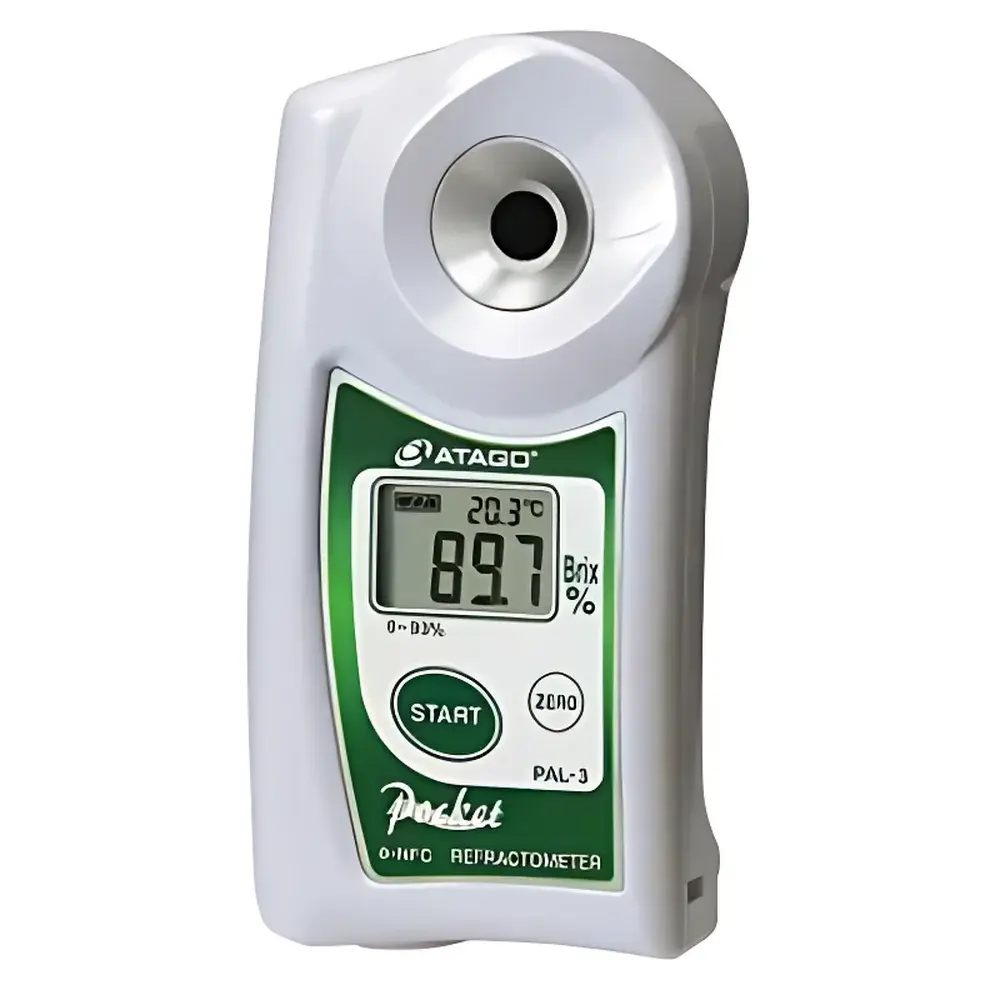
ATAGO PAL-3 Portable Digital Refractometer
| Brand | ATAGO |
|---|---|
| Model | PAL-3 |
| Origin | Japan |
| Instrument Type | Destructive Sampling Refractometer |
| Measurement Principle | Total Internal Reflection (TIR) via Abbe-type Prism |
| Brix Range | 0.0–93.0% |
| Resolution | 0.1% Brix / 0.1°C |
| Accuracy | ±0.1% Brix, ±1.0°C |
| Temperature Compensation | Automatic (10–100°C) |
| Measurement Time | ~3 seconds |
| Power Supply | 2 × AAA batteries |
| IP Rating | IP65 |
| Dimensions | 55(W) × 31(D) × 109(H) mm |
| Weight | 100 g (instrument only) |
Overview
The ATAGO PAL-3 Portable Digital Refractometer is an entry-level yet precision-engineered handheld optical instrument designed for rapid, field-deployable measurement of refractive index–derived concentration values—primarily expressed as Brix (% w/w sucrose equivalent). Operating on the principle of total internal reflection (TIR) at the prism-sample interface, the PAL-3 utilizes a high-stability Abbe-type sapphire-coated prism and temperature-compensated photodiode array to convert angular deviation of refracted light into digitally displayed Brix values. Its compact, ergonomic form factor and robust mechanical architecture make it suitable for routine quality control in production lines, R&D laboratories, agricultural grading stations, and third-party inspection environments where portability, repeatability, and regulatory traceability are essential. Unlike non-destructive near-infrared or ultrasonic alternatives, the PAL-3 requires a small liquid sample (typically 0.3 mL) placed directly onto the prism surface—a destructive sampling method that ensures direct optical contact and eliminates air-gap interference, thereby supporting higher metrological confidence under controlled ambient conditions.
Key Features
- Wide Brix measurement range from 0.0 to 93.0%, accommodating low-sugar beverages (e.g., sports drinks, flavored waters) through highly concentrated syrups, honey, and industrial glycol-based coolants.
- High-resolution digital display with 0.1% Brix and 0.1°C resolution, enabling detection of subtle formulation deviations during batch verification or process validation.
- Integrated automatic temperature compensation (ATC) across 10–100°C, compliant with ISO 2173:2003 and AOAC Official Method 932.12 for temperature-corrected Brix reporting.
- IP65-rated enclosure ensures resistance to dust ingress and low-pressure water jets—critical for operation in humid processing environments, wet cleaning zones, or outdoor harvest assessments.
- Three-second measurement cycle time supports high-throughput screening without thermal equilibration delays, minimizing operator fatigue during extended use.
- Calibration verification using distilled water (0.0% Brix) and standard sucrose solutions (e.g., 10.0%, 50.0%) aligns with internal calibration protocols required under GLP and ISO/IEC 17025-accredited facilities.
Sample Compatibility & Compliance
The PAL-3 is validated for aqueous solutions where solute refractivity correlates linearly with Brix—particularly sucrose, glucose, fructose, and common food-grade acids (e.g., citric, malic). It is routinely applied in juice concentration monitoring (apple, orange, tomato), dairy product standardization (sweetened condensed milk), fermentation endpoint estimation (wine must, kombucha), and industrial fluid management (coolant concentration in CNC machining, antifreeze dilution ratios in automotive service). While not intended for strongly acidic (pH 10,000 mPa·s), or suspended-particle-laden samples without filtration, its prism surface tolerates brief exposure to ethanol, propylene glycol, and mild alkaline cleaners when wiped post-use. The instrument conforms to IEC 61010-1 safety standards for portable electrical equipment and meets CE marking requirements for electromagnetic compatibility (EMC Directive 2014/30/EU).
Software & Data Management
The PAL-3 operates as a standalone, battery-powered device with no embedded data logging or Bluetooth connectivity. However, its consistent output format and stable analog-to-digital conversion support manual transcription into LIMS or Excel-based QC dashboards. For facilities requiring audit-ready records, users commonly pair the PAL-3 with external barcode scanners and dedicated QC tablets running validated spreadsheet templates—enabling timestamped entry of sample ID, operator, ambient temperature, and measured Brix. This workflow satisfies basic FDA 21 CFR Part 11 compliance when combined with electronic signature controls and change logs. ATAGO provides traceable NIST-traceable calibration certificates (optional purchase) and maintains full technical documentation—including uncertainty budgets per ISO/IEC 17025 Annex A.3—for integration into laboratory quality management systems.
Applications
- Food & Beverage: Real-time Brix verification during fruit juice evaporation, jam cooking, soft drink syrup blending, and dairy powder reconstitution.
- Agriculture: Field-side assessment of grape, mango, or citrus maturity prior to harvest; post-harvest sorting of tomatoes and apples by soluble solids content.
- Pharmaceutical Excipients: Monitoring sucrose or dextrose concentration in oral rehydration solutions and syrup-based pediatric formulations.
- Automotive & Metalworking: Verification of ethylene glycol/water ratios in engine coolant and triethanolamine-based cutting fluid concentrations.
- Academic Teaching Labs: Demonstrating refractive index principles, calibration curve construction, and temperature dependence of optical density in physical chemistry curricula.
FAQ
Is the PAL-3 suitable for measuring alcohol content?
No—the PAL-3 reports Brix only and does not compensate for ethanol’s negative refractive contribution. For alcoholic beverages, use ATAGO’s RX-5000α or dedicated alcohol refractometers calibrated to % v/v.
Can I measure viscous samples like honey or molasses directly?
Yes, but ensure complete prism coverage and allow 1–2 seconds for surface leveling. Wipe thoroughly after each measurement to prevent crystallization-induced drift.
Does the PAL-3 require annual recalibration?
While no mandatory schedule exists, ATAGO recommends verification against certified standards before each shift in regulated environments—and full recalibration every 12 months by an accredited service center.
What is the uncertainty budget for Brix measurements at 20°C?
Per ATAGO’s Type A evaluation (n=20, k=2), expanded uncertainty is ±0.15% Brix, including repeatability, temperature sensor drift, and prism aging effects.
How does IP65 rating impact daily maintenance?
The sealed housing permits rinsing under tap water (not submersion) and disinfection with 70% isopropyl alcohol—ideal for shared-use scenarios in multi-shift production settings.




