
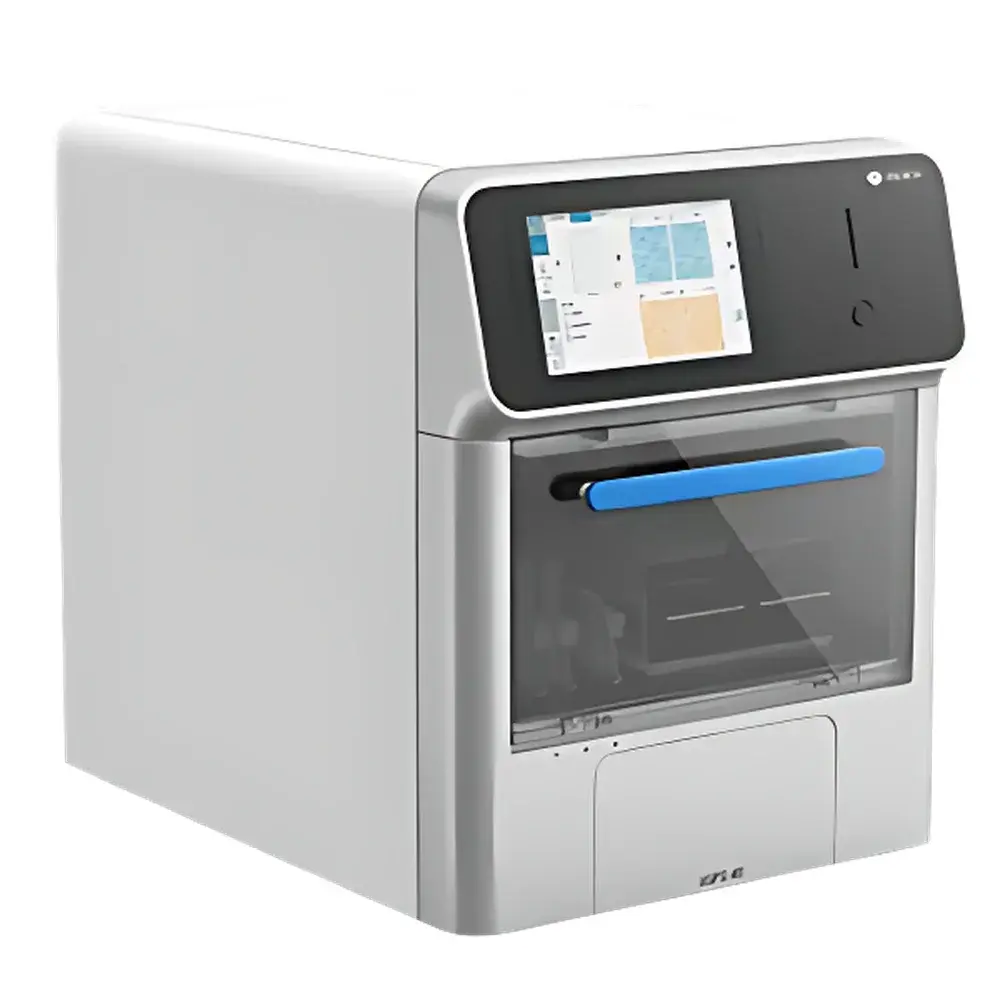
Bioer ASPS-48 Fully Automated Sample Aliquoting Workstation
| Brand | Bioer |
|---|---|
| Origin | Zhejiang, China |
| Model | ASPS-48 |
| Instrument Type | Benchtop |
| Sample Throughput | 48 samples per run |
| Sample Tube Compatibility | 1 mL, 3 mL, 5 mL, and 10 mL viral transport tubes |
| Pipetting Format Support | 8×12 skirted or unskirted 0.1 mL / 0.2 mL PCR strips and 96-well PCR plates |
| Dimensions (L×W×H) | 540 × 670 × 742 mm |
| Weight | 80 kg |
| Power Supply | AC 100–240 V, 50/60 Hz, 300 VA |
| Interface | Ethernet port, USB 2.0 ports |
| Functional Modules | Automated tube cap opening/closing, aliquoting, and reaction setup |
Overview
The Bioer ASPS-48 Fully Automated Sample Aliquoting Workstation is a benchtop laboratory automation platform engineered for nucleic acid pre-analytical processing in high-throughput diagnostic and research environments. Designed around a dual-axis robotic arm architecture with integrated cap manipulation, positive-displacement pipetting, and real-time positional feedback, the ASPS-48 executes standardized sample handling workflows—including tube uncapping, volume-controlled transfer, and master mix dispensing—without manual intervention. Its operation adheres to core principles of liquid handling reproducibility, mechanical repeatability, and biosafety containment. The system is intended for use in molecular diagnostics laboratories, public health testing centers, and clinical research facilities where consistent, auditable, and low-risk sample preparation is required prior to downstream applications such as RT-qPCR, NGS library preparation, or extraction.
Key Features
- Automated cap handling mechanism with torque-sensing actuation ensures reliable opening and recapping across multiple tube formats (1–10 mL viral transport media tubes), minimizing operator exposure and cross-contamination risk.
- High-precision positive-displacement pipetting system calibrated for volumes ranging from 10 µL to 1000 µL, supporting both single-channel and multi-channel dispensing modes with CV ≤ 3% at 100 µL.
- Integrated biosafety features include a downward-facing UV-C lamp (254 nm) for surface decontamination between runs, a HEPA-filtered laminar airflow hood (ISO Class 5 compliant), and a liquid droplet capture tray beneath the pipetting zone.
- Compact footprint (540 × 670 × 742 mm) enables deployment in standard BSL-2 cabinets or under laminar flow hoods without requiring dedicated robotics infrastructure.
- Modular workflow programming via intuitive touchscreen interface; preloaded protocols for common assay configurations (e.g., 5 µL RNA input + 15 µL master mix into 96-well plates) are editable and version-controlled.
Sample Compatibility & Compliance
The ASPS-48 accommodates conical-bottom and round-bottom tubes with standardized screw-cap geometries, including but not limited to BD Vacutainer® VT tubes, COPAN eSwab™, and domestically certified viral transport media containers. It supports direct integration with commercially available RNA/DNA extraction kits and PCR-ready consumables, including 0.1 mL and 0.2 mL skirted/unskirted 8×12 PCR strips and full 96-well plates meeting ANSI/SBS dimensional standards. The system complies with IEC 61000-6-2 (EMC immunity) and IEC 61000-6-3 (EMC emissions) requirements. While not FDA-cleared as an IVD device, its operational logs, user access controls, and protocol execution records support alignment with GLP and GMP documentation practices, including audit trail generation for ISO 15189-accredited laboratories.
Software & Data Management
The onboard control software provides role-based user authentication (administrator, operator, technician), encrypted local storage of run logs (including timestamped cap status, pipette calibration history, and error codes), and export capability in CSV and PDF formats. Network connectivity enables remote monitoring via secure HTTP(S) API endpoints compatible with LIMS integration (e.g., STARLIMS, LabVantage). All software updates are delivered through signed firmware packages validated against SHA-256 checksums. Audit trails meet ALCOA+ criteria—attributable, legible, contemporaneous, original, accurate—and support retrospective review during regulatory inspections under ISO/IEC 17025 or CAP accreditation frameworks.
Applications
- High-volume SARS-CoV-2 and influenza A/B screening workflows requiring consistent input volume normalization across batches.
- Pre-extraction sample partitioning for parallel processing on automated nucleic acid extractors (e.g., QIAGEN QIAcube HT, Thermo KingFisher Flex).
- Standardized reaction setup for multiplex RT-qPCR panels targeting antimicrobial resistance genes or respiratory pathogen panels.
- Biobanking operations involving aliquot archiving of residual clinical specimens into cryovial arrays for longitudinal studies.
- Research labs implementing FAIR data principles by linking instrument-generated metadata (sample ID, timepoint, operator) directly to sequencing run manifests.
FAQ
What tube types are supported for automated uncapping?
The ASPS-48 supports standard-threaded viral transport tubes with outer diameters of 12.5–16.5 mm and heights up to 110 mm, including 1 mL, 3 mL, 5 mL, and 10 mL formats commonly used in national surveillance programs.
Can the system be validated for regulated environments?
Yes—users may perform IQ/OQ/PQ qualification using Bioer-provided test protocols and traceable calibration tools; system suitability checks include cap engagement success rate, pipette accuracy verification per ISO 8655-6, and UV irradiance mapping reports.
Is remote software update functionality available?
Firmware updates are distributed via encrypted USB media or authenticated HTTPS download; no automatic over-the-air updates are enabled by default to maintain configuration stability in production settings.
Does the workstation require external exhaust or venting?
No—the internal HEPA filtration and UV decontamination cycle eliminate the need for ducted ventilation; however, placement within a certified biosafety cabinet is recommended when handling Category B infectious materials.
How is user training delivered?
Bioer offers on-site installation qualification and operator certification courses covering maintenance routines, error troubleshooting, and protocol customization—delivered by ISO 9001-certified field application specialists.





