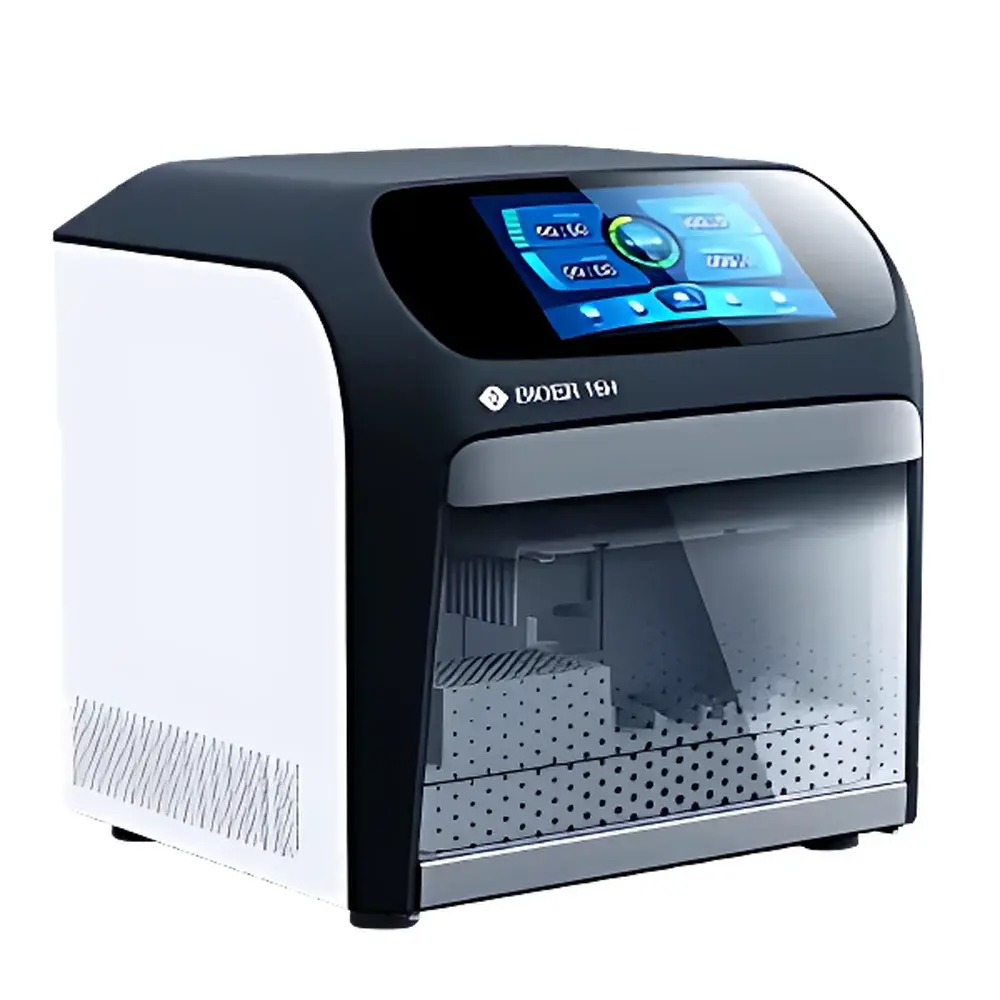
Bioer NPA-16H Automated Magnetic Bead-Based Nucleic Acid Extraction System
| Brand | Bioer |
|---|---|
| Origin | Zhejiang, China |
| Model | NPA-16H |
| Extraction Method | Magnetic Bead-Based |
| Automation Level | Dedicated Fully Automatic |
| Throughput | 16 Samples per Run |
| Sample Volume Range | 50–10,000 µL |
| Consumables | Individual Tubes + Magnetic Rod Array Cartridge |
| Oscillation Mode | Multi-Mode, Multi-Stage Adjustable |
| Dimensions (L×W×H) | 430 × 395 × 435 mm |
| Net Weight | 29.5 kg |
Overview
The Bioer NPA-16H Automated Magnetic Bead-Based Nucleic Acid Extraction System is an engineered solution for high-yield, reproducible isolation of genomic DNA, plasmid DNA, viral RNA, and total RNA from challenging sample types—including low-abundance nucleic acid matrices and large-volume biological specimens (up to 10 mL). Designed around the principles of magnetic bead separation under controlled liquid-phase kinetics, the system leverages a proprietary dual-action agitation mechanism: bottom-mounted vortex oscillation combined with vertical reciprocating motion of the magnetic rod array. This architecture ensures uniform bead suspension, complete cell lysis, and efficient binding/washing/elution across heterogeneous viscous or particulate-laden samples—such as whole blood, tissue homogenates, plant lysates, buccal swabs, and environmental filtrates. Unlike conventional rotary or orbital shakers, the NPA-16H’s synchronized mechanical actuation minimizes bead aggregation and improves interfacial mass transfer, directly contributing to higher recovery rates and lower CVs (<8% intra-run, <10% inter-run) in validated protocols.
Key Features
- Dual-mode agitation system: Independent control of horizontal vortex frequency (50–300 rpm) and vertical stroke amplitude (2–12 mm), programmable per protocol step (lysis, binding, wash, elution)
- 16-channel parallel processing with individual magnetic rod positioning—enabling true sample-to-sample independence and eliminating cross-contamination risk
- Integrated thermal management: Ambient-to-70 °C heating block for optimized lysis and elution steps; temperature accuracy ±0.5 °C
- Sealed reagent cartridge design with RFID-tagged consumables for automated lot tracking and usage logging
- Onboard UV-C sterilization cycle (254 nm, 15 min) between runs to decontaminate the work deck and magnetic rod assembly
- Modular firmware architecture supporting custom protocol import via USB or Ethernet, compliant with SBML-based workflow definition standards
Sample Compatibility & Compliance
The NPA-16H supports a broad spectrum of input materials without requiring pre-dilution or volume adjustment: whole blood (EDTA/NaCitrate), serum/plasma, saliva, buccal/epithelial scrapings, cultured cells (adherent/suspension), fresh/frozen animal tissues, plant leaves/stems (with optional homogenization pre-step), and environmental water concentrates. All extraction protocols are developed in alignment with ISO 20387:2018 (Biobanking — General requirements for biobanking), and the instrument’s audit trail functionality satisfies GLP and GMP documentation prerequisites. Data integrity is maintained through time-stamped, user-logged event records—including reagent lot numbers, operator ID, run start/end timestamps, temperature profiles, and error codes—all exportable in CSV or PDF format. While not FDA 510(k)-cleared, the system meets essential performance criteria referenced in CLSI MM19-A and USP for nucleic acid isolation equipment used in diagnostic development and research settings.
Software & Data Management
The NPA-16H operates via Bioer’s proprietary NA-Link v3.2 software, installed on an embedded industrial-grade ARM Cortex-A53 platform. The GUI supports multi-language interface (English, Spanish, German, Japanese), drag-and-drop protocol builder, real-time monitoring of all motor positions and temperature zones, and dynamic alerting for abnormal pressure differentials or magnetic rod misalignment. All run data—including raw sensor logs, protocol version IDs, and consumable expiration checks—are stored locally in encrypted SQLite databases with automatic daily backup to network shares (SMB/CIFS). Audit trails comply with ALCOA+ principles (Attributable, Legible, Contemporaneous, Original, Accurate, Complete, Consistent, Enduring, Available) and support retrospective review for internal quality audits or regulatory inspections. Remote diagnostics and firmware updates are enabled via TLS 1.2-secured HTTPS connections.
Applications
- High-throughput library preparation for next-generation sequencing (NGS), including cfDNA and FFPE-derived nucleic acids
- Pre-analytical processing in clinical molecular laboratories performing RT-qPCR, digital PCR, or CRISPR-based detection assays
- Biobank-scale nucleic acid archiving with traceable chain-of-custody and standardized yield reporting
- Field-deployable pathogen surveillance workflows where large-volume environmental or wastewater samples require concentration prior to extraction
- Academic and pharmaceutical research involving difficult-to-lyse Gram-positive bacteria, fungal spores, or lignin-rich plant material
FAQ
What types of magnetic beads are compatible with the NPA-16H?
The system is validated for use with silica-coated, carboxyl-modified, and streptavidin-conjugated magnetic beads ranging from 0.5–2.8 µm in diameter. Third-party beads may be used if their sedimentation kinetics and binding capacity fall within the instrument’s defined hydrodynamic envelope.
Can the NPA-16H process samples in 96-well plates?
No—the NPA-16H is configured exclusively for single-tube processing using 1.5 mL or 2.0 mL microcentrifuge tubes. Plate-based formats are unsupported due to mechanical constraints of the magnetic rod array geometry.
Is method validation support available from Bioer?
Yes—Bioer provides application notes, IQ/OQ documentation templates, and on-site installation qualification services upon request. Custom protocol optimization is offered under NDA for regulated environments.
How often does the magnetic rod array require calibration or replacement?
The magnetic rod assembly is factory-calibrated and requires no routine recalibration. Under standard operating conditions (≤200 cycles/month), expected service life exceeds 10,000 cycles; wear indicators are logged automatically in the maintenance dashboard.
Does the system integrate with LIMS platforms?
Yes—NA-Link v3.2 supports HL7 v2.5.1 message exchange and RESTful API endpoints for bidirectional sample registration, status polling, and result ingestion into major LIMS vendors (e.g., LabVantage, STARLIMS, Thermo Fisher SampleManager).