
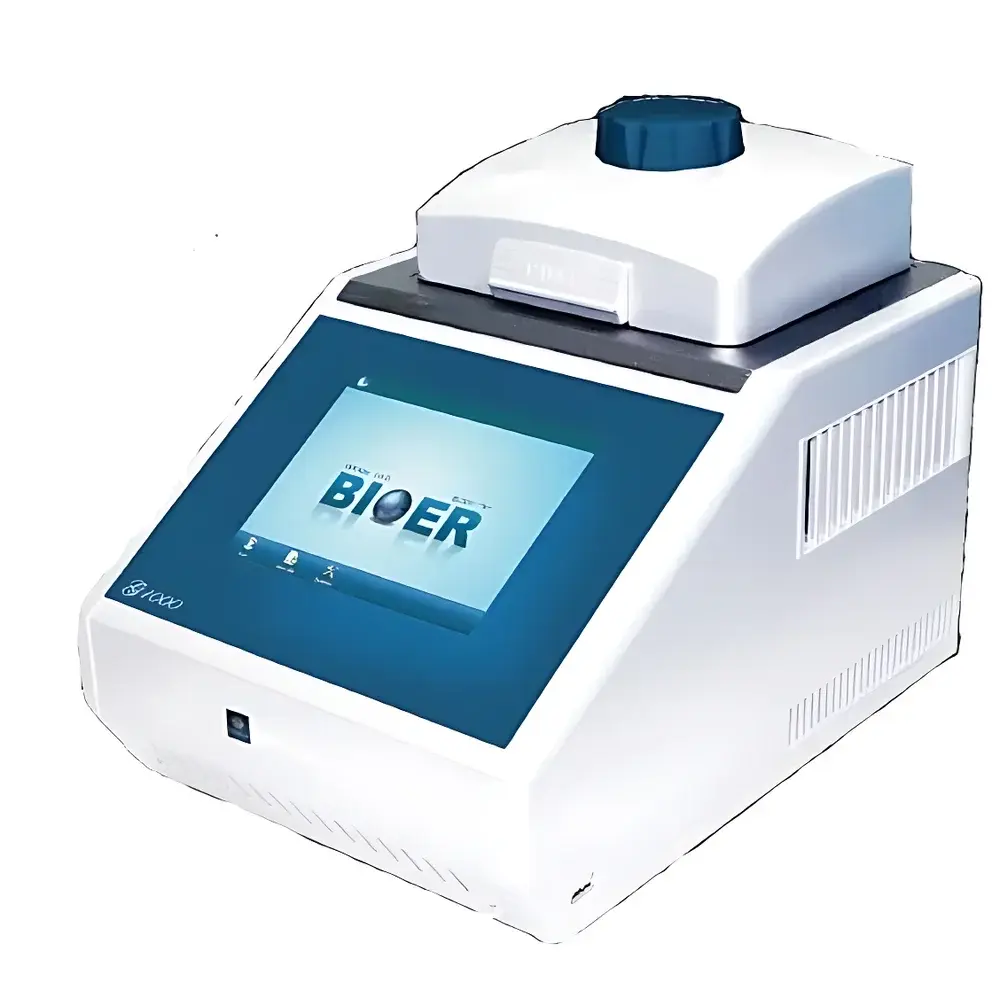
Bioer G-1000 Gradient PCR Thermal Cycler
| Brand | Bioer |
|---|---|
| Origin | Zhejiang, China |
| Manufacturer Type | Authorized Distributor |
| Product Category | Domestic |
| Model | TC-96/G/H(b)B1 |
| Instrument Type | Gradient PCR Thermal Cycler |
| Sample Capacity | 96-well format |
| Heating Rate | ≥5.5 °C/s |
| Temperature Accuracy | ≤±0.1 °C at 55 °C |
| Well-to-Well Temperature Uniformity | ≤±0.2 °C |
| Gradient Range | Up to 30 °C across block |
| Thermal Lid Temperature & Pressure | Adjustable |
| Control Interface | USB-based multi-unit networking (up to 30 units per PC) |
| Data Storage | Internal memory + USB flash drive support |
| Safety Features | Power-loss recovery, file encryption, Ferrotec Peltier modules |
Overview
The Bioer G-1000 Gradient PCR Thermal Cycler is a high-performance, benchtop thermal cycler engineered for precision nucleic acid amplification in academic research laboratories, clinical diagnostics facilities, and quality control environments. Built upon the proven architecture of Bioer’s Lifetouch series, the G-1000 integrates advanced thermoelectric (Peltier) heating and cooling technology with proprietary Thermal Accuracy Stabilization (TAS) engineering to deliver exceptional temperature uniformity and reproducibility across all 96 wells. Its core operational principle relies on rapid, symmetric thermal cycling—achieving ≥5.5 °C/s heating rates—while maintaining strict thermal fidelity under dynamic gradient conditions. Designed for compliance with routine molecular biology workflows, the instrument supports standard PCR, touchdown PCR, hot-start protocols, and critical primer optimization via its programmable 30 °C gradient span. The system operates within a validated temperature range of 4–105 °C and meets fundamental performance benchmarks aligned with ISO/IEC 17025–recommended verification practices for thermal cyclers.
Key Features
- 96-well aluminum thermal block with TAS-enabled heat distribution to eliminate edge-effect-induced well-to-well variation (≤±0.2 °C uniformity)
- Adjustable thermal lid: independently controllable temperature (30–110 °C) and mechanical pressure settings to prevent evaporation across diverse tube/tube-strip formats
- High-resolution graphical LCD display with dual-mode interface (text + real-time temperature/time curve visualization)
- Tactile membrane keypad with industrial-grade micro-switch actuation—rated for >1 million cycles, ensuring long-term operational reliability
- USB-host connectivity enabling centralized control of up to 30 G-1000 units from a single Windows-based workstation
- Ferrotec第三代 Peltier modules integrated with closed-loop PID temperature regulation for sustained accuracy (≤±0.1 °C at 55 °C)
- Onboard non-volatile memory (≥1,000 program storage slots) plus plug-and-play USB data import/export capability
Sample Compatibility & Compliance
The G-1000 accommodates standard 0.2 mL thin-wall PCR tubes, 8-well strips, and full 96-well plates—including skirted, semi-skirted, and unskirted variants—without adapter requirements. Its adjustable thermal lid pressure mechanism ensures consistent contact force across varying plate heights and material rigidity (e.g., polypropylene vs. cyclic olefin copolymer). From a regulatory standpoint, the instrument supports GLP-compliant workflow documentation when used with validated PC-based control software. While not pre-certified to IEC 61010-1 or FDA 21 CFR Part 11 out-of-the-box, its architecture permits integration into audit-ready environments through external logging, user access controls, and encrypted file export—features routinely leveraged in ISO 15189-accredited clinical labs and pharmaceutical QC units performing USP nucleic acid assay validation.
Software & Data Management
The G-1000 operates natively via its embedded firmware but is fully interoperable with Bioer’s LifePro Control Suite (Windows 10/11 compatible), which provides protocol scheduling, remote monitoring, version-controlled method archiving, and CSV-formatted run report generation. All user-created programs can be password-protected and digitally signed to enforce traceability. The USB interface supports direct firmware updates and batch parameter synchronization across networked units—critical for harmonized operation in high-throughput core facilities. Audit trail functionality—including timestamped operator ID, parameter changes, and thermal profile execution logs—is available when configured with optional server-side logging modules compliant with ALCOA+ data integrity principles.
Applications
- Gene expression analysis via quantitative real-time PCR (qPCR) setup and optimization
- Genotyping assays requiring stringent annealing temperature discrimination (e.g., SNP detection)
- Library preparation for next-generation sequencing (NGS), including adapter ligation and index amplification
- Viral load quantification and pathogen screening in public health and veterinary diagnostic labs
- Validation of CRISPR-Cas editing efficiency through T7E1 or RFLP-based amplicon analysis
- Educational training in molecular biology techniques where robustness and intuitive operation are essential
FAQ
Does the G-1000 support ramp rate customization per segment?
Yes—users may define distinct heating and cooling rates (0.1–5.5 °C/s) for each step in multi-stage protocols.
Is the thermal block interchangeable with other Bioer models?
No—the G-1000 uses a proprietary 96-well block optimized for TAS performance and is not mechanically or electrically compatible with Lifetouch or TC series blocks.
Can gradient profiles be saved and recalled independently of main protocols?
Yes—gradient parameters are stored as integral components of each protocol and can be duplicated, renamed, and exported via USB without affecting base cycling conditions.
What safety certifications does the instrument carry?
It complies with GB 4793.1–2019 (Chinese equivalent of IEC 61010-1) and bears CCC mark; CE marking is pending EU representative registration.
How is data integrity ensured during power interruption?
The system implements automatic resume-on-power restoration with full state recovery—including cycle count, elapsed time, and current temperature—plus write-protected internal EEPROM for critical configuration retention.
Related Products



