
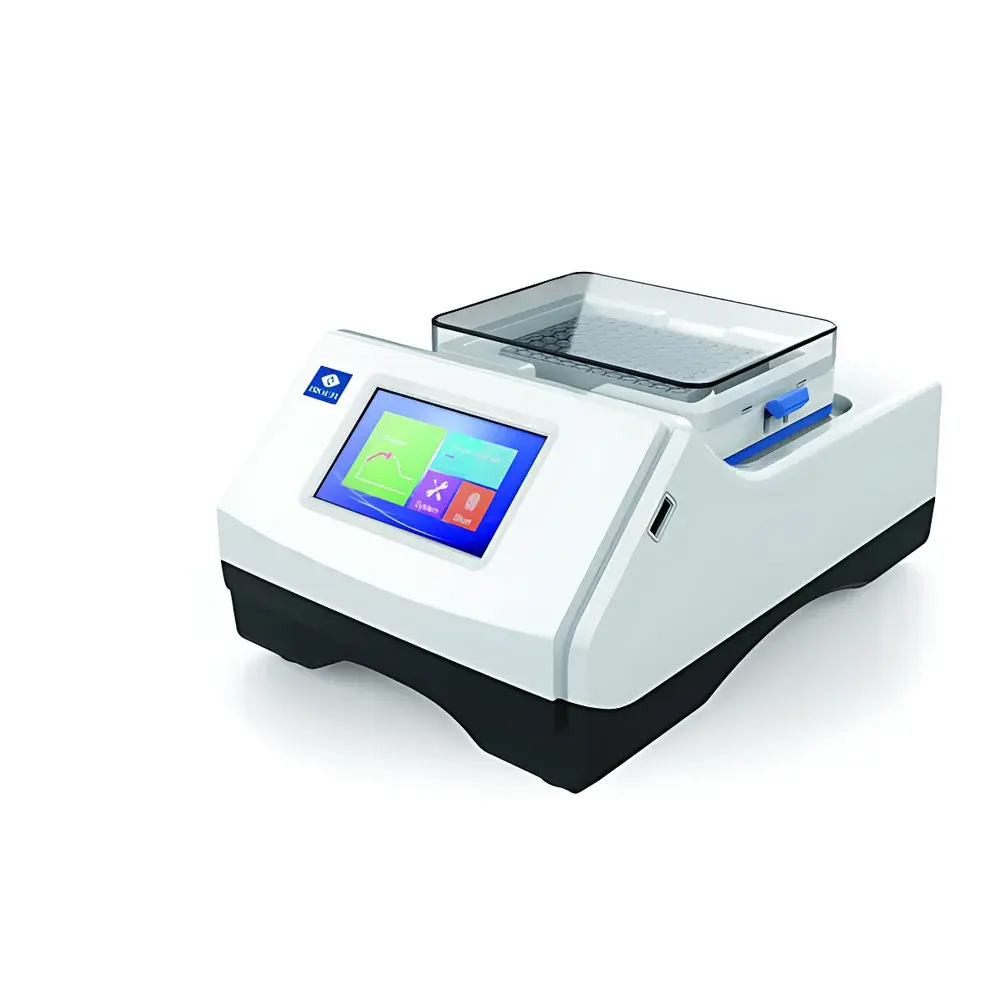
Bioer MB-202 Thermo Shaker Metal Bath
| Brand | Bioer |
|---|---|
| Origin | Zhejiang, China |
| Model | MB-202 |
| Temperature Range | 0–100 °C |
| Temperature Accuracy | ≤ ±0.5 °C |
| Heating Time | ≤ 12 min (varies by block) |
| Oscillation Frequency | 300–3000 rpm |
| Oscillation Amplitude | 3 mm |
| Timer Range | 1 s – 99 h 59 min |
| Power Input | AC 100–240 V, 50/60 Hz, 180 W |
| Dimensions (L×W×H) | 310 × 210 × 145 mm |
| Net Weight | 5.9 kg |
| Block Recognition | Auto-detect (9 standard blocks included) |
Overview
The Bioer MB-202 Thermo Shaker Metal Bath is an integrated temperature-controlled orbital shaker engineered for precision thermal management and consistent mechanical agitation in life science and analytical chemistry workflows. Unlike conventional dry baths or water baths, the MB-202 employs a solid aluminum heating block architecture combined with a brushless DC motor-driven oscillation system to deliver simultaneous, independent control of temperature and mixing—enabling reproducible incubation, enzymatic reactions, cell lysis, DNA/RNA hybridization, and sample homogenization under tightly regulated conditions. Its design follows fundamental principles of conductive heat transfer and controlled harmonic oscillation, ensuring minimal thermal gradient across the block surface (< ±0.3 °C uniformity at 37 °C) and stable rotational dynamics across the full 300–3000 rpm range. The unit operates without liquid media, eliminating contamination risks, evaporation artifacts, and maintenance overhead associated with water-based systems—making it particularly suitable for low-volume microtiter formats and sensitive biomolecular assays.
Key Features
- High-performance oscillation: Precisely adjustable speed from 300 to 3000 rpm with < ±2% speed stability at setpoint, supporting both gentle mixing and vigorous suspension of viscous or particulate samples.
- Intelligent block recognition: Built-in thermal and mechanical sensors auto-identify one of nine standardized interchangeable aluminum blocks upon insertion—no manual configuration required; eliminates setup errors and accelerates workflow transitions.
- Touchscreen interface with multi-program capability: 4.3-inch capacitive LCD supports creation, storage, and recall of up to 10 independent protocols—including ramp-to-target temperature, timed oscillation sequences, and dual-stage incubation-mixing profiles.
- Dual-mode operation: Combines continuous orbital shaking with instant “tap-to-shake” functionality (press-and-hold touch gesture activates short-duration high-speed pulse mixing), enhancing flexibility during protocol optimization.
- Safety-engineered thermal protection: Independent overtemperature cutoff circuit interrupts power if internal block temperature exceeds 110 °C; automatic reset occurs only after passive cooling to safe threshold, complying with IEC 61010-1 Class II safety requirements.
- Compact footprint and energy-efficient operation: 180 W maximum draw and optimized thermal insulation reduce standby heat loss—validated for uninterrupted 24/7 operation in shared lab environments.
Sample Compatibility & Compliance
The MB-202 accommodates a broad spectrum of common laboratory consumables via its modular block system, including 384-well microplates (A), skirted 96-well PCR plates (B), 0.2–50 mL tubes (C–H), and hybrid configurations (J). All blocks are CNC-machined from high-purity anodized aluminum to ensure consistent thermal conductivity and chemical resistance to ethanol, isopropanol, and dilute acids/bases. The instrument meets CE marking requirements and conforms to ISO/IEC 17025-relevant environmental controls for method validation. While not certified for GMP production use, its programmable audit trail (via optional USB data export) supports GLP-compliant documentation for QC testing, stability studies, and assay development in R&D labs.
Software & Data Management
The MB-202 operates as a standalone instrument with embedded firmware—no PC dependency required for routine use. All parameters (temperature, rpm, time, block ID) are logged internally with timestamping for each run. Through the USB-C port, users may export CSV-formatted session logs for traceability and integration into LIMS or ELN platforms. Firmware updates are delivered via encrypted binary files to maintain integrity; version history and calibration status are accessible directly on the touchscreen. The interface supports multilingual display (English, German, French, Spanish, Japanese) and adheres to WCAG 2.1 AA contrast standards for accessibility.
Applications
- PCR/qPCR pre-amplification setup: Uniform heating and gentle mixing of master mixes prior to thermocycling.
- Enzyme kinetics assays: Controlled incubation of substrate-enzyme solutions at defined temperatures with continuous agitation to minimize diffusion-limited artifacts.
- Protein solubilization and refolding: Gradual thermal ramping combined with intermittent shaking to prevent aggregation during denaturant dilution.
- Microbial culture maintenance: Short-term sub-culturing of bacterial or yeast suspensions in microcentrifuge tubes under aerobic mixing conditions.
- Antibody labeling and conjugation: Mixing of reactive dyes with immunoglobulins at 4 °C or room temperature without vortex-induced shear stress.
- Environmental sample preparation: Homogenization of soil extracts or wastewater filtrates prior to filtration or instrumental analysis.
FAQ
Does the MB-202 support external temperature probes for sample-core monitoring?
No—the system relies on integrated PT100 sensor feedback from the aluminum block surface. For direct sample temperature verification, users should employ calibrated immersion probes and apply correction offsets based on block-to-sample thermal lag (typically 0.5–1.2 °C under static conditions).
Can third-party blocks be used with the MB-202?
Only Bioer-certified blocks with embedded RFID tags or mechanical keying patterns are recognized. Non-OEM blocks will not trigger auto-configuration and may compromise thermal performance or safety interlocks.
Is the timer resolution truly 1 second across the full range?
Yes—timer increments are resolved to 1 second for durations ≤ 10 minutes, and to 1 minute beyond 10 minutes, maintaining ISO 8601-compliant time formatting in all exported logs.
What is the expected service life of the oscillation motor under continuous 3000 rpm operation?
Rated for ≥ 20,000 hours at nominal load (3000 rpm, 37 °C ambient); brushless design eliminates commutator wear, and thermal management ensures sustained torque output without derating.
How does the MB-202 handle power interruptions?
Upon AC loss, the unit powers down completely and retains last-run settings in non-volatile memory. After restoration, it defaults to standby mode—not auto-resume—to prevent unintended activation during unattended operation.



