
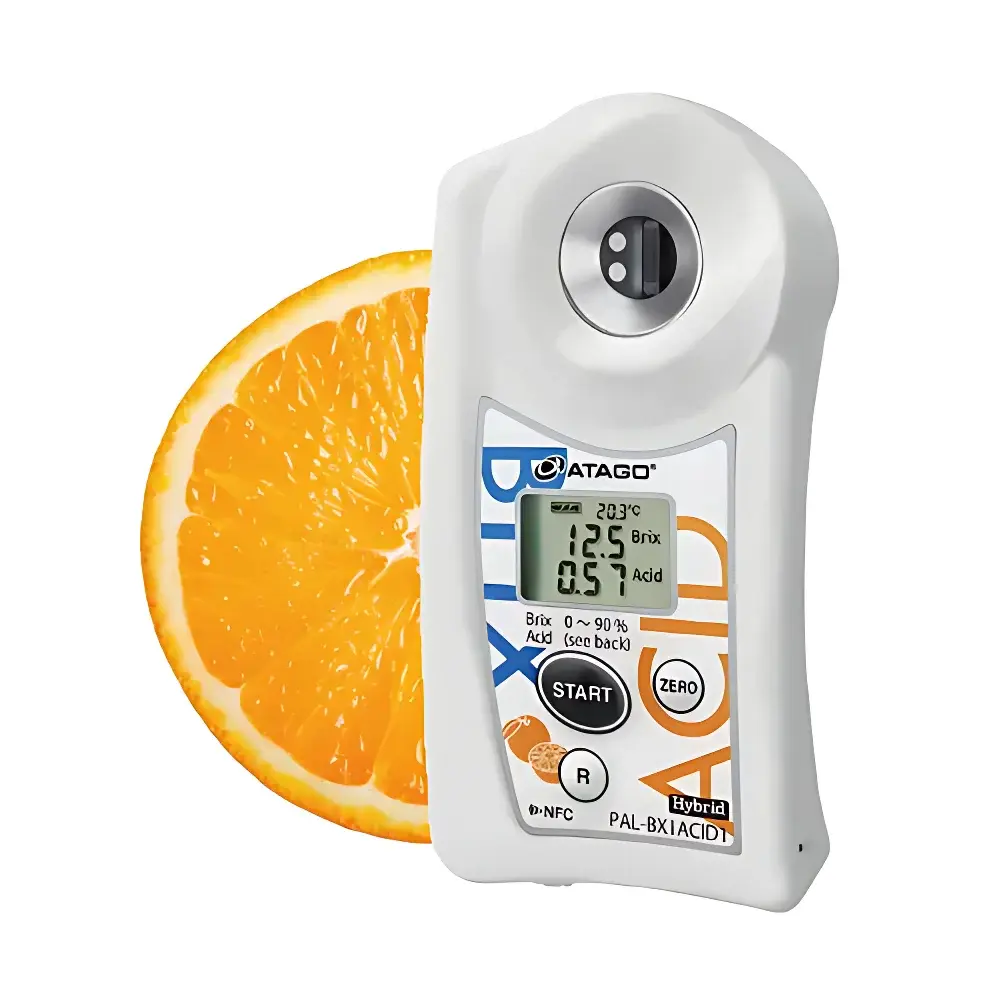
ATAGO PAL-BX/ACID 1 Citrus Refractometer & Acidimeter
| Brand | ATAGO |
|---|---|
| Origin | Japan |
| Model | PAL-BX/ACID 1 |
| Instrument Type | Destructive Sampling |
| Measurement Range | Brix 0.0–90.0%, Acid (as citric acid) Low Range 0.10–4.00%, High Range 2.50–8.80% |
| Accuracy | Brix ±0.2%, Acid ±0.10% (0.10–1.00%), ±10% rel. (1.01–8.80%), Temp ±1°C |
| Resolution | Brix 0.1%, Acid 0.01% (0.00–9.99%), 0.1% (≥10.0%), Sugar-Acid Ratio 0.01 (0.00–9.99), 0.1 (10.0–99.9), 1 (≥100) |
| ATC Range | 10–40°C |
| Power | 2×AAA alkaline batteries |
| IP Rating | IP65 |
| Dimensions | 5.5 × 3.1 × 10.9 cm |
| Weight | 100 g (instrument only) |
Overview
The ATAGO PAL-BX/ACID 1 is a handheld, dual-parameter optical instrument engineered for rapid, on-site quantification of total soluble solids (TSS) and titratable acidity in citrus fruits and derivatives. Unlike conventional benchtop systems requiring sample preparation, solvent extraction, or titration, this device integrates Abbe-type refractometry for Brix measurement and potentiometric pH-based acid quantification—calibrated specifically to citric acid equivalence—within a single, palm-sized platform. Its core function is the real-time calculation and display of the sugar-acid ratio (SAR), a critical sensory index defined as Brix (%) divided by acid concentration (% w/w, expressed as citric acid). SAR directly correlates with perceived flavor balance in oranges, mandarins, grapefruits, and processed citrus products such as juices, concentrates, and pulps. The instrument employs automatic temperature compensation (ATC) across 10–40°C using a built-in thermistor, ensuring metrological consistency under field or packing-line conditions without external calibration fluids.
Key Features
- Dual-mode optical-electrochemical detection: Simultaneous Brix (refractive index) and acid (pH-derived citric acid concentration) measurement in one assay cycle
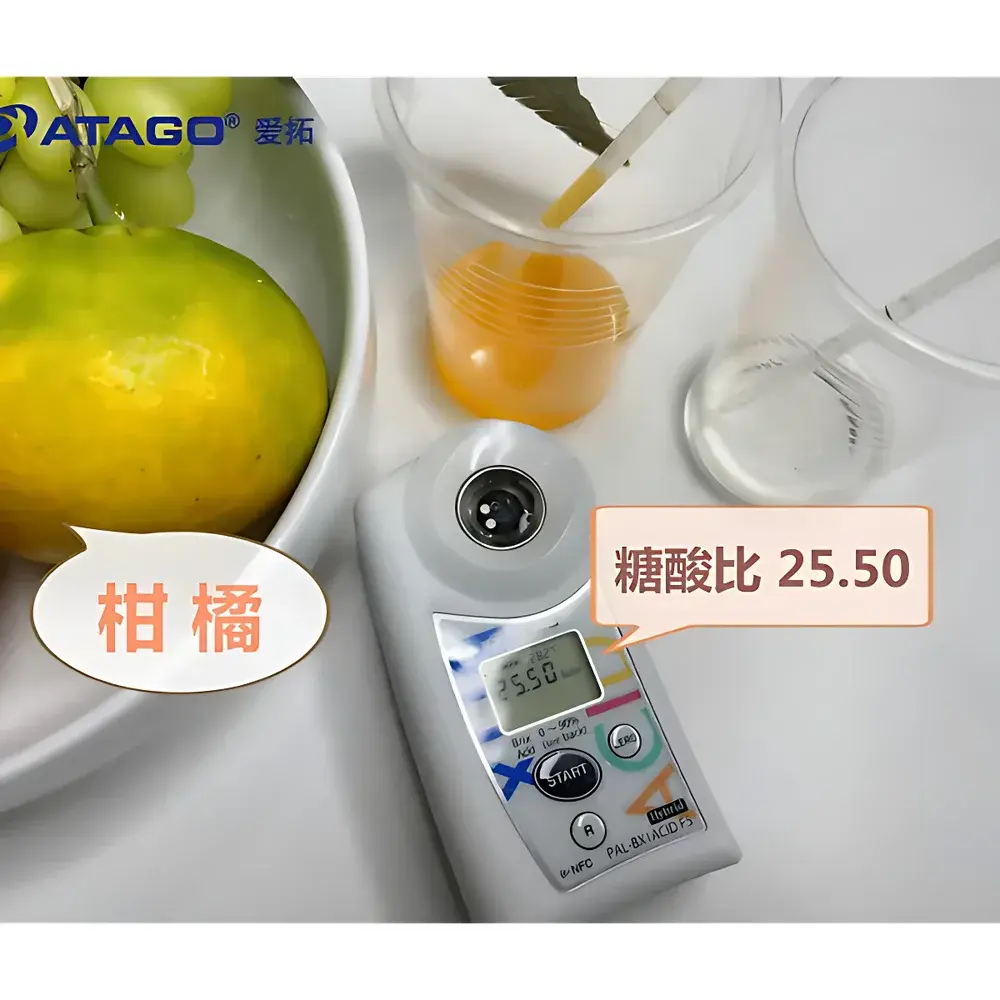
- One-touch sugar-acid ratio (SAR) computation: Pressing the “R” key instantly calculates and displays SAR with context-sensitive resolution (0.01, 0.1, or 1 unit depending on magnitude)
- Citrus-optimized calibration: Factory-set offset curves correct for matrix-specific deviations between refractometric Brix and true soluble solids, and between pH-based acid estimation and standardized titration results (e.g., AOAC 973.25)
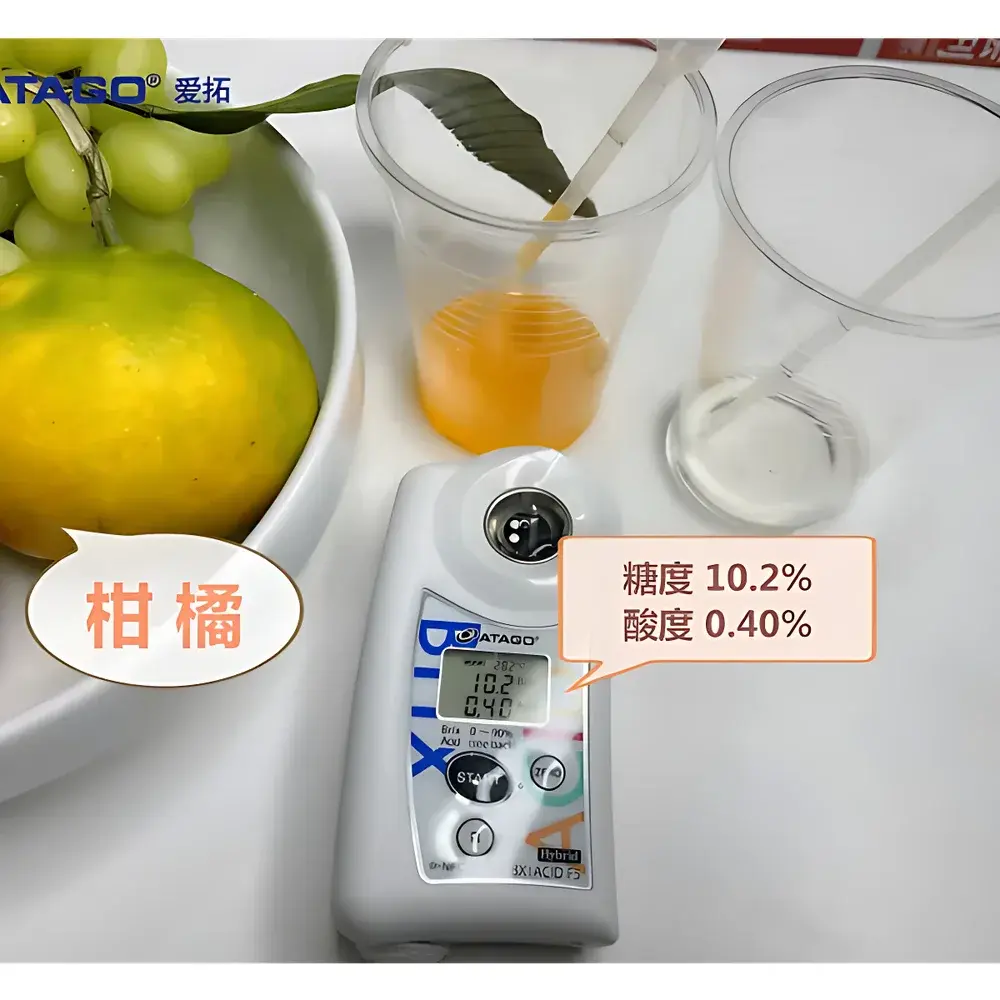
- Destructive sampling protocol: Requires minimal sample volume—1 mL undiluted juice for Brix; 1 mL juice + 50 mL distilled water (1:50 w/v dilution) for acid determination—ensuring repeatability and minimizing interferences from pulp or suspended solids
- IP65-rated enclosure: Dust-tight and protected against low-pressure water jets, enabling reliable operation in humid post-harvest environments, orchards, and processing facilities
- Battery-powered portability: Operates on two AAA alkaline cells (typical life >10,000 measurements); no AC adapter or PC interface required for basic operation
Sample Compatibility & Compliance
The PAL-BX/ACID 1 is validated for use with fresh-squeezed citrus juices (orange, tangerine, lemon, lime, grapefruit), clarified citrus beverages, and homogenized pulp suspensions. It is not intended for non-citrus matrices (e.g., apple, tomato, or dairy) due to its fixed citric acid conversion algorithm. While not a GLP-compliant analytical instrument per se, its measurement traceability aligns with ISO 2173:2003 (fruit and vegetable products — determination of soluble solids content — refractometric method) and AOAC Official Method 973.25 (total acidity in fruit juices). The offset correction function supports method equivalency verification against reference titration data, facilitating internal method validation under quality assurance frameworks such as HACCP or IFS Food standards.
Software & Data Management
The PAL-BX/ACID 1 operates as a standalone, embedded-system device with no onboard data logging or USB connectivity. All measurements are displayed in real time on a high-contrast LCD and discarded upon power-off or new sample initiation. For traceable recordkeeping, users must manually transcribe values or integrate the instrument into broader QA workflows via external digital logbooks or LIMS-compatible entry forms. No firmware updates or software drivers are provided; calibration is performed exclusively at ATAGO-certified service centers using NIST-traceable sucrose and citric acid standards. The absence of electronic data storage ensures compliance with environments where electromagnetic interference or cybersecurity restrictions prohibit connected instrumentation.
Applications
- Orchard maturity assessment: Field-based SAR trending to determine optimal harvest windows for sweet-orange cultivars (e.g., Navel, Valencia) and mandarin hybrids (e.g., Murcott, Tango)
- Post-harvest grading: Objective classification of fruit lots according to industry SAR thresholds (e.g., ≥12.0 for premium table oranges; 8.0–10.0 for processing-grade juice fruit)
- Processing line QC: Rapid verification of juice blending ratios, concentrate reconstitution accuracy, and thermal degradation effects on acid stability
- Varietal screening programs: Comparative SAR profiling across germplasm collections to identify breeding lines with balanced flavor architecture
- Research applications: Correlation studies between SAR and sensory panel scores (sweetness, sourness, overall acceptability) under controlled tasting protocols
FAQ
Is the PAL-BX/ACID 1 suitable for non-citrus fruits such as apples or grapes?
No. Its acid algorithm is fixed to citric acid equivalence and lacks user-selectable acid type calibration. Using it on malic- or tartaric-acid-dominant matrices yields non-representative acid values.
Why is a 1:50 dilution required for acid measurement but not for Brix?
Citrus juice acidity falls outside the linear response range of the integrated pH sensor. Dilution brings the hydrogen ion activity into the calibrated working range while preserving stoichiometric proportionality to original citric acid concentration.
Does the instrument comply with FDA 21 CFR Part 11 for electronic records?
No. It generates no electronic records, audit trails, or user authentication—making it unsuitable for regulated GMP environments requiring electronic signature capability.
Can the offset curve be customized by the end user?
No. Offset parameters are factory-programmed and non-adjustable. Users may only apply the preloaded citrus-specific curve during measurement.
What is the recommended recalibration interval?
ATAGO recommends annual verification against certified reference standards at an authorized service center. Field verification using 10.00% Brix sucrose solution and 1.00% citric acid solution is advised before each daily use session.




