
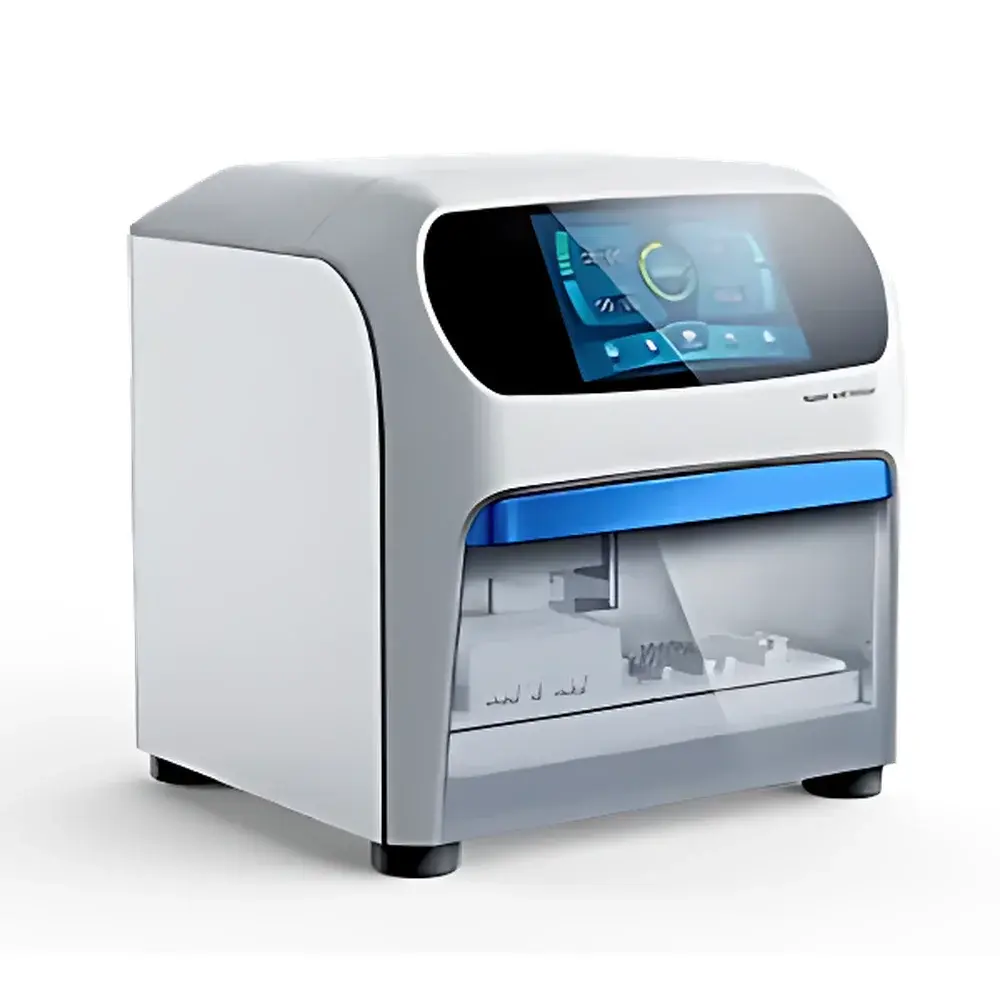
Bioer NPA-32E Automated Magnetic Bead-Based Nucleic Acid Extraction System
| Brand | Bioer |
|---|---|
| Origin | Zhejiang, China |
| Model | NPA-32E |
| Principle | Magnetic bead-based separation |
| Automation Level | Dedicated fully automated platform |
| Sample Throughput | 1–32 samples per run |
| Processing Time | As fast as 8 minutes per batch |
| Heating Capacity | Deep-well heating block with programmable lysis/elution temperature control (ambient to 95 °C) |
| Magnet Type | Permanent magnet rod array with dynamically adjustable oscillation amplitude |
| Sample Plate Compatibility | 2.2 mL 96-well deep-well plates |
| Interface | USB port for protocol transfer and system update |
| Oscillation Mode | Vertical reciprocating motion |
| Dimensions (L×W×H) | 430 × 395 × 435 mm |
| Net Weight | 28.5 kg |
| Power Input | AC 100–240 V, 50/60 Hz, 350 W |
| Safety Features | Interlocked door sensor, built-in UV-C germicidal lamp (254 nm), aerosol-resistant sealing design |
| Modular Expandability | Optional 48-well adapter module available |
Overview
The Bioer NPA-32E is a dedicated, fully automated nucleic acid extraction system engineered for high-reproducibility magnetic bead-based purification in molecular diagnostics, clinical microbiology, and translational research laboratories. It operates on the principle of solid-phase reversible immobilization (SPRI), wherein silica-coated superparamagnetic beads selectively bind nucleic acids under chaotropic salt and pH-controlled conditions. Integrated permanent magnet rods—precisely positioned above sample wells—enable rapid capture, washing, and elution of bound nucleic acids without liquid handling pumps or disposable tips. This eliminates cross-contamination risks associated with pipetting mechanisms while ensuring consistent magnetic field strength across all 32 positions. The system’s thermally isolated deep-well heating block supports independent, programmable temperature control for both lysis (up to 95 °C) and elution (37–75 °C), critical for optimizing yield from challenging matrices such as whole blood, FFPE tissue, sputum, and environmental swabs.
Key Features
- Precision-engineered permanent magnet rod array with real-time oscillation amplitude modulation—ensures complete bead resuspension and uniform binding kinetics across all wells, minimizing inter-well CV (coefficient of variation) to <5%.
- Thermally shielded 32-position deep-well heating block featuring ±0.5 °C temperature accuracy and ramp rates up to 3 °C/sec—enabling stringent lysis protocols and low-volume elution (as low as 20 µL).
- Integrated UV-C (254 nm) sterilization cycle activated automatically upon lid closure—validated to achieve ≥4-log reduction of common lab contaminants including Escherichia coli, Staphylococcus aureus, and RNase A.
- Intuitive 7-inch full-color capacitive touchscreen with icon-driven UI—supports protocol cloning, step-by-step visual feedback, and password-protected user role management (Operator, Technician, Administrator).
- Modular hardware architecture—field-upgradable to 48-sample throughput via certified adapter kit; compatible with single-use, pre-aliquoted reagent cartridges to eliminate manual reagent preparation and reduce hands-on time.
Sample Compatibility & Compliance
The NPA-32E processes diverse biological specimens—including whole blood (EDTA/K2EDTA), plasma, serum, saliva, buccal swabs, nasopharyngeal swabs, bacterial cultures, and formalin-fixed paraffin-embedded (FFPE) tissue lysates—using validated magnetic bead chemistries. All standard operating procedures (SOPs) are designed to comply with ISO 15189:2022 requirements for medical laboratories and support GLP/GMP-aligned documentation workflows. The system meets IEC 61010-1:2010 safety standards for laboratory equipment and incorporates audit-trail functionality compliant with FDA 21 CFR Part 11 when paired with Bioer’s optional LIMS-integrated software suite.
Software & Data Management
Firmware v3.2+ includes embedded protocol storage (≥100 user-defined methods), timestamped operation logs, and USB-based method import/export. Raw instrument logs record every thermal cycle, magnet actuation event, and door status change—exportable in CSV format for internal QA review. Optional Bioer Connect™ software enables remote monitoring via Ethernet/Wi-Fi, centralized method deployment across multiple NPA units, and electronic signature support for SOP execution. All data files are SHA-256 hashed to ensure integrity during transfer and archival.
Applications
- Routine viral load testing (e.g., SARS-CoV-2, HIV, HBV) in clinical virology labs requiring CLIA-waived or moderate-complexity workflow integration.
- High-throughput DNA/RNA isolation for next-generation sequencing library prep—particularly suited for Illumina TruSight and QIAseq panels where input consistency directly impacts library complexity.
- Point-of-care–adjacent deployment in public health surveillance networks, where minimal training, low maintenance, and robust performance under variable ambient conditions (15–32 °C) are essential.
- Biobanking operations requiring traceable, temperature-validated nucleic acid extraction with full chain-of-custody logging for ISO 20387:2018 compliance.
FAQ
Does the NPA-32E support third-party magnetic bead kits?
Yes—provided the kit is optimized for 96-well deep-well plate format and specifies compatible buffer volumes and incubation times. Bioer provides open protocol templates for method adaptation.
Can the system be integrated into a robotic liquid handling workflow?
It features standardized deck dimensions and mechanical alignment pins compatible with common lab automation platforms (e.g., Hamilton STAR, Tecan Fluent); API-level integration requires Bioer’s OEM communication protocol license.
What maintenance is required beyond routine UV lamp replacement?
No consumable wear parts exist in the magnetic drive train. Annual calibration verification of thermal block accuracy and magnet field homogeneity is recommended using NIST-traceable reference standards.
Is the instrument suitable for BSL-2 environments?
Yes—the sealed reaction chamber, HEPA-filtered exhaust path (optional), and UV decontamination cycle meet CDC/NIH BSL-2 containment recommendations for nucleic acid extraction from infectious samples.
How is data integrity ensured during power interruption?
The system employs non-volatile flash memory with automatic checkpointing; interrupted runs resume from the last completed step upon power restoration, with full log continuity preserved.




