
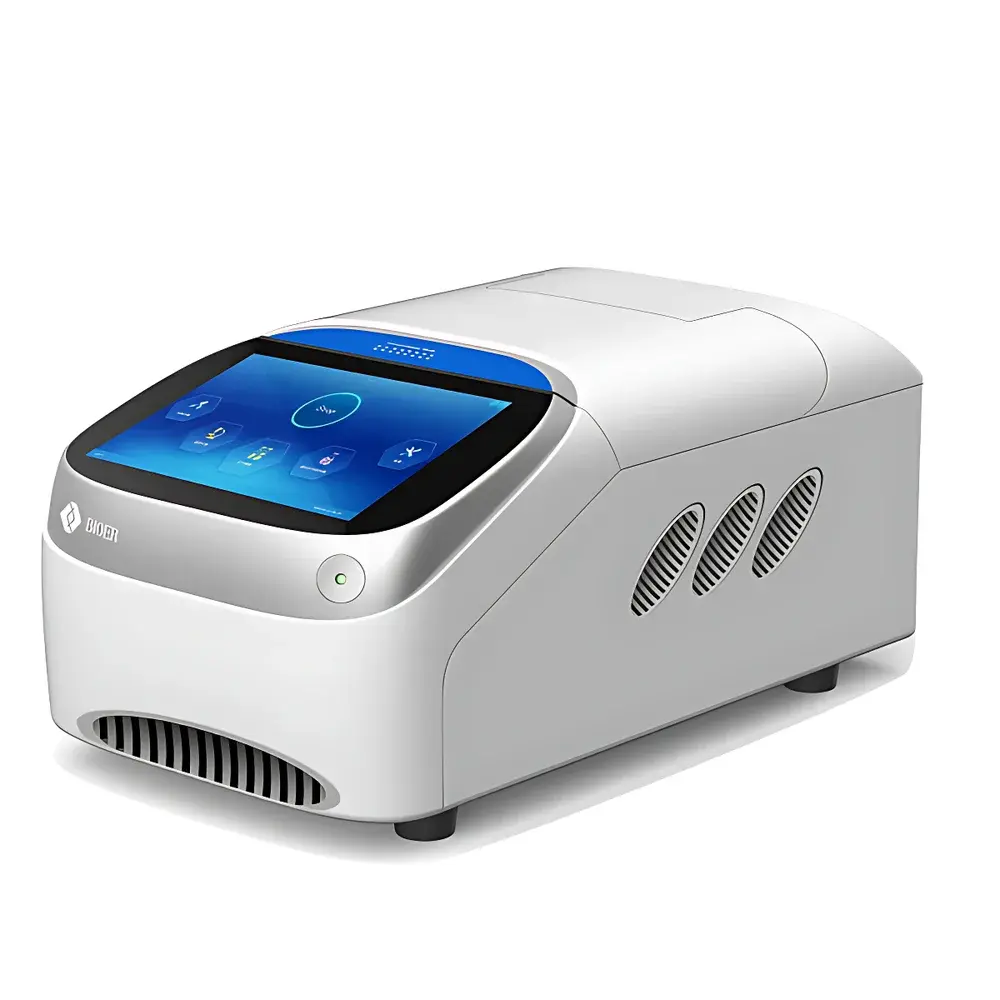
BIOER FQD-16B Real-Time Fluorescent Quantitative PCR System
| Brand | BIOER |
|---|---|
| Origin | Zhejiang, China |
| Manufacturer Type | Authorized Distributor |
| Instrument Type | Real-Time Fluorescent Quantitative PCR System |
| Model | FQD-16B |
| Sample Throughput | 16 wells |
| Maximum Heating Rate | 5 °C/s |
| Temperature Accuracy | ±0.1 °C |
| Well-to-Well Temperature Uniformity | ±0.1 °C |
Overview
The BIOER FQD-16B Real-Time Fluorescent Quantitative PCR System is a compact, thermally optimized benchtop instrument engineered for precise nucleic acid quantification and kinetic amplification monitoring using sequence-specific fluorescent probes (e.g., SYBR Green I, TaqMan, Molecular Beacons) or intercalating dyes. It operates on the principle of real-time detection of fluorescence emission during each PCR cycle, enabling absolute and relative quantification via threshold cycle (Ct) analysis. Designed for laboratories with moderate throughput requirements—such as academic core facilities, clinical research units, and quality control labs in biopharma and diagnostics—the FQD-16B delivers high thermal fidelity and optical consistency across its 16-well reaction block. Its rapid 5 °C/s heating rate supports shortened assay run times without compromising amplification efficiency or reproducibility, while the ±0.1 °C temperature accuracy and uniformity ensure robust inter-run comparability essential for gene expression profiling and low-abundance target detection.
Key Features
- High-fidelity thermal control system with Peltier-based heating/cooling and precision PID feedback regulation, achieving ±0.1 °C accuracy and ±0.1 °C well-to-well uniformity across the full operating range (4–99 °C).
- Optimized optical path incorporating high-stability LED excitation sources and matched photodiode detection channels for four fluorescence spectra (FAM/SYBR, HEX/VIC, ROX, Cy5), supporting multiplexed assays with minimal spectral crosstalk.
- Compact 16-well format using standard 0.2 mL thin-wall PCR tubes—ideal for method development, validation studies, and low-volume sample screening where resource conservation and experimental agility are prioritized.
- Integrated thermal gradient functionality (optional via firmware update) allows empirical optimization of annealing temperatures across the block, facilitating primer validation and assay robustness assessment.
- Rugged mechanical architecture with vibration-dampened optical module and sealed reaction chamber minimizes signal noise and condensation-related artifacts during extended runs.
Sample Compatibility & Compliance
The FQD-16B accommodates standard 0.2 mL skirted or semi-skirted PCR tubes compatible with manual or robotic liquid handling systems. It supports common qPCR chemistries including hydrolysis probes, hybridization probes, and DNA-binding dyes. While not certified for in vitro diagnostic (IVD) use under CE-IVDR or FDA 510(k), the system meets general laboratory equipment safety standards per GB 4793.1 (equivalent to IEC 61010-1) and electromagnetic compatibility per GB/T 18268.1. Data integrity features—including user-defined audit trails, electronic signature support, and exportable .csv/.xlsx result files—align with GLP and basic GMP documentation practices. The instrument does not natively comply with FDA 21 CFR Part 11; however, raw fluorescence and Ct data can be archived externally in validated LIMS or ELN environments meeting regulatory requirements.
Software & Data Management
The FQD-16B is operated via Bioer’s proprietary Windows-based qPCR Analysis Software (v3.2+), providing intuitive workflow navigation from experiment setup to publication-ready reporting. Key software capabilities include automatic baseline and threshold setting, multiplate comparative ΔΔCt analysis, melt curve derivation with derivative peak calling, and customizable report templates. All raw fluorescence intensity values (Rn), normalized reporter signals (ΔRn), and calculated Ct values are stored in a local SQLite database with timestamped acquisition metadata. Export functions support direct generation of MIQE-compliant data packages, including amplification plots, melt curves, and plate layout annotations. Software updates are distributed through secure vendor portal access; no cloud connectivity or remote telemetry is implemented by default.
Applications
- Relative and absolute quantification of mRNA transcripts in gene expression studies, including time-course and dose-response experiments.
- Detection and quantification of single-nucleotide polymorphisms (SNPs) and insertion/deletion variants using allele-specific hydrolysis probes.
- Verification of genetically modified organism (GMO) content in food and feed samples per ISO 21569 and EN ISO 24276 guidelines.
- Monitoring of viral load dynamics in preclinical antiviral studies using standardized reference materials.
- Validation of CRISPR editing efficiency via T7E1 or Surveyor nuclease-coupled qPCR assays.
- Quality control of synthetic oligonucleotides and plasmid preparations through quantitative yield assessment.
FAQ
Is the FQD-16B suitable for clinical diagnostic use?
No—it is designated for research use only (RUO) and lacks regulatory clearance for clinical testing or patient management decisions.
Can the system perform high-resolution melt (HRM) analysis?
Yes, it supports continuous fluorescence acquisition during controlled ramping (0.02–0.2 °C/s) between 60–95 °C, enabling discrimination of amplicons differing by as little as one base pair.
What file formats are supported for data export?
Raw data (.fql), analysis results (.csv, .xlsx), and annotated reports (.pdf) are natively exportable; third-party import into GraphPad Prism, R, or Python (via pandas) is fully supported.
Does the instrument require external calibration?
No routine optical or thermal recalibration is required; factory calibration is traceable to NIST-certified references, and verification protocols are included in the user manual.
Is remote operation or network integration possible?
Local USB connection is standard; Ethernet or Wi-Fi modules are not available, and the system does not support DICOM, HL7, or LIS interfacing.



