
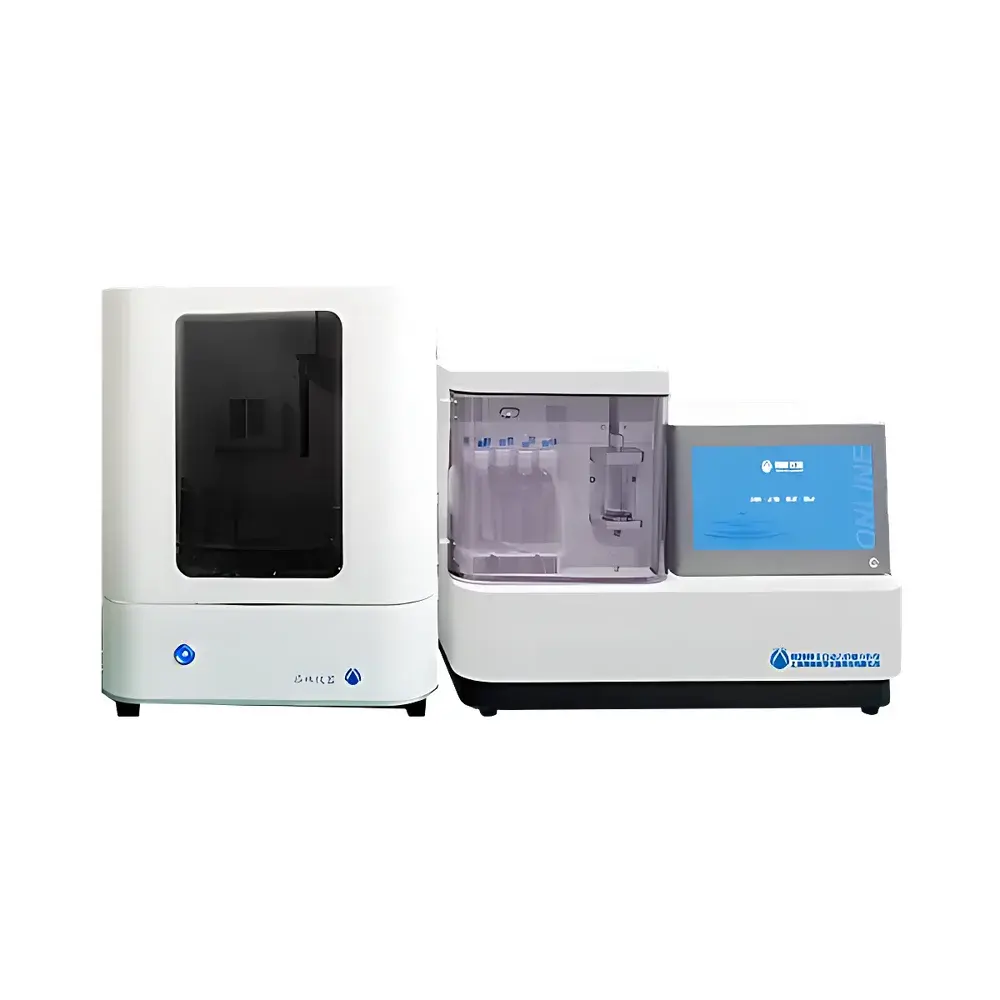
Online Instrument OL2090 Fully Automated Nitrite Analyzer
| Brand | Online Instrument |
|---|---|
| Origin | Shanghai, China |
| Manufacturer Type | Manufacturer |
| Product Category | Domestic |
| Model | OL2090 Fully Automated Nitrite Analyzer |
| Instrument Type | Laboratory Water Quality Analyzer |
| Analyte | Nitrite (NO₂⁻) |
| Linearity Coefficient | ≥0.999 |
| Automation Level | Full Workflow Automation (Sample Transfer, Reagent Dispensing, Standard Preparation, Mixing, Dilution, Measurement, Cleaning, Waste Collection, Report Generation) |
| Compliance Context | Designed for compliance with ISO 10304-1, ASTM D3869, and GB/T 5750.5–2023 (Standard Methods for Examination of Drinking Water – Nitrite) |
Overview
The Online Instrument OL2090 Fully Automated Nitrite Analyzer is a laboratory-grade, discrete-flow spectrophotometric analyzer engineered for precise, trace-level quantification of nitrite (NO₂⁻) in aqueous matrices. It operates on the principle of the Griess reaction—where nitrite reacts with sulfanilamide under acidic conditions to form a diazonium salt, subsequently coupled with N-(1-naphthyl)ethylenediamine dihydrochloride (NED) to yield a stable pink-purple azo dye measurable at 540 nm. This method is internationally standardized (e.g., ISO 10304-1, ASTM D3869, US EPA Method 354.1) and widely accepted for regulatory reporting in drinking water, source water, wastewater effluent, and environmental monitoring applications. The OL2090 integrates hardware-level fluidic control, optical detection, and embedded analytical logic into a single compact chassis, eliminating manual pipetting, reagent handling, and calibration steps—thereby minimizing analyst variability and improving inter-laboratory reproducibility.
Key Features
- Fully automated assay workflow: integrated sample aspiration, reagent dispensing (sulfanilamide + NED), timed incubation, photometric measurement, and post-run cleaning—all executed without user intervention.
- Multi-range standard curve management: system stores pre-validated calibration curves for low-range (0–0.5 mg/L NO₂⁻-N) and high-range (0–5.0 mg/L NO₂⁻-N); auto-selects optimal curve based on preliminary screening or user input.
- Intelligent dilution protocol: detects out-of-range absorbance signals and triggers on-board serial dilution using calibrated peristaltic pumps and precision volumetric modules—ensuring accurate quantification across five orders of magnitude without manual re-runs.
- Optical detection module: dual-beam spectrophotometer with 540 nm LED source, temperature-stabilized photodiode detector, and real-time baseline correction—delivering <±0.002 AU photometric precision over 24 h.
- Sealed, closed-system architecture: all liquid pathways—including reagent reservoirs, reaction coils, waste lines, and cuvette chamber—are housed within an inert, chemically resistant enclosure; prevents operator exposure to acidic reagents and volatile intermediates.
- Embedded reagent monitoring: capacitive level sensors track consumption of sulfanilamide, NED, and acid buffer in real time; alerts appear on HMI and via SNMP when volume falls below configurable thresholds.
Sample Compatibility & Compliance
The OL2090 accepts clarified, filtered (0.45 µm membrane), or centrifuged aqueous samples—including raw surface water, treated drinking water, groundwater, wastewater influent/effluent, and food processing rinse water. It meets core requirements for GLP-compliant laboratories: full audit trail (timestamped actions, operator ID, calibration history), electronic signature support, and data integrity aligned with FDA 21 CFR Part 11 Annex 11 principles. All methods are traceable to NIST-traceable nitrite reference standards (SRM 2012a), and performance validation reports include MDL (Method Detection Limit ≤0.005 mg/L NO₂⁻-N), precision (RSD <3% at 0.1 mg/L), and spike recovery (92–105% across matrix types). Certified compliant with Chinese national standard GB/T 5750.5–2023 and harmonized with ISO/IEC 17025:2017 testing laboratory accreditation criteria.
Software & Data Management
The analyzer runs on a Linux-based embedded OS with a 7-inch capacitive touchscreen HMI. Software supports menu-driven method selection, one-touch run initiation, real-time status visualization (fluidic pressure, temperature, absorbance kinetics), and PDF/CSV report export with embedded metadata (sample ID, analyst, instrument ID, calibration date, QC flags). Remote access is enabled via TLS-secured web interface (HTTPS) and optional MQTT integration—allowing lab managers to monitor instrument uptime, queue status, error logs, and historical results from desktop or mobile devices. Data storage includes local 32 GB eMMC (retaining ≥12 months of raw spectra and processed results) plus optional network share backup. Audit trail entries are immutable and timestamped to UTC, supporting forensic review during regulatory inspections.
Applications
- Drinking water utilities: routine compliance monitoring of nitrite per WHO Guidelines and national regulatory limits (e.g., ≤0.5 mg/L NO₂⁻-N in China’s GB 5749–2022).
- Environmental monitoring agencies: field-deployable lab analysis for river, lake, and reservoir surveillance programs tracking agricultural runoff or nitrification anomalies.
- Food & beverage QA/QC labs: verification of nitrite residuals in cured meats, vegetable wash water, and fermentation broth control points.
- Research institutions: kinetic studies of nitrite transformation pathways, method development for emerging contaminants, and inter-laboratory comparison exercises.
- Third-party testing laboratories: accredited analysis for ISO/IEC 17025 scope expansion in inorganic anion testing.
FAQ
What is the typical analysis time per sample?
Approximately 4.5 minutes per sample, including reagent addition, 10-minute color development, measurement, and initial rinse—excluding optional extended cleaning cycles.
Does the OL2090 require daily recalibration?
No. Calibration curves remain valid for up to 72 hours under stable ambient conditions (20–25°C); system performs automatic zero-check and blank verification before each batch.
Can it analyze turbid or colored samples without pretreatment?
Turbidity >5 NTU or absorbance >0.3 AU at 540 nm requires offline filtration (0.45 µm) or centrifugation; the instrument does not include on-board solid-phase removal.
Is method validation documentation provided?
Yes—each unit ships with a Factory Validation Report (FVR) including linearity, accuracy, precision, MDL, and interference testing data against Cl⁻, SO₄²⁻, Fe²⁺, and NO₃⁻ at relevant concentrations.
How is waste handled during unattended operation?
All waste liquids—including spent reagents and reaction mixtures—are pneumatically transferred to a sealed 5 L HDPE waste container with level sensor; container replacement is indicated via HMI and remote alert.







