
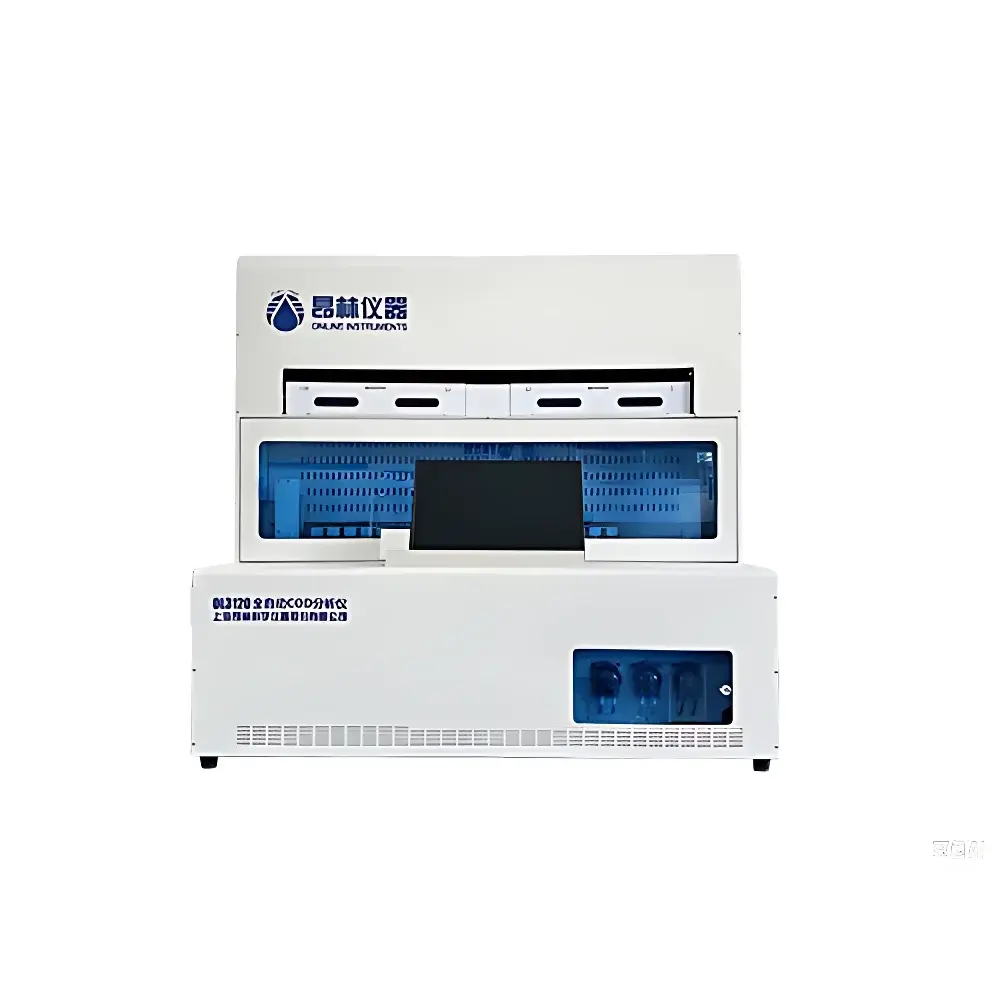
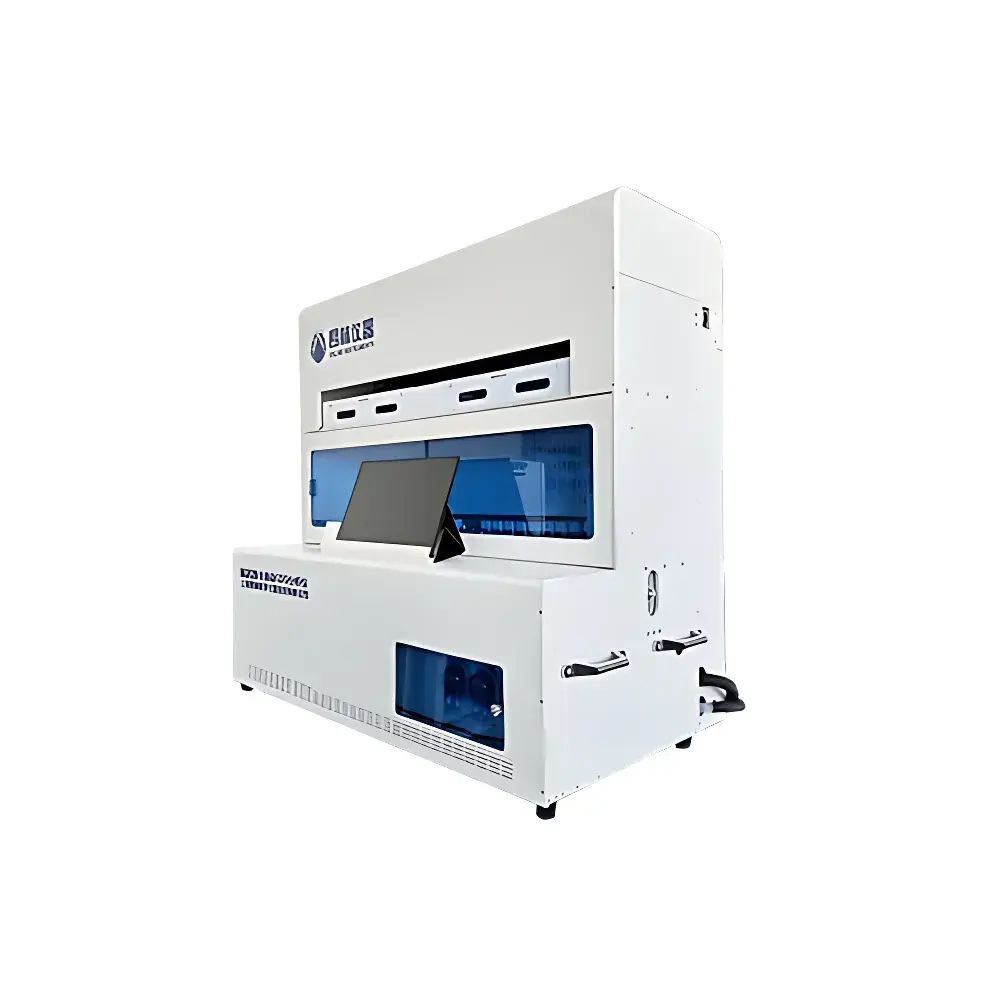
Online Instrument OL 3120 Automated COD Analyzer
| Brand | Online Instrument |
|---|---|
| Origin | Shanghai, China |
| Manufacturer Type | Manufacturer |
| Product Category | Domestic |
| Model | OL 3120 |
| Instrument Type | Laboratory-Grade |
| Measurement Principle | 2-Hour Closed-Vessel Digestion Followed by Potentiometric/Colorimetric Titration |
| Measurement Range | 0–70,000 mg/L COD (with automatic dilution for over-range samples) |
| Accuracy | ≤2% RSD (vs. certified reference materials) |
| Repeatability | ≤2% RSD |
| Detection Limit | 4 mg/L COD |
| Sample Processing Time | <3 min per sample (post-digestion titration) |
| Sample Capacity | 30–100 positions (user-configurable) |
| Digestion Stations | 20 parallel positions |
| Cooling Method | Point-to-point forced-air condensation system |
| Endpoint Detection | Dual-mode (colorimetric + algorithm-assisted hue transition recognition per ISO 6060 and EPA 410.4) |
| Digestion Control | Intelligent micro-boiling temperature regulation (150–165 °C, ±0.5 °C stability) |
| Data Output | Excel/PDF export, LIMS integration (HL7/ASTM E1384 compliant), automated report generation with audit trail |
Overview
The Online Instrument OL 3120 Automated COD Analyzer is a laboratory-grade, fully integrated chemical oxygen demand (COD) measurement system engineered for precision, regulatory compliance, and high-throughput water quality analysis. It implements the standardized 2-hour closed-vessel digestion protocol per ISO 6060:1989 and EPA Method 410.4, followed by automated potentiometric-colorimetric endpoint detection during titration with standardized potassium permanganate or ceric sulfate reagents. Unlike semi-automated or manual reflux systems, the OL 3120 eliminates operator-dependent variables—such as inconsistent heating profiles, subjective endpoint judgment, or manual pipetting errors—by embedding process control within a sealed, sensor-monitored architecture. Its core function is to quantify the oxygen-demanding organic and inorganic substances in aqueous matrices through controlled oxidation under acidic, high-temperature conditions, delivering traceable, repeatable results suitable for environmental compliance reporting, wastewater treatment optimization, and research-grade water characterization.
Key Features
- Fully automated digestion-titration workflow: 20-position digestion block synchronized with 30–100-sample carousel for unattended batch processing.
- Dual-core titration system: Adaptive fast/slow titration kinetics engine dynamically adjusts delivery rate based on real-time colorimetric slope analysis—ensuring sub-milliliter reagent precision and minimizing overshoot error.
- Point-to-point forced-air condensation: Independent airflow control per condenser tube maintains consistent reflux efficiency across all 20 digestion vessels, eliminating thermal gradient-induced variability in digestion completeness.
- Intelligent range switching: On-the-fly sample dilution via calibrated syringe pump when initial reading exceeds upper detection limit; auto-recalibration of titration curve parameters ensures metrological continuity between low- and high-range modes (0–1,500 mg/L and 1,500–70,000 mg/L).
- Self-contained cleaning protocol: Programmable multi-stage rinse cycles for sample probes, reagent lines, digestion cups, and titration cells using deionized water and optional acid wash—fully configurable cycle count and duration per module.
- Hermetic process enclosure: All wetted components operate within a sealed chamber meeting IP54 environmental rating, preventing vapor leakage, cross-contamination, and operator exposure to hazardous fumes (e.g., Cr(VI), Hg²⁺, SO₂).
Sample Compatibility & Compliance
The OL 3120 accommodates diverse aqueous matrices without manual pretreatment, including municipal wastewater effluent, industrial process streams (textile, pharmaceutical, food & beverage), surface water (rivers, lakes, estuaries), and landfill leachate. It complies with ISO 6060:1989, ASTM D1252–06 (Method B), and Chinese Standard HJ 828–2017. The system supports GLP/GMP-aligned operation via time-stamped audit logs, user-level access controls, electronic signatures, and full 21 CFR Part 11–compliant data integrity features—including immutable raw signal storage (absorbance vs. time), reagent lot traceability, and calibration history with uncertainty budgets. Digestion temperature and ramp profiles are validated against NIST-traceable thermocouples; titration endpoints meet visual equivalence thresholds defined in APHA Standard Methods 5220D.
Software & Data Management
The embedded Windows-based control software provides intuitive touchscreen navigation, method library management, and customizable SOP templates. All analytical data—including raw absorbance curves, digestion temperature logs, titrant consumption volumes, and final COD concentrations—are stored in an encrypted SQLite database with automatic daily backup. Export options include ANSI-compliant CSV, ISO-standard PDF reports (with digital signature), and Excel (.xlsx) files containing metadata headers required by national monitoring programs (e.g., China’s MEP Monitoring Network). Native HL7 v2.5 and ASTM E1384 interfaces enable seamless bidirectional communication with LIMS platforms, supporting automated result ingestion, QC flagging, and instrument status polling.
Applications
- Regulatory wastewater discharge monitoring per local environmental protection bureaus (e.g., MEP Order No. 48, EU Urban Wastewater Treatment Directive).
- Biological treatment plant performance evaluation: influent/effluent COD tracking, sludge loading ratio calculation, and nitrification/denitrification efficiency assessment.
- Industrial pretreatment verification for electroplating, dyeing, and petrochemical facilities subject to sector-specific COD limits.
- Research applications: kinetic studies of organic pollutant degradation, comparative analysis of advanced oxidation processes (AOPs), and validation of alternative COD surrogates (e.g., UV₂₅₄, TOC).
- Drinking water source protection: early-warning detection of organic contamination events in reservoirs and groundwater recharge zones.
FAQ
What digestion method does the OL 3120 use, and how is temperature controlled?
It employs a standardized 2-hour closed-vessel digestion at 150–165 °C, regulated by PID-controlled micro-boiling modules with NIST-traceable RTD feedback.
Does the system support external LIMS integration?
Yes—via ASTM E1384-compliant drivers and configurable HL7 v2.5 message routing for automated result push/pull and instrument status synchronization.
How is endpoint detection performed during titration?
Using dual-mode recognition: real-time RGB photometry tracks chromatic shift from green to purple during dichromate reduction, augmented by derivative-based inflection point detection to minimize human interpretation bias.
Can the OL 3120 handle highly turbid or suspended-solid-laden samples?
Yes—integrated centrifugal filtration (optional add-on module) or pre-digestion homogenization protocols ensure representative subsampling without clogging or signal interference.
Is method validation documentation provided?
Each unit ships with a Factory Acceptance Test (FAT) report, ISO/IEC 17025-aligned validation package (including accuracy, precision, LOD/LOQ, and linearity per ICH Q2(R2)), and a Certificate of Conformance to HJ 828–2017.
Related Products







