
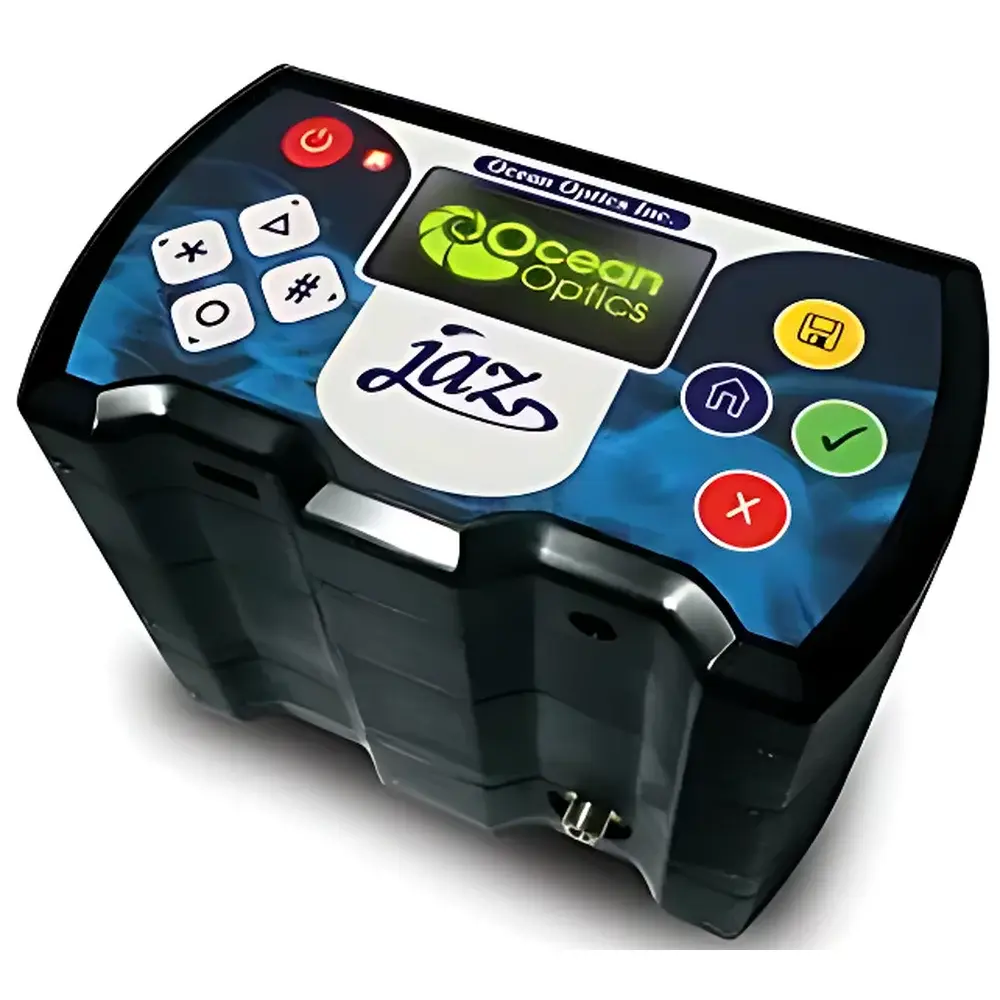
Ocean Optics JAZ Series Miniature Fiber Optic Spectrometer
| Brand | Ocean Optics |
|---|---|
| Origin | USA |
| Model | JAZ |
| Spectral Range | Configurable via interchangeable gratings (standard options: 200–1025 nm) |
| Detector Type | CMOS linear array (custom-optimized) |
| Optical Resolution | ~0.3–10.0 nm FWHM (grating- and slit-dependent) |
| Sensitivity | 75 photons/count @ 400 nm |
| Signal-to-Noise Ratio | 250:1 (full signal, 1 s integration) |
| Dynamic Range | 8.5 × 10⁷ (system) |
| 1300 | 1 (single acquisition) |
| Stray Light | < 0.05% @ 600 nm |
| Power Consumption | ~2.5 W |
| Compliance | RoHS-compliant |
| Communication | 100 Mbps Ethernet (TCP/IP), USB 2.0, SD card interface |
| Onboard Processing | ARM-based microprocessor with real-time data logging and post-processing capability |
| Modular Architecture | Supports up to 8 stacked instrument modules (spectrometer, OLED display, Ethernet/SD, battery, LED source, etc.) |
Overview
The Ocean Optics JAZ Series Miniature Fiber Optic Spectrometer is a modular, field-deployable spectroscopic platform engineered for high-fidelity optical measurements in resource-constrained or remote environments. Built upon a reimagined crossed Czerny-Turner optical design, the JAZ system enables rapid interchangeability of slits and diffraction gratings—allowing users to configure spectral range (200–1025 nm), resolution (~0.3–10.0 nm FWHM), and throughput without optical realignment. Its core measurement principle relies on dispersive spectroscopy: incident light, delivered via fiber-optic coupling, is collimated, diffracted by a ruled or holographic grating, and focused onto a high-quantum-efficiency CMOS linear array detector. The onboard ARM processor executes real-time dark-current correction, pixel binning, and intensity calibration—eliminating dependency on external PCs during acquisition. Designed for operational resilience, the JAZ operates at ~2.5 W, supports battery-powered continuous logging, and maintains thermal stability across ambient temperatures from –10 °C to +50 °C—critical for unattended outdoor deployments.
Key Features
- Modular stackable architecture: Up to eight function-specific modules—including spectrometer, OLED display, Ethernet/SD memory, rechargeable Li-ion battery, and tunable LED illumination—can be mechanically and electrically integrated via standardized interconnects.
- Field-serviceable optics: Slits and gratings are user-replaceable using standard tools; no recalibration required after swapping, ensuring long-term adaptability across applications.
- Embedded computing: ARM-based microprocessor enables standalone operation with onboard data logging, spectral averaging, baseline subtraction, and user-defined script execution (e.g., chlorophyll index calculation).
- Dual-channel capability: JAZ-TR configurations integrate two synchronized spectrometers (350–1000 nm each) for simultaneous reflectance and transmittance acquisition—essential for thin-film and leaf optical property analysis.
- Integrated connectivity: 100 Mbps Ethernet provides both power-over-Ethernet (PoE) and TCP/IP remote control; SD card slots support autonomous storage of calibrated spectra with timestamped metadata.
- Low-stray-light optical path: Optimized baffling and grating selection yield stray light < 0.05% at 600 nm, meeting ASTM E275 and ISO 9050 requirements for quantitative reflectance/transmittance metrology.
Sample Compatibility & Compliance
The JAZ platform interfaces seamlessly with Ocean Optics’ SpectroClip family of handheld sampling probes—specifically designed for field-based diffuse reflectance and transmittance measurements of thin, heterogeneous materials (≤1 mm thickness). SpectroClip-R employs a 5-mm-diameter integrating sphere for reflectance-only analysis; SpectroClip-TR adds a second sphere for concurrent transmittance capture. Both comply with CIE Publication No. 177 for integrating sphere geometry and maintain NIST-traceable calibration when paired with certified reflectance standards (e.g., WS-1-SL). System-level compliance includes RoHS Directive 2011/65/EU, FCC Part 15 Class B, and IEC 61326-1 for electromagnetic compatibility in laboratory and industrial settings. Data integrity aligns with GLP principles through embedded audit trails, time-stamped acquisition logs, and non-modifiable SD card write-once functionality.
Software & Data Management
The JAZ operates natively with OceanView™ software (Windows/macOS/Linux), which provides full spectral acquisition control, real-time visualization, and export in CSV, TXT, or HDF5 formats. For embedded operation, the OLED module hosts a lightweight firmware environment supporting Python-based scripting (via MicroPython runtime), enabling on-device computation of derived indices—such as NDVI, PRI, or ozone absorption depth at 300–320 nm. All Ethernet-connected units are discoverable via DHCP and controllable via RESTful API endpoints, facilitating integration into SCADA or LIMS frameworks. Raw spectral data include wavelength-calibrated intensity arrays, integration time, temperature sensor readings, and module serial identifiers—ensuring traceability per ISO/IEC 17025 clause 7.5.2. Firmware updates are performed over Ethernet or SD card, preserving configuration parameters across revisions.
Applications
- Environmental monitoring: Solar irradiance characterization (280–400 nm UV-B/A bands), stratospheric ozone column estimation via differential optical absorption spectroscopy (DOAS) preprocessing, and PAR (photosynthetically active radiation) quantification.
- Agricultural phenotyping: In-field chlorophyll-a/b ratio estimation from leaf reflectance (500–700 nm), water content assessment via NIR water absorption features (970 nm, 1450 nm), and stress-induced anthocyanin detection (520–560 nm).
- Industrial process control: Real-time colorimetric verification of coatings, thin-film thickness monitoring via interference fringe analysis, and LED binning validation using absolute spectral power distribution (SPD) measurements.
- Education and research: Portable teaching spectrometer for undergraduate optics labs; low-cost platform for citizen science air quality networks requiring spectral fingerprinting of particulate scattering signatures.
FAQ
Can the JAZ operate without a connected PC?
Yes—the onboard ARM processor and OLED display module enable fully autonomous operation, including spectrum acquisition, storage to SD card, and real-time numerical display of user-defined metrics.
What spectral calibration standards are supported?
Factory calibration uses NIST-traceable tungsten-halogen and deuterium lamps. Users may perform field recalibration using Ocean Optics’ QR-1000 or WS-1-SL reflectance standards, with coefficients stored in non-volatile memory.
Is the system compatible with third-party fiber-optic probes?
Yes—any SMA905-coupled probe operating within the configured spectral range and irradiance limits (≤10 mW/mm² at detector plane) is interoperable; SpectroClip probes are optimized for angular response uniformity per ASTM E308.
How is thermal drift managed during extended outdoor use?
The JAZ incorporates a thermistor-monitored thermal stabilization loop that adjusts dark reference acquisition frequency and applies temperature-dependent pixel gain correction, maintaining photometric repeatability within ±0.5% over 8-hour field sessions.
Does the Ethernet module support secure remote access?
The embedded TCP/IP stack supports static IP assignment, subnet masking, and firewall-compatible port forwarding; encrypted data transfer requires external TLS termination at the network gateway level, consistent with FDA 21 CFR Part 11 Annex 11 guidance for remote instrument control.



