
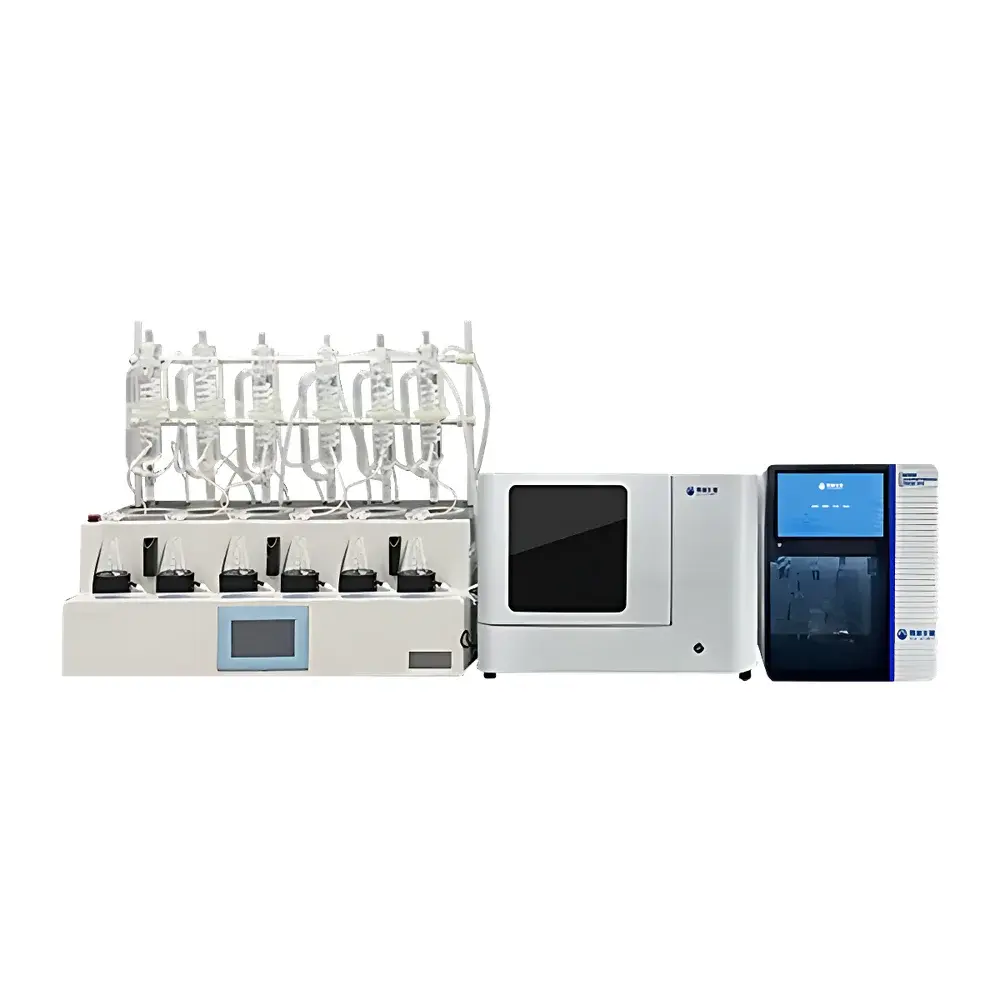
Online Instrument OL 2030N Fully Automated Anionic Surfactant and Volatile Phenol Analyzer
| Brand | Online Instrument |
|---|---|
| Origin | Shanghai, China |
| Manufacturer Type | Original Equipment Manufacturer (OEM) |
| Product Category | Domestic |
| Model | OL 2030N |
| Instrument Type | Laboratory-Grade Volatile Phenol & Anionic Surfactant Analyzer |
| Sample Capacity | Anionic Surfactant – up to 55 positions |
| Sample Introduction | Rotary Disk Autosampler |
| Fluid Handling | Precision Syringe + Peristaltic Pump Hybrid Delivery |
| Extraction Protocol | Programmable Multi-Stage Chloroform Extraction & Back-Extraction (compliant with GB 7494-1987, HJ 503-2009, GB/T 39302-2020, etc.) |
| Calibration | Fully Automated Standard Preparation, Multi-Point Curve Generation, and Auto-Dilution for High-Concentration Samples |
| Waste Management | Closed-Loop Waste Collection, Activated Carbon Exhaust Scrubbing |
| Compliance | Designed for GLP-aligned laboratory workflows |
Overview
The Online Instrument OL 2030N is a fully automated, dual-parameter benchtop analyzer engineered for the simultaneous or independent quantification of anionic surfactants (AS) and volatile phenols (VP) in aqueous environmental matrices. It implements standardized liquid–liquid extraction (LLE) methodology based on chloroform-mediated partitioning—precisely replicating the core procedural steps defined in major Chinese national standards including GB 7494-1987 (for AS), HJ 503-2009 (for VP), GB/T 39302-2020 (water quality — determination of anionic surfactants), and GB/T 5750.4-2023 (standard methods for examination of drinking water). The system operates on a validated three-stage extraction–back-extraction cycle, achieving analyte recovery rates ≥95% under routine calibration verification conditions. Its architecture integrates sample introduction, reagent dispensing, phase separation, optical detection (via spectrophotometric measurement at specified wavelengths), and waste containment within a single sealed platform—eliminating manual handling of toxic organic solvents and minimizing operator exposure risk.
Key Features
- Fully automated LLE workflow: Programmable chloroform addition, vigorous mixing, phase separation, back-extraction into aqueous alkaline medium, and final spectrophotometric readout—all executed without manual intervention.
- Dual-channel modular design: Independent sample racks and fluid paths for AS and VP analysis enable concurrent or staggered batch processing, maximizing lab throughput.
- Rotary disk autosampler: Supports configurable sample trays—25/50/55 positions for AS analysis and 10/22 positions for VP—with optional expansion kits for high-volume monitoring labs.
- Hybrid fluid delivery system: Combines micro-syringe precision (for low-volume reagent dosing and standard preparation) with peristaltic pump robustness (for bulk solvent transfer and waste evacuation), ensuring long-term volumetric accuracy and reproducibility.
- Integrated safety engineering: All solvent-handling steps occur within a closed-loop manifold; spent chloroform is automatically collected in designated waste reservoirs, while volatile exhaust gases pass through replaceable activated carbon cartridges compliant with GB/T 16758-2008 ventilation safety guidelines.
- Intelligent reagent management: Real-time level monitoring with audible/visual alerts; auto-suspension of assay upon critical reagent depletion to prevent invalid runs.
Sample Compatibility & Compliance
The OL 2030N is validated for use with raw and treated water matrices including potable water, surface water, domestic wastewater, and industrial effluents. It accommodates turbid or particulate-laden samples through integrated filtration-assisted phase separation and programmable agitation intensity control. Method compliance extends across multiple regulatory frameworks: AS determination follows the methylene blue active substances (MBAS) principle per GB 7494-1987 and ISO 7875-1; VP analysis adheres to the 4-aminoantipyrine (4-AAP) colorimetric method per HJ 503-2009 and APHA Standard Methods 5530 B. The instrument’s operational logs—including reagent lot numbers, calibration timestamps, sample IDs, and extraction parameters—are timestamped and exportable in CSV format, supporting traceability requirements under CNAS-CL01:2018 (equivalent to ISO/IEC 17025:2017) and local ecological monitoring accreditation protocols.
Software & Data Management
The embedded control software provides intuitive method setup, real-time run monitoring, and post-acquisition data review. Users define extraction cycles (1–5 stages), back-extraction pH, incubation times, and dilution factors via graphical workflow templates. All calibration curves are generated using NIST-traceable reference standards, with linear regression statistics (r², LOD/LOQ) automatically calculated and archived. Audit trail functionality records user logins, parameter changes, and result modifications—enabling alignment with GLP documentation expectations. Data exports conform to LIMS-compatible formats (CSV, PDF analytical reports) and support optional integration with enterprise-level laboratory information management systems via TCP/IP or RS232 interfaces.
Applications
This analyzer serves municipal water utilities conducting routine compliance testing against China’s “Environmental Quality Standards for Surface Water” (GB 3838-2002); environmental monitoring stations performing regional pollution source tracking; wastewater treatment plants optimizing coagulation–flocculation processes where AS interference is suspected; and third-party testing laboratories accredited under CMA (China Metrology Accreditation). Academic research groups utilize the OL 2030N for kinetic studies of phenol biodegradation or surfactant sorption behavior in sediment–water systems. Its modularity also supports method development for emerging contaminants structurally analogous to target analytes—provided UV–Vis spectral characteristics remain within the instrument’s photometric detection range (340–800 nm).
FAQ
Does the OL 2030N comply with international standards such as ISO or ASTM?
It is designed to replicate procedures aligned with ISO 7875-1 (anionic surfactants) and ISO 6439 (phenolic compounds), though formal ISO/IEC 17025 certification applies to laboratory operations—not individual instruments. Validation data sheets include cross-references to equivalent ISO clauses.
Can the system analyze both parameters in a single run?
No—it performs AS and VP analyses sequentially using dedicated fluidic pathways and detection wavelengths; however, unattended overnight batching allows mixed-sample queues to be processed autonomously.
What maintenance intervals are recommended for the separation module?
The phase separator requires cleaning every 200 extractions using manufacturer-supplied regeneration solution; full cartridge replacement is advised after 1,000 cycles or when back-pressure exceeds 0.15 MPa.
Is remote diagnostics supported?
Yes—via secure SSH-enabled Ethernet connection, authorized service engineers can perform firmware updates, sensor diagnostics, and error log analysis without onsite presence.
How is calibration traceability ensured?
All factory calibrations use CRM-grade reference materials certified by NIM (National Institute of Metrology, China); end-user calibration verification must employ secondary standards traceable to the same primary references.
Related Products







