
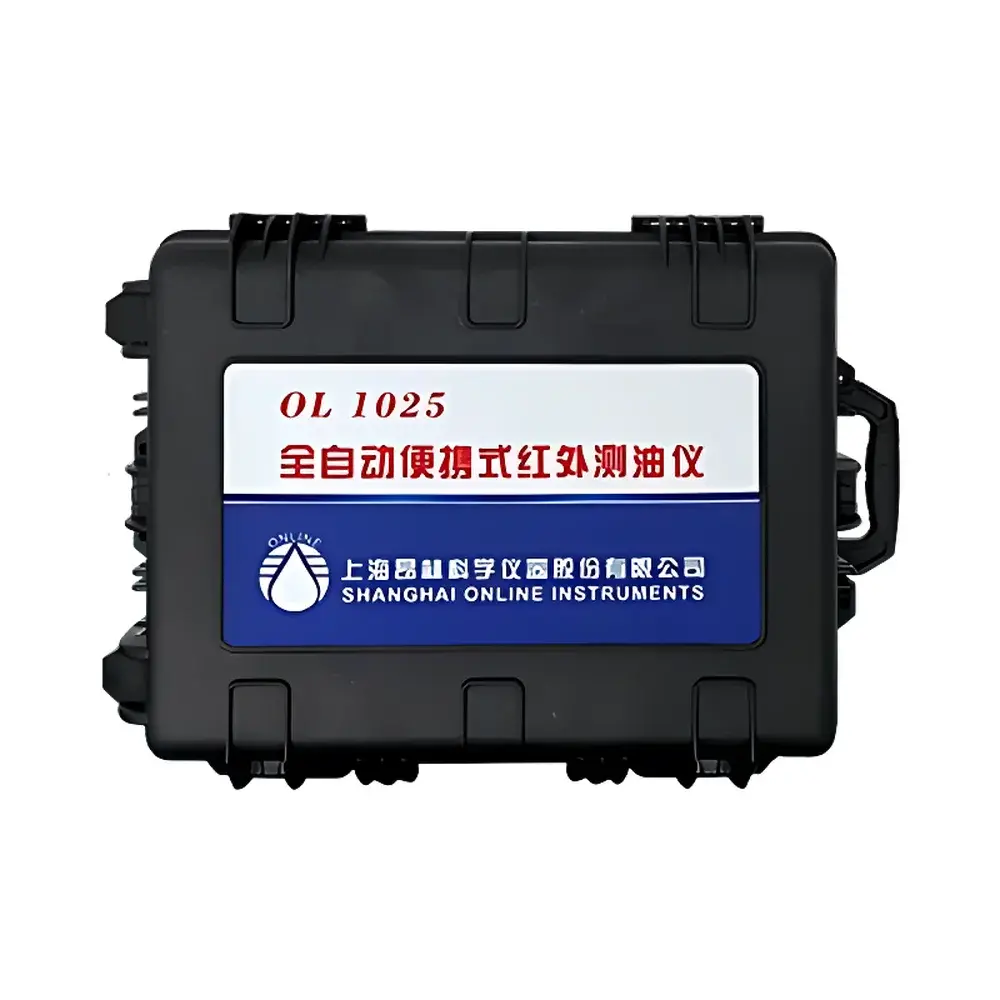
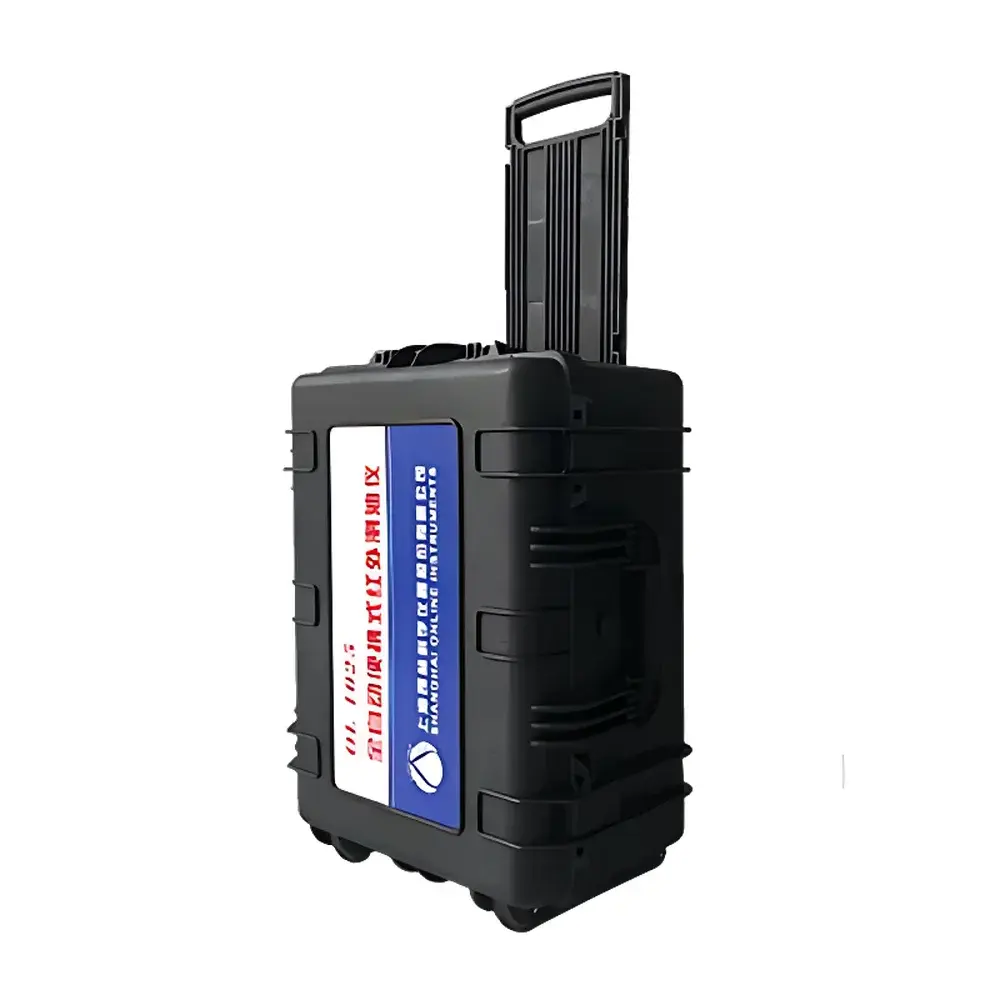
Online Instrument OL1025 Portable Automated Infrared Oil Content Analyzer
| Brand | Online Instrument |
|---|---|
| Origin | Shanghai, China |
| Manufacturer Type | Manufacturer |
| Product Category | Domestic |
| Model | OL1025 |
| Instrument Type | Portable |
| Measurement Principle | Infrared Spectrophotometry |
| Measurement Range | 0–50,000 mg/L (with automatic high-concentration dilution) |
| Detection Limit | 0.06 mg/L |
| Accuracy | ±2% |
| Resolution | 0.001 mg/L |
| Analysis Time | 10 min per sample |
Overview
The Online Instrument OL1025 Portable Automated Infrared Oil Content Analyzer is an integrated field-deployable system engineered for precise, on-site quantification of total petroleum hydrocarbons (TPH), mineral oil, and non-polar extractable organic matter—including animal and vegetable oils—in aqueous matrices. It operates on the fundamental principle of infrared absorption spectroscopy at the characteristic C–H stretching band near 2930 cm⁻¹ (≈3.4 µm), in strict accordance with standardized methodologies including EPA Method 1664A, ISO 9377-2, and China’s HJ 637–2018 and HJ/T 91–2002. Unlike benchtop IR analyzers requiring manual solvent extraction and transfer, the OL1025 embeds a fully automated liquid–liquid extraction workflow within a single ruggedized chassis—eliminating operator-induced variability, minimizing exposure to hazardous solvents (e.g., tetrachloroethylene), and enabling real-time decision-making during environmental incident response or routine wastewater surveillance.
Key Features
- Integrated all-in-one architecture: Combines extraction unit, IR spectrometer, reagent reservoir (tetrachloroethylene), waste separation module, sample bottle holder, and touchscreen control PC into a single portable enclosure—no external pumps, tubing, or auxiliary electronics required.
- Robust optical design: Sealed, vibration-damped interferometer and fixed-pathlength flow cell ensure stable photometric performance even during mobile deployment (e.g., inside moving monitoring vehicles).
- Non-contact volumetric sensing: Uses ultrasonic or capacitive sensing to automatically detect and record sample volume directly from standard wide-mouth sampling bottles (per HJ/T 91–2002), eliminating manual pipetting and associated transfer losses (<2% volume measurement error).
- True walk-away automation: One-touch initiation triggers sequential steps—volume recognition → reagent dosing → mechanical shaking extraction → phase separation via gravity-assisted membrane filtration → organic phase transfer → IR absorbance measurement → auto-dilution for over-range samples.
- Cross-contamination mitigation: Integrated back-flush mechanism uses reverse-pressure tetrachloroethylene flow to clean the phase separator between analyses, preventing carryover and ensuring long-term reproducibility.
Sample Compatibility & Compliance
The OL1025 accepts untreated water samples collected in standard 250–1000 mL wide-mouth HDPE or glass bottles without pre-filtration or homogenization. It accommodates heterogeneous matrices—including oily emulsions, suspended solids, and viscous industrial effluents—by performing in-situ extraction prior to phase separation. All operational protocols align with national and international regulatory frameworks: calibration traceability to NIST-traceable oil standards; compliance with HJ 637–2018 (China), ASTM D7066–22 (for TPH in water), and EU Water Framework Directive Annex II analytical requirements. Data integrity meets GLP-aligned audit trails, with time-stamped logs for every critical step (extraction duration, separation efficiency, absorbance baseline stability).
Software & Data Management
The embedded Linux-based control system features a 10.1-inch capacitive touchscreen interface with intuitive icon-driven navigation. Preloaded software supports three-point calibration using n-hexadecane, benzene, and tetrachloroethylene reference standards—enabling simultaneous quantification of aliphatic, aromatic, and chlorinated hydrocarbon contributions. All raw spectra, processed results, method parameters, and QC flags are stored locally with optional encrypted export via USB or Wi-Fi. Remote monitoring capability allows secure access via TLS-encrypted web portal or dedicated iOS/Android app—enabling real-time instrument status checks, historical data retrieval, and firmware updates without physical presence. Audit logs comply with basic ALCOA+ principles (Attributable, Legible, Contemporaneous, Original, Accurate), supporting internal QA reviews.
Applications
- Field-based regulatory enforcement: Rapid screening of discharge points at municipal WWTPs, petrochemical terminals, and manufacturing outfalls during unannounced inspections.
- Emergency spill response: Quantitative assessment of surface water contamination following pipeline ruptures, tanker groundings, or storage tank leaks—within 10 minutes of sample acquisition.
- Process water monitoring: Continuous verification of oil removal efficiency across API separators, dissolved air flotation units, and activated carbon filters in refineries and metalworking facilities.
- Drinking water source protection: Surveillance of reservoirs and intake channels near upstream industrial zones where hydrocarbon intrusion poses acute risk.
- Contract laboratory support: Mobile deployment for third-party environmental testing firms needing certified, defensible data under ISO/IEC 17025-accredited workflows.
FAQ
Does the OL1025 require daily calibration verification?
Yes—daily calibration verification using a mid-range check standard (e.g., 50 mg/L mineral oil in tetrachloroethylene) is recommended before initiating field campaigns, consistent with EPA 1664A quality control requirements.
Can it analyze seawater or high-salinity brines?
Yes—the phase separation module is tolerant of salinities up to 35 g/L (seawater strength); however, users should validate recovery rates for specific matrix types using spike-recovery experiments.
Is tetrachloroethylene the only approved extraction solvent?
The system is optimized for tetrachloroethylene per HJ 637–2018; alternative solvents (e.g., cyclohexane) may be used only after full method validation and documented performance verification.
How is data security handled during remote transmission?
All wireless communications employ WPA3-Enterprise encryption and TLS 1.3 tunneling; no raw spectral data is cached on cloud servers—only metadata and final concentration reports are synchronized upon user authorization.
What maintenance intervals are specified for the phase separator?
The hydrophobic membrane separator requires replacement every 200 analyses or quarterly—whichever occurs first—to maintain >99.5% phase separation efficiency, as verified by blank solvent absorbance checks.
Related Products







