
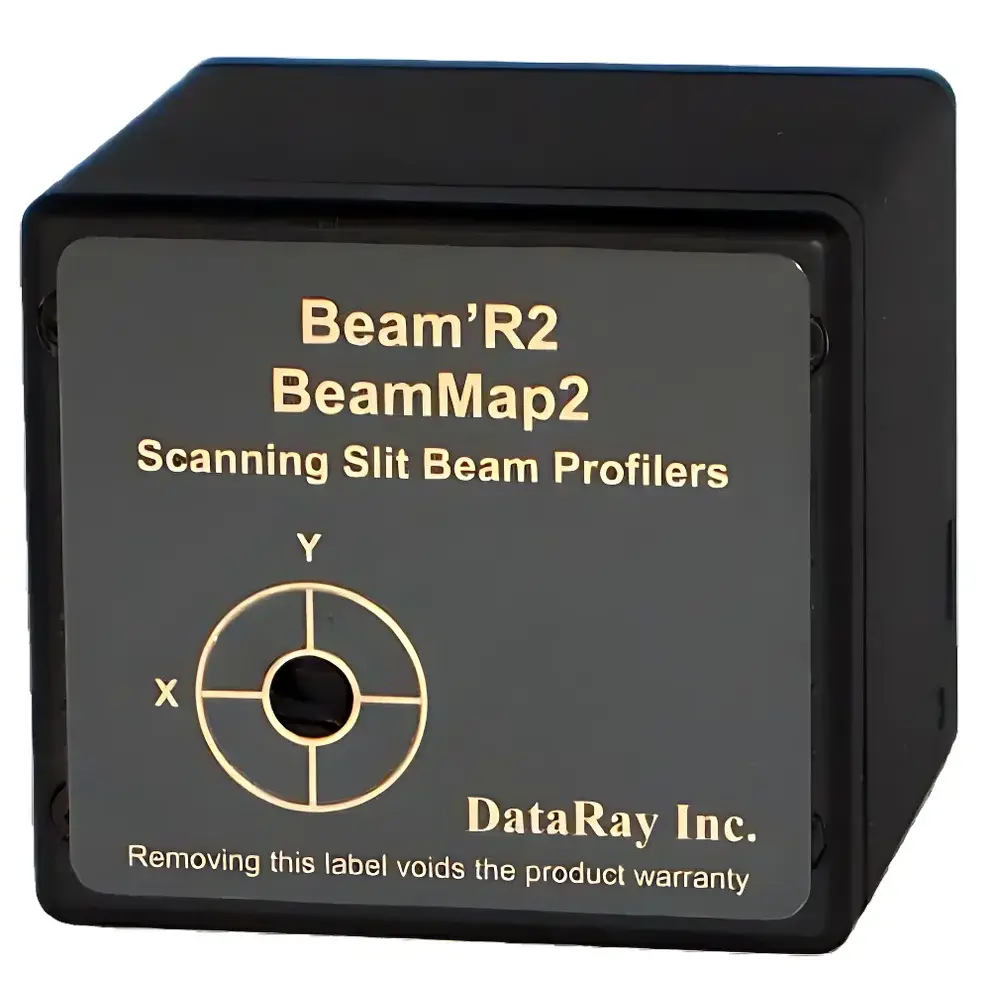
DataRay Beam’R2 and BeamMap2 Scanning Slit Beam Profilers
| Brand | DataRay |
|---|---|
| Origin | USA |
| Model(s) | Beam’R2, BeamMap2 |
| Wavelength Range | Si: 190–1150 nm |
| InGaAs | 650–1800 nm |
| Si + InGaAs | 190–1800 nm |
| Si + InGaAs (extended) | 190–2500 nm |
| Measurable Beam Diameter | 2 µm to 4 mm (2 mm for InGaAs variants) |
| Resolution | 0.1 µm or 0.05% of scan range |
| Accuracy | ±<2% beam diameter, ±≤0.5 µm positional |
| Operation Modes | CW and pulsed (min. PRR ≈ [500 / beam diameter (µm)] kHz) |
| M² Measurement Capability | Supported with motorized translation stage (Beam’R2) |
| Max. Power Handling | 1 W total, 0.3 mW/µm² |
| Gain | 32 dB |
| Detector Types | Silicon (Si), Indium Gallium Arsenide (InGaAs) |
Overview
DataRay Beam’R2 and BeamMap2 are high-precision scanning slit beam profilers engineered for quantitative characterization of laser beams in demanding R&D, manufacturing, and quality assurance environments. Unlike camera-based systems, these instruments employ a mechanically scanned narrow slit coupled with a calibrated photodetector to reconstruct one-dimensional intensity profiles via sequential spatial sampling. This method delivers sub-micron spatial resolution—down to 0.1 µm—and exceptional accuracy in beam width (±<2%), centroid position (±≤0.5 µm), and divergence metrics. The scanning slit architecture eliminates pixelation artifacts and avoids saturation issues common in CMOS/CCD sensors, making it especially suitable for tightly focused, high-peak-power, or ultra-narrow beams (<1 µm) where camera resolution and dynamic range are limiting. Both models support full 2D (X/Y) and 3D (X/Y/Z + angular θ/Φ) beam profiling, enabling rigorous ISO 11146-compliant M² measurements when paired with optional motorized linear stages.
Key Features
- Sub-micron resolution: 0.1 µm absolute positioning resolution or 0.05% of full scan range—ideal for characterizing diffraction-limited spots and near-field fiber outputs.
- Dual-detector flexibility: Interchangeable Si and InGaAs detector heads cover 190–2500 nm across four spectral configurations, supporting UV excimer, visible diode, NIR telecom, and SWIR LIDAR sources.
- Pulsed & CW compatibility: Minimum pulse repetition rate scales inversely with beam size (e.g., ≥500 kHz for 1-µm beams), ensuring stable profile acquisition without temporal aliasing.
- Integrated power handling: Rated for up to 1 W total incident power and 0.3 mW/µm² power density—enabling direct measurement of collimated or moderately focused beams without attenuation.
- Onboard signal conditioning: 32 dB programmable gain with low-noise analog front-end ensures high SNR across low-flux alignment tasks and high-intensity industrial beams.
- Real-time analysis engine: Embedded firmware computes ISO-standard beam parameters—including D4σ, knife-edge FWHM, centroid, ellipticity, and astigmatism—in real time during scanning.
Sample Compatibility & Compliance
The Beam’R2 and BeamMap2 accommodate free-space Gaussian, multimode, top-hat, and structured beams from continuous-wave lasers, Q-switched solid-state systems, and mode-locked oscillators. Their slit-based geometry inherently supports beams with high spatial coherence and low M² values (<1.1), including single-mode fiber outputs and ultrafast amplifier outputs. All firmware and data export protocols comply with ISO/IEC 17025 documentation requirements for metrological traceability. Exported datasets include full audit trails (timestamp, operator ID, instrument serial, calibration epoch) and support GLP/GMP-aligned workflows. Optional FDA 21 CFR Part 11-compliant software modules provide electronic signatures, role-based access control, and immutable data archiving for regulated medical laser validation (e.g., ophthalmic ablation systems).
Software & Data Management
DataRay’s WinCamD-SDK and BeamGage Professional software suite provides full control, visualization, and reporting capabilities. BeamGage supports automated pass/fail thresholding against user-defined tolerances, batch processing of multi-position scans, and generation of PDF/CSV/Excel reports compliant with internal QA standards. Raw profile data is stored in HDF5 format—ensuring long-term readability and interoperability with MATLAB, Python (h5py), and LabVIEW. The BeamMap2 variant includes an integrated precision motorized stage, eliminating external controller dependencies and enabling fully synchronized Z-scan acquisitions for M² determination per ISO 11146-1 & -2. All software updates are version-controlled and validated per IEC 62304 Class B medical device software requirements where applicable.
Applications
- Laser manufacturing: Real-time monitoring of focus stability in fiber laser cutting heads and galvo-scanned welding optics.
- Telecom R&D: Mode field diameter verification of SMF-28 and photonic crystal fibers at 1310/1550 nm.
- LIDAR system development: Characterization of VCSEL array near-field uniformity and far-field divergence in AR/VR depth-sensing modules.
- Ophthalmic laser systems: Quantitative validation of Gaussian beam quality and spot size repeatability in femtosecond LASIK platforms.
- Spectroscopy source qualification: Measurement of excimer laser beam homogeneity and spatial coherence for LIBS and MALDI applications.
- LED and micro-LED metrology: Near-field irradiance mapping of chip-scale emitters for automotive headlamp and display backlighting design.
FAQ
How does a scanning slit profiler differ from a camera-based beam profiler?
Scanning slit systems use mechanical translation of a narrow aperture to sample beam intensity point-by-point, achieving higher spatial resolution and dynamic range than pixel-limited cameras—especially critical for beams 60 dB intensity variation.
Can the BeamMap2 perform M² measurements without external hardware?
Yes—the BeamMap2 integrates a precision motorized linear stage and synchronized Z-axis control, enabling fully automated ISO 11146 M² measurements without third-party motion controllers or alignment fixtures.
What calibration standards are supported?
Factory calibration is traceable to NIST-certified reference apertures and spectral irradiance standards; users may perform on-site verification using certified pinhole arrays and neutral density filters per ISO 13694.
Is real-time beam stabilization possible?
BeamGage Professional supports hardware-triggered acquisition and closed-loop feedback output (via analog voltage or USB command) for integration into active beam steering or adaptive optics control loops.
Does the system support ultrafast pulses (e.g., <100 fs)?
Yes—provided average power remains within thermal limits and pulse energy does not exceed detector damage thresholds (typically >100 nJ for Si, >1 µJ for InGaAs with appropriate attenuation).




