
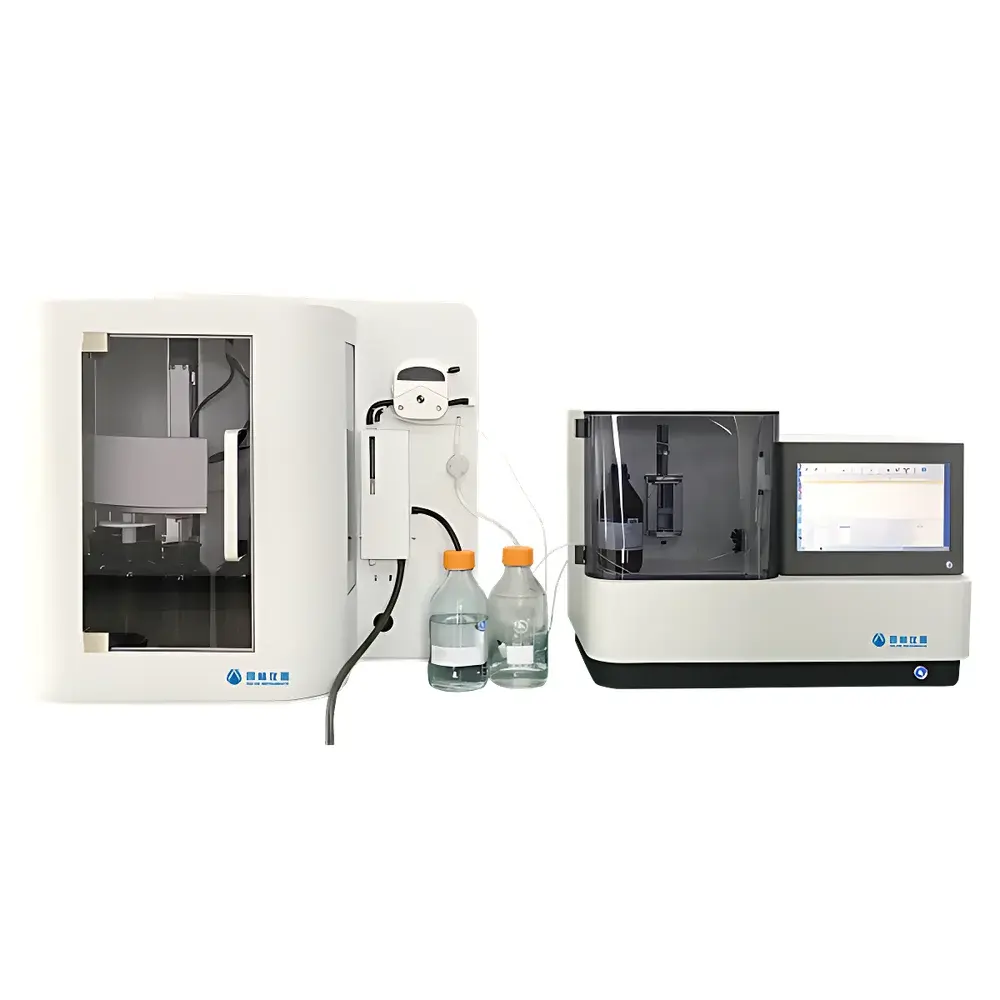
Online Instrument OL1043 Fully Automated Fluorescence Oil-in-Water Analyzer
| Brand | Online Instrument |
|---|---|
| Origin | Shanghai, China |
| Manufacturer Type | Direct Manufacturer |
| Region of Origin | Domestic (China) |
| Model | OL1043 |
| Instrument Category | Laboratory-Based |
| Measurement Principle | Fluorescence Spectrophotometry |
| Measurement Range | 0–5 mg/L (with automatic dilution beyond range) |
| Detection Limit | 0.0010 mg/L |
| Accuracy | ±2% |
| Resolution | 0.001 mg/L |
Overview
The Online Instrument OL1043 Fully Automated Fluorescence Oil-in-Water Analyzer is engineered for precise, high-throughput quantification of petroleum hydrocarbons in aqueous environmental matrices. It operates on the principle of fluorescence spectrophotometry—where polycyclic aromatic hydrocarbons (PAHs) and aliphatic components in extracted petroleum compounds are excited at specific UV wavelengths (typically 225–230 nm), emitting characteristic fluorescence signals proportional to concentration. This method delivers superior selectivity and sensitivity over infrared or gravimetric alternatives, especially in low-concentration marine, estuarine, and freshwater samples where background interferences (e.g., humic substances, chlorophyll) are minimized via spectral discrimination and multi-stage phase separation. Designed for compliance with ISO 9377-2:2000 (Water quality — Determination of hydrocarbon oil index — Part 2: Method using fluorescence), ASTM D7678-22 (Standard Test Method for Determination of Total Petroleum Hydrocarbons in Water by Fluorescence), and China’s HJ 970-2018 (Determination of petroleum hydrocarbons in water — Fluorescence spectrophotometric method), the OL1043 supports regulatory reporting for environmental monitoring agencies, municipal wastewater laboratories, and offshore research platforms.
Key Features
- Fully automated sample processing from 500 mL narrow-mouth glass sampling bottles—eliminating manual transfer, reducing contamination risk, and ensuring traceability per EPA Method 1664B and HJ 970-2018 sampling protocols.
- Triple-phase separation architecture: integrated liquid-liquid extraction, membrane-based water/organic phase partitioning, and anhydrous Na₂SO₄ dehydration—ensuring >99.5% removal of residual water and particulates prior to fluorescence measurement.
- Reverse-pressure solvent flush mechanism for separation modules—preventing channel clogging and eliminating carryover between samples (cross-contamination < 0.1% RSD).
- Hermetically sealed fluidic path with activated carbon exhaust filtration—fully isolating operators from hazardous solvents (e.g., petroleum ether) and meeting OSHA 29 CFR 1910.1200 (Hazard Communication Standard) requirements.
- Onboard reagent recovery system: spent petroleum ether is automatically segregated, stored in dedicated containment vessels, and compatible with off-site solvent recycling per RCRA guidelines.
- Modular sample carousel supporting 6–12 positions (field-upgradable to 24+), enabling unattended overnight operation and batch analysis of coastal, riverine, and open-ocean monitoring campaigns.
Sample Compatibility & Compliance
The OL1043 accepts standard 500 mL EPA-compliant narrow-neck borosilicate glass bottles without decanting or pre-filtration. It accommodates heterogeneous aqueous samples—including turbid estuarine waters, sediment-laden river inflows, and saline seawater—with no loss of accuracy due to its non-contact volume recognition system (<2% volumetric error). All wetted components comply with USP Class VI biocompatibility standards and resist corrosion from petroleum ether (boiling point 60–80 °C). The instrument meets GLP/GMP data integrity requirements through audit-trail-enabled firmware, electronic signatures, and full 21 CFR Part 11 compliance for raw data storage, method versioning, and user access logs.
Software & Data Management
Controlled via a ruggedized 10.1-inch capacitive touchscreen interface running embedded Linux OS, the OL1043 supports both local operation and remote supervision via secure HTTPS web portal or dedicated iOS/Android application. Software modules include: auto-calibration using NIST-traceable mineral oil standards; dynamic range extension via programmable 1:2 to 1:100 dilution sequences; real-time QC flagging (e.g., signal saturation, baseline drift, separation failure); and export of CSV, PDF, and XML reports compliant with LIMS integration (ASTM E1482-21). All spectral scans, raw fluorescence intensities, and diagnostic logs are timestamped and cryptographically hashed for forensic audit readiness.
Applications
- Regulatory monitoring of petroleum hydrocarbons in coastal discharge points, harbor sediments, and ballast water per IMO Ballast Water Management Convention Annexes.
- Long-term trend analysis in national water quality surveillance networks (e.g., China’s National Surface Water Monitoring Network, USGS NWIS).
- Emergency response screening following oil spills—providing quantitative results within 12 minutes per sample.
- Research applications in marine biogeochemistry, including PAH bioavailability studies and microbial degradation kinetics under controlled lab conditions.
- Wastewater treatment plant effluent verification, particularly for refineries and petrochemical facilities subject to NPDES permit limits.
FAQ
Does the OL1043 require external ventilation or fume hood installation?
No—the system is fully self-contained with internal activated carbon adsorption and negative-pressure exhaust management, certified for benchtop use in standard laboratory environments.
Can it analyze seawater samples with salinity up to 35 ppt?
Yes—its triple-phase separation and fluorescence compensation algorithms correct for ionic strength effects and natural organic matter quenching across full marine salinity ranges.
Is method validation documentation provided for regulatory submissions?
Yes—factory-installed IQ/OQ protocols, linearity verification reports (R² ≥ 0.999 over 0.001–5 mg/L), and inter-laboratory precision datasets (per ISO 5725-2) are included with each unit.
What maintenance intervals are recommended for routine operation?
Primary maintenance includes quarterly replacement of Na₂SO₄ cartridges and activated carbon filters; annual calibration verification using certified reference materials; no optical alignment or lamp replacement required within first 5 years (LED excitation source lifetime > 20,000 hours).
Related Products







