
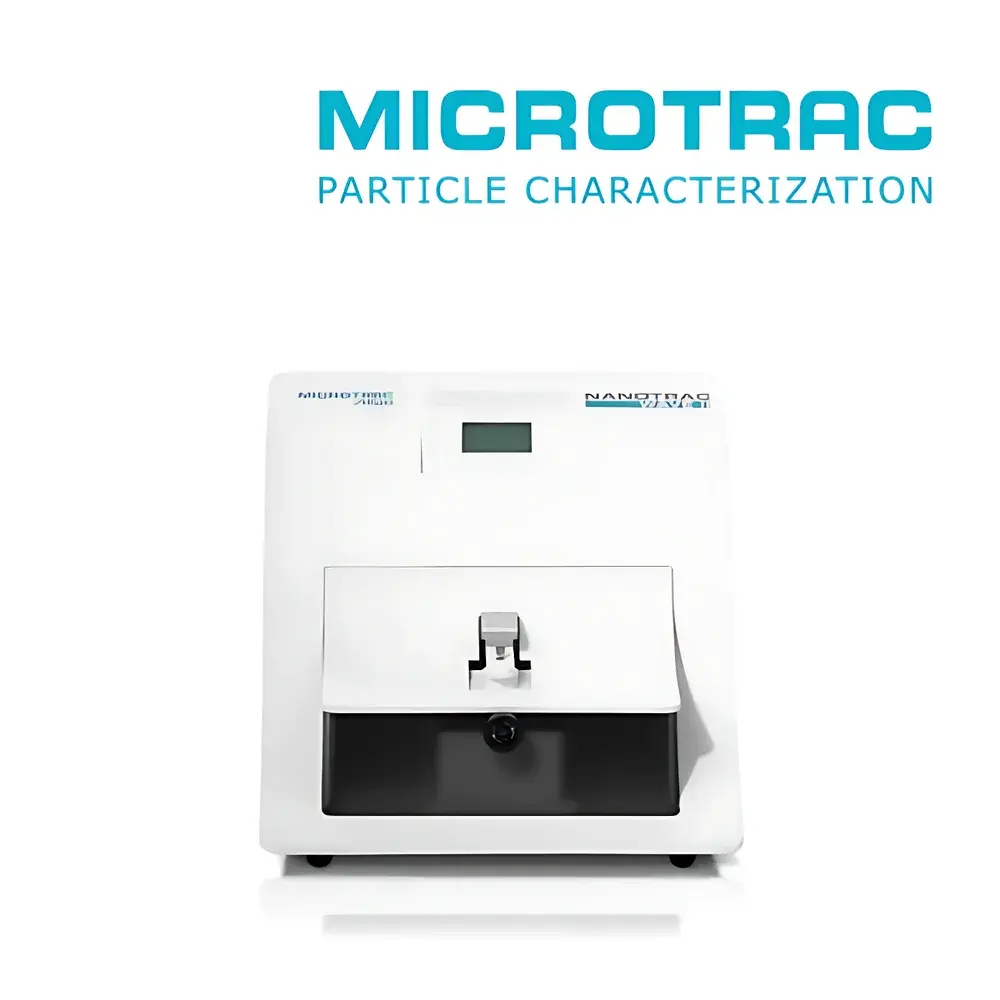
Microtrac NANOTRAC WAVE II Nanoparticle Size and Zeta Potential Analyzer
| Brand | Microtrac |
|---|---|
| Origin | Germany |
| Model | NANOTRAC WAVE II |
| Zeta Potential Range | ±200 mV |
| Temperature Operating Range | 0–90 °C (programmable ramp) |
| pH Resolution | 0.1 |
| Temperature Accuracy | ±0.1 °C |
| Particle Size Range | 0.3 nm – 10 µm |
| Concentration Range | 100 ppb – 40 % w/v |
| Detection Angle | 180° (backscatter) |
| Repeatability | ≤1% |
| Theoretical Basis | Full-range Mie theory with non-spherical particle correction factor |
| Compliance | ISO 13321, ISO 13099-2:2012, ISO 22412:2008 |
| Software Compliance | FDA 21 CFR Part 11 (electronic signatures, audit trail, user access control) |
Overview
The Microtrac NANOTRAC WAVE II is a fully integrated nanoparticle characterization platform engineered for simultaneous, high-fidelity measurement of hydrodynamic size distribution and zeta potential in colloidal dispersions. Unlike conventional instruments requiring separate optical cells or sequential measurement modes, the WAVE II employs a unified optical-electrokinetic architecture based on dynamic light backscattering (DLB) and microelectrophoretic mobility analysis. Its core innovation lies in the fixed-position, fiber-coupled 780 nm semiconductor laser (3 mW) and Y-shaped optical probe that delivers incident light directly through a sapphire window into the sample—eliminating alignment drift, cell-to-cell variability, and optical path loss associated with cuvette-based systems. Zeta potential is determined via electrophoretic mobility under a precisely controlled microelectric field generated by an integrated membrane electrode, avoiding Joule heating, electrode polarization, and electrolyte contamination. This design enables true in-situ, single-injection analysis across aqueous and organic media—without dilution, filtration, or cell replacement—while maintaining traceable accuracy per ISO 13099-2:2012 (zeta potential) and ISO 22412:2008 (DLS).
Key Features
- Patented Y-fiber optical architecture with sapphire immersion window ensures stable, alignment-free backscatter detection at 180°—minimizing signal attenuation from cell walls, refractive index mismatch, or particulate fouling.
- Membrane electrode system generates a uniform, low-power electric field (<5 V/cm) directly within the measurement zone, enabling precise electrophoretic velocity measurement without thermal artifacts or bubble formation.
- Heterodyne multi-Doppler frequency shift detection enhances signal-to-noise ratio by >3 orders of magnitude versus standard photon correlation spectroscopy (PCS), improving resolution for polydisperse or weakly scattering samples.
- Controlled Reference Method (CRM) algorithm deconvolves Doppler spectral broadening to resolve subtle mobility differences—critical for detecting surface charge heterogeneity in protein conjugates or functionalized nanoparticles.
- Ultra-short optical path length (<1 mm) suppresses multiple scattering effects, allowing accurate sizing up to 40 % w/v concentration—ideal for undiluted biologics, polymer emulsions, and ceramic slurries.
- Real-time Fast Fourier Transform (FFT) processing delivers full size and zeta distributions in 30–120 seconds, with automatic peak discrimination (unimodal/multimodal) based on statistical confidence thresholds—not user-defined assumptions.
Sample Compatibility & Compliance
The NANOTRAC WAVE II accommodates both aqueous and organic dispersants—including water, ethanol, isopropanol, THF, DMF, and chloroform—without hardware modification. Its temperature-controlled sample chamber supports programmable ramps from 0 °C to 90 °C (±0.1 °C stability), enabling kinetic studies of aggregation onset, surfactant desorption, or thermoresponsive polymer collapse. All measurements adhere to internationally recognized standards: ISO 13321 (DLS methodology), ISO 13099-2:2012 (electrophoretic light scattering for zeta potential), and ISO 22412:2008 (general principles of DLS). Instrument validation includes documented IQ/OQ protocols, and raw data files retain full metadata (temperature, voltage, count rate, autocorrelation decay) for retrospective analysis.
Software & Data Management
FLEX software provides a validated, 21 CFR Part 11–compliant environment for instrument control, data acquisition, and reporting. It features role-based user authentication, electronic signatures, immutable audit trails, and configurable permission levels for method editing, result approval, and data export. Analytical outputs include volume-, number-, and intensity-weighted size distributions; cumulative/differential percentiles; polydispersity index (PdI); zeta potential histograms with mobility-to-zeta conversion using Henry’s equation and Smoluchowski approximation; and Debye length calculations. Export formats include PDF (print-ready reports), Microsoft Access (.mdb via OLE), CSV, and XML. Data can be archived to network drives or shared securely via HTTPS-enabled web portals—fully supporting GLP and GMP laboratory workflows.
Applications
The NANOTRAC WAVE II serves critical quality control and R&D functions across pharmaceuticals (liposome stability, mRNA-LNP formulation, protein aggregation), advanced materials (quantum dot surface functionalization, carbon nanotube dispersion), cosmetics (nanoemulsion charge stabilization), and environmental science (colloidal clay transport, nanoparticle ecotoxicity screening). Its ability to quantify both size and surface charge in one run—under physiologically relevant ionic strength and pH—makes it indispensable for predicting colloidal stability via DLVO theory, optimizing surfactant selection, and qualifying batch-to-batch consistency of nanotherapeutics.
FAQ
Does the NANOTRAC WAVE II require calibration standards for routine operation?
No—its optical and electrokinetic subsystems are factory-aligned and drift-compensated in real time. NIST-traceable polystyrene latex standards are optional for verification but not mandatory for daily use.
Can it measure zeta potential in high-salt buffers (e.g., 150 mM NaCl)?
Yes—the membrane electrode and low-voltage field design maintain reliable mobility resolution even at conductivity levels up to 200 mS/cm, provided the laser signal remains detectable.
Is sample volume consumption minimized?
Yes—only 0.5–1.0 mL is required per analysis, and the flow-through cell option supports automated, unattended sequential measurements.
How does it handle non-spherical particles such as nanorods or platelets?
The FLEX software applies empirically validated non-spherical correction factors derived from Mie theory extensions, improving accuracy for anisotropic morphologies when shape parameters are known or estimated.
What maintenance is required for long-term operational reliability?
Annual optical alignment verification and electrode performance testing are recommended; no consumables (e.g., cuvettes, capillaries) are needed—reducing cost of ownership and cross-contamination risk.



