
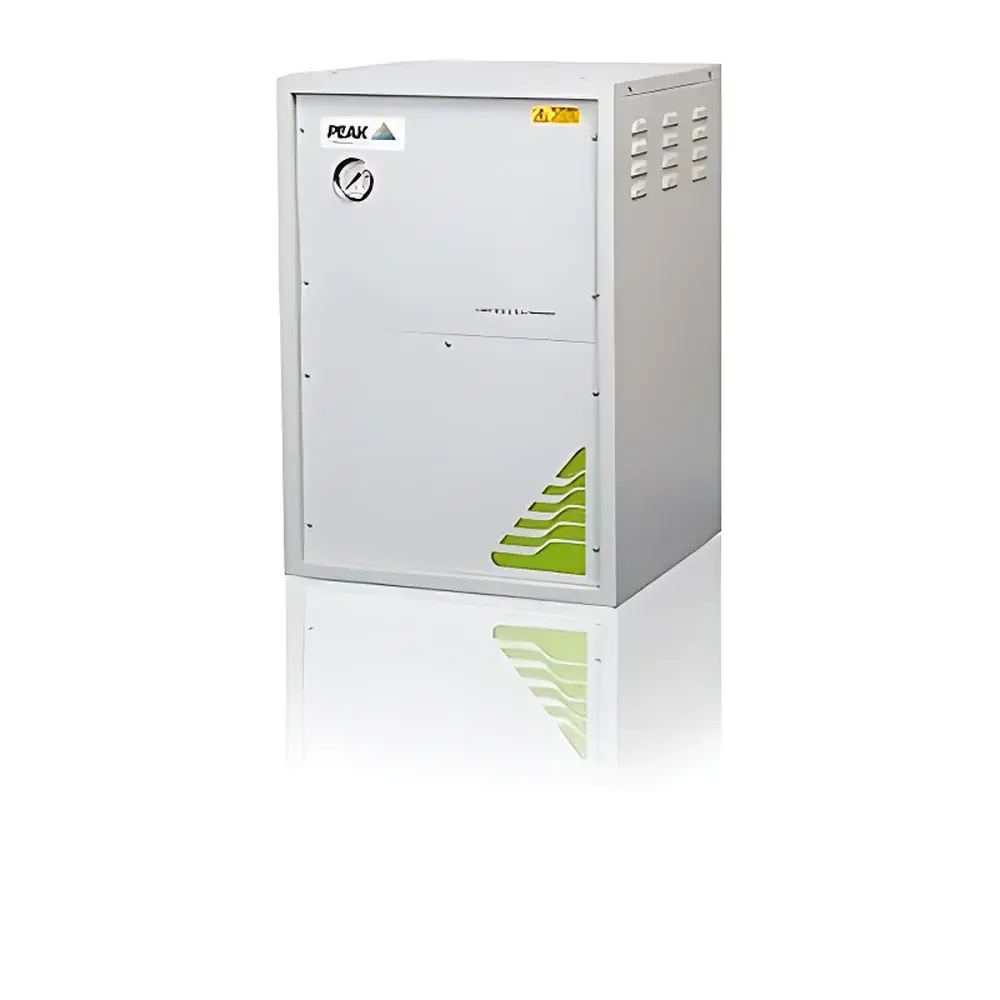
Peak Scientific NG250(A)–4000(A) PSA Nitrogen Generator
| Brand | PEAK |
|---|---|
| Origin | United Kingdom |
| Manufacturer Type | Original Equipment Manufacturer (OEM) |
| Product Category | Imported |
| Model | NG250(A)–4000(A) |
| Nitrogen Generation Principle | Pressure Swing Adsorption (PSA) |
| Output Flow Rate | 250–4,000 cc/min |
| Output Pressure | 80 psi (5.5 bar) |
| Nitrogen Purity | 99.9995% (O₂ < 0.5 ppm) |
| Dew Point | −70 to −94 °C |
Overview
The Peak Scientific NG250(A)–4000(A) PSA Nitrogen Generator is an engineered solution for laboratories requiring continuous, on-demand, ultra-high-purity nitrogen gas as carrier, purge, or auxiliary gas for analytical instrumentation. Utilizing proven pressure swing adsorption (PSA) technology, the system separates nitrogen from compressed air by selectively adsorbing oxygen, moisture, and CO₂ onto carbon molecular sieve (CMS) beds under elevated pressure, then regenerating the beds during depressurization cycles. This cyclic, self-regenerating process eliminates consumables and ensures long-term operational stability without manual intervention. Designed for integration with gas chromatography (GC), GC-MS, LC-MS, FTIR, TOC analyzers, ICP-OES/MS, and thermal analysis platforms—including DSC, TGA, TMA, DMA, and TOD—the NG series delivers consistent, laboratory-grade nitrogen meeting stringent analytical requirements across regulated and research environments.
Key Features
- Modular configuration: Available with or without integrated oil-free air compressor—enabling flexible installation in labs with existing compressed air infrastructure or limited utility space.
- Ultra-high purity output: 99.9995% N₂ (≤0.5 ppm O₂), validated per ISO 8573-1:2010 Class 2:2:2 for particulates, water, and oil content.
- Stable pressure delivery: Regulated output up to 80 psi (5.5 bar) with minimal fluctuation (<±1 psi), ensuring compatibility with high-backpressure GC inlets and mass spectrometer interfaces.
- Deep-dry gas: Achieves dew point temperatures between −70 °C and −94 °C, minimizing condensation risk in sensitive detector housings and transfer lines.
- Self-regenerating CMS columns: No scheduled replacement required; automatic regeneration maintains consistent performance over >20,000 hours of operation under standard duty cycles.
- Plug-and-play architecture: Pre-calibrated, factory-tested, and CE/UKCA marked—ready for immediate deployment with standard 1/4″ NPT female outlet.
- Energy-efficient design: Optimized compressor duty cycling and low-power solenoid valve sequencing reduce total cost of ownership versus liquid nitrogen or high-pressure cylinder supply.
Sample Compatibility & Compliance
The NG250(A)–4000(A) is compatible with all major GC and GC-MS platforms requiring high-purity nitrogen, including those from Agilent, Thermo Fisher Scientific, Shimadzu, Waters, Bruker, and AB Sciex. Its output meets ASTM D6349–22 specifications for nitrogen used in trace-level hydrocarbon analysis and complies with USP and EP 2.5.27 guidelines for inert gases in pharmaceutical testing. The system supports GLP and GMP workflows through optional audit-trail-enabled firmware (available via Peak’s Genie™ software suite), facilitating compliance with FDA 21 CFR Part 11 requirements for electronic records and signatures when paired with validated configurations.
Software & Data Management
While the base NG series operates autonomously via embedded microcontroller logic, optional Genie™ Connect integration enables remote monitoring, real-time pressure/flow telemetry, predictive maintenance alerts, and event logging via Ethernet or Wi-Fi. Logged data—including CMS cycle count, inlet pressure history, and alarm timestamps—is exportable in CSV format for internal QA review or regulatory submission. Firmware updates are delivered securely over HTTPS, and all configuration changes are timestamped and user-attributed to support audit readiness.
Applications
- GC carrier gas for capillary column separation, especially in trace VOC, pesticide residue, and environmental contaminant analysis.
- Collision/reaction gas in triple-quadrupole and Q-TOF mass spectrometers.
- Purge gas for headspace samplers and thermal desorption units.
- Blanketing and inerting in thermal analysis systems (DSC, TGA, TMA, DMA) to prevent oxidative degradation during heating ramps.
- Plasma gas for ICP-OES and ICP-MS instruments requiring stable, low-particulate nitrogen supply.
- Zero-air generation support when coupled with catalytic oxidation modules (via third-party integration).
FAQ
What is the expected lifetime of the carbon molecular sieve (CMS) columns?
CMS columns are rated for ≥20,000 operating hours under nominal flow and pressure conditions. No scheduled replacement is required due to the self-regenerating PSA cycle.
Can this generator supply multiple instruments simultaneously?
Yes—provided total demand remains within the selected model’s rated flow range and distribution piping is properly sized to minimize pressure drop (recommended max 10% loss from generator to farthest outlet).
Is external compressed air required for models without built-in compressors?
Yes—models designated without “(A)” suffix require a clean, dry, oil-free air source delivering 100–120 psi at ≥5 SCFM (NG250) to ≥20 SCFM (NG4000), compliant with ISO 8573-1 Class 1:2:1.
Does the system include filtration for oil and particulates?
All models incorporate multi-stage pre-filtration (coalescing + activated carbon + desiccant) upstream of the CMS beds, meeting ISO 8573-1 Class 2:2:2 at the nitrogen outlet.
How does ambient temperature affect dew point performance?
Dew point is maintained across ambient ranges of 15–35 °C; operation outside this range may require environmental conditioning to ensure stable adsorption kinetics and long-term CMS integrity.
Related Products



