
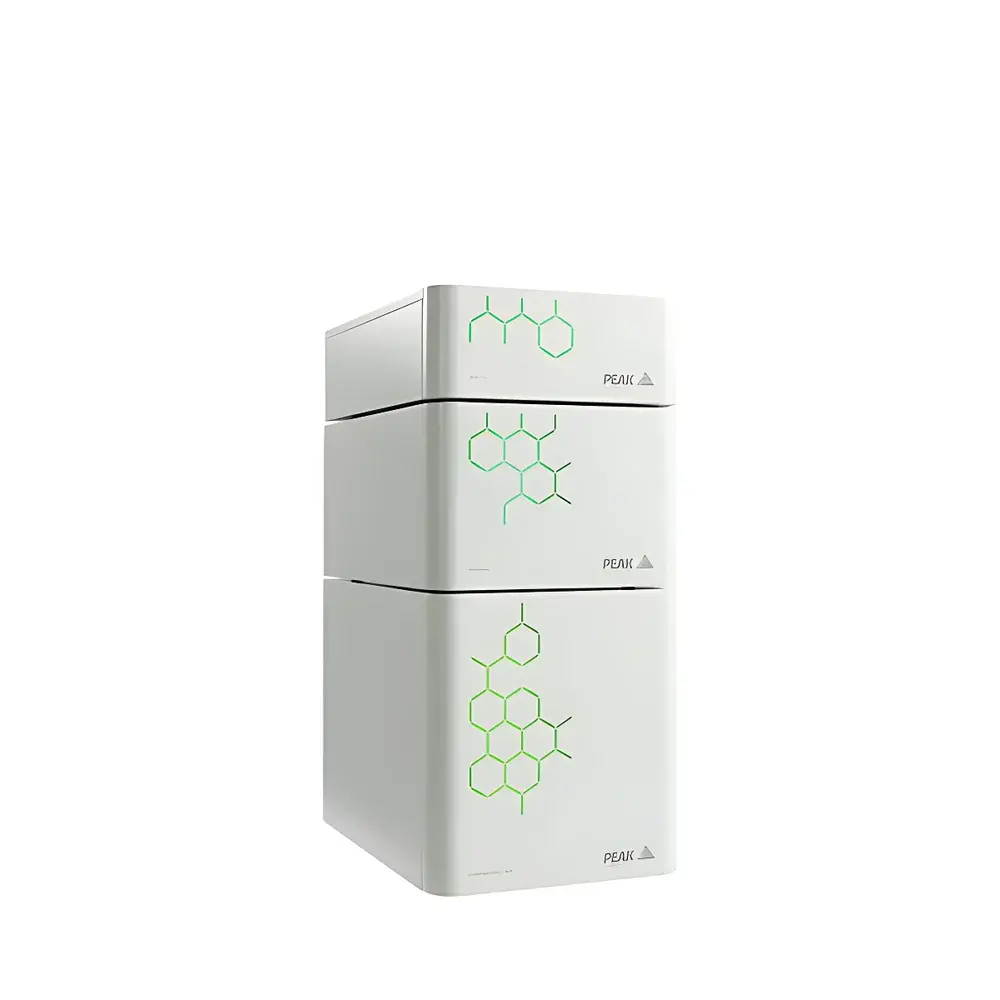
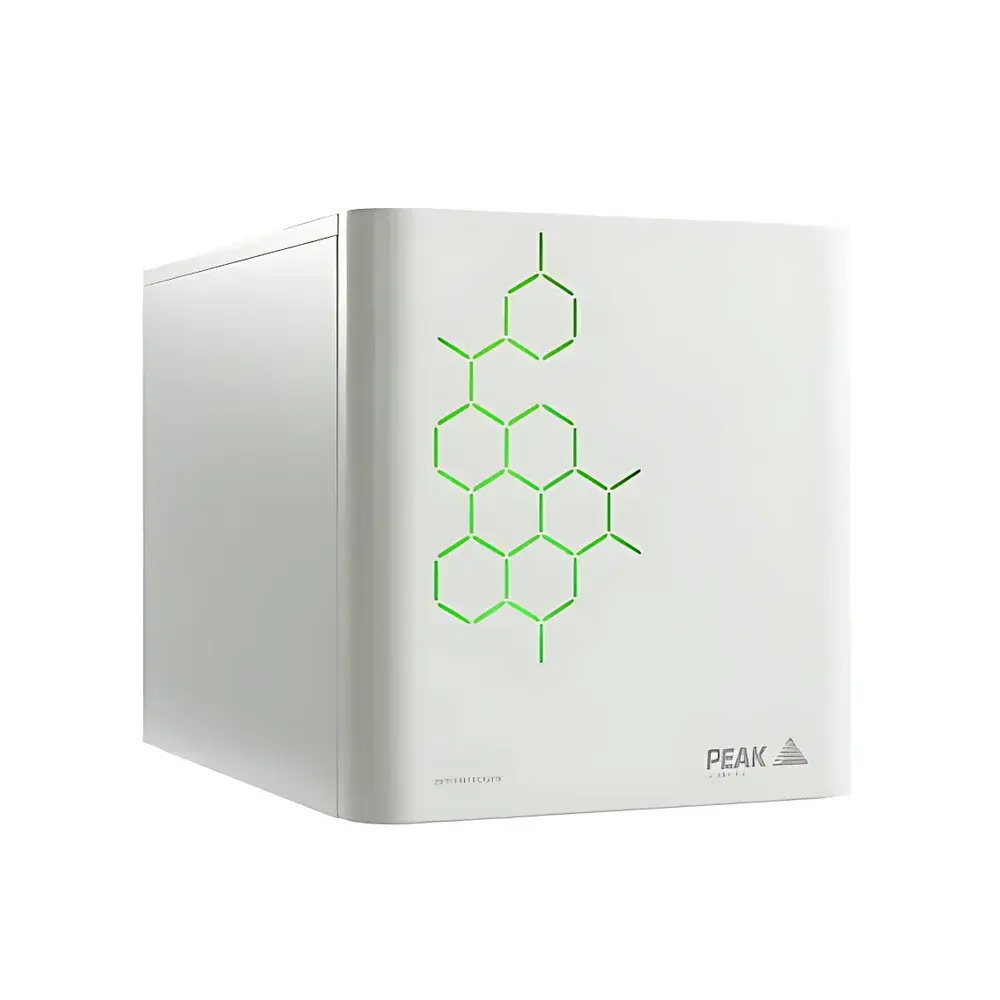
Peak Scientific Precision Zero Air 3L Air Generator
| Brand | PEAK |
|---|---|
| Origin | United Kingdom |
| Manufacturer | Peak Scientific |
| Product Type | Imported |
| Model | Precision Zero Air 3L |
| Hydrocarbon Removal Principle | High-Temperature Catalytic Cracking |
| Output Flow Rate | 3 L/min |
| Output Pressure | 80 psi |
| Total Hydrocarbon (THC) Content | < 0.05 ppm |
| Particle Filtration | < 0.01 µm |
| Startup Time | 60 min |
| Operating Temperature | 5–35 °C |
| Electrical Requirement | 110–230 VAC, 50/60 Hz |
| Power Consumption | 1.54 kW |
| Dimensions (W×D×H) | 15.1" × 21.3" × 15.9" |
| Weight | 41 kg (90.3 lbs) |
| Noise Level | Low-noise operation |
Overview
The Peak Scientific Precision Zero Air 3L Air Generator is an engineered solution for laboratories requiring ultra-pure, hydrocarbon-free compressed air as a combustion support gas—primarily for Flame Ionization Detectors (FID) in gas chromatography (GC) systems. It operates on the principle of high-temperature catalytic cracking to decompose trace volatile organic compounds (VOCs), including methane and other C1–C4 hydrocarbons, into CO₂ and H₂O prior to final filtration. This process ensures consistent delivery of zero-grade air meeting stringent analytical requirements for GC-FID, GC-MS, FTIR, TOC analyzers, and other instrumentation sensitive to hydrocarbon interference. Designed and manufactured in the UK, the Precision Zero Air 3L integrates a proprietary oil-free scroll compressor, multi-stage catalytic purification, and sub-micron particulate filtration to deliver air with < 0.05 ppm total hydrocarbons (as methane), < 0.01 µm particulate removal efficiency, and zero detectable phthalates—fully compliant with ASTM D6216 and ISO 8573-1 Class 1:1:1 for solid particles, water, and oil aerosols.
Key Features
- Optimized for GC-FID applications: Delivers stable, low-hydrocarbon air at up to 3 L/min and 80 psi, eliminating baseline drift and false positives caused by ambient or cylinder-derived hydrocarbon contamination.
- High-temperature catalytic converter: Operates continuously at >350 °C to ensure complete oxidation of residual hydrocarbons—validated per ICH Q2(R2) method suitability criteria for trace-level impurity detection.
- Integrated precision scroll compressor: Oil-free, low-vibration architecture minimizes maintenance intervals and eliminates risk of oil carryover into downstream instrumentation.
- Rapid system readiness: Achieves specification-grade output within 60 minutes of power-on, supporting same-day instrument qualification without dependency on external gas supply logistics.
- Space-efficient stackable chassis: Compact footprint (15.1″ W × 21.3″ D × 15.9″ H) enables benchtop or under-bench installation, reducing spatial constraints in regulated QC/QA laboratories.
- Comprehensive safety architecture: Includes real-time pressure monitoring, thermal cut-off protection, automatic shutdown on filter saturation, and CE/UKCA certification per EN 61000-6-3 (EMC) and EN 61000-6-4 (immunity).
Sample Compatibility & Compliance
The Precision Zero Air 3L is validated for use with major analytical platforms including Agilent, Thermo Fisher Scientific, Waters, Shimadzu, Bruker, and AB Sciex GC and GC-MS systems. Its output meets the air purity specifications referenced in USP , EP 2.2.37, and ISO/IEC 17025-accredited methods requiring hydrocarbon-free combustion gases. The system supports GLP and GMP environments through optional audit-ready logging (via RS232/USB), with full traceability of runtime hours, pressure events, and maintenance alerts. All consumables—including the annual maintenance kit (Part No. 08-3611)—are manufactured to ISO 9001:2015 and ISO 13485:2016 standards, ensuring batch-to-batch consistency and regulatory acceptance across EMA, FDA, and NMPA submissions.
Software & Data Management
While the Precision Zero Air 3L operates as a standalone hardware unit, its embedded controller provides digital status feedback via LED indicators and optional serial/USB interface for integration into laboratory information management systems (LIMS). When connected to Peak’s optional PrecisionLink™ software (v3.2+), users gain access to historical operational logs—including cumulative runtime, pressure deviation trends, and filter life estimation—enabling predictive maintenance scheduling aligned with ISO/IEC 17025 Clause 6.4.2. Audit trail functionality complies with FDA 21 CFR Part 11 requirements when deployed with appropriate electronic signature controls and user-access protocols.
Applications
- Gas Chromatography with Flame Ionization Detection (GC-FID): Primary application for hydrocarbon-free combustion air in environmental, petrochemical, and pharmaceutical residue analysis.
- Trace-level VOC monitoring: Supports EPA Method 8260D, ASTM D5504, and ISO 11843-3 validation studies where background hydrocarbon interference must be below method detection limits.
- FTIR spectroscopy: Provides clean purge and reference air for high-sensitivity absorption measurements in polymer and pharmaceutical excipient characterization.
- Total Organic Carbon (TOC) analysis: Serves as carrier and oxidant gas in high-temperature catalytic oxidation (HTCO) systems per USP and EP 2.2.44.
- Calibration gas blending: Used as matrix gas in dynamic dilution systems for certified reference material (CRM) preparation under ISO Guide 34.
FAQ
What is the recommended maintenance schedule for the Precision Zero Air 3L?
Annual replacement of the integrated filter cartridge (Part No. 08-3611) is required under normal operating conditions (8 hrs/day, 5 days/week). Filter life may vary based on ambient air quality; Peak recommends monitoring pressure differential across the catalytic bed and initiating service if ΔP exceeds 15 psi.
Can this generator be used with multiple GC instruments simultaneously?
The Precision Zero Air 3L is rated for single-instrument support at 3 L/min. For multi-GC configurations, Peak recommends the Precision Zero Air 30L model or manifolded parallel units with pressure-regulated distribution manifolds compliant with ISO 8573-7.
Is the output air suitable for mass spectrometry applications?
While optimized for GC-FID, the air stream meets ISO 8573-1 Class 1:1:1 for particles and oil aerosols but is not intended as source gas for MS ion sources; nitrogen or helium remains the preferred carrier and nebulizer gas for LC-MS and GC-MS.
Does the system require external cooling or ventilation?
Yes. The unit dissipates ~1.5 kW of heat and must be installed in an environment with ≥200 CFM ambient airflow and clearance of ≥10 cm on all sides to maintain operating temperature between 5–35 °C.
How is compliance with pharmacopeial air purity standards verified?
Peak supplies factory-certified test reports per ISO 8573-1 Annex B, including GC-FID chromatograms demonstrating <0.05 ppm THC (methane equivalent) and particle count data from certified laser particle counters—available upon request with each shipment.



