
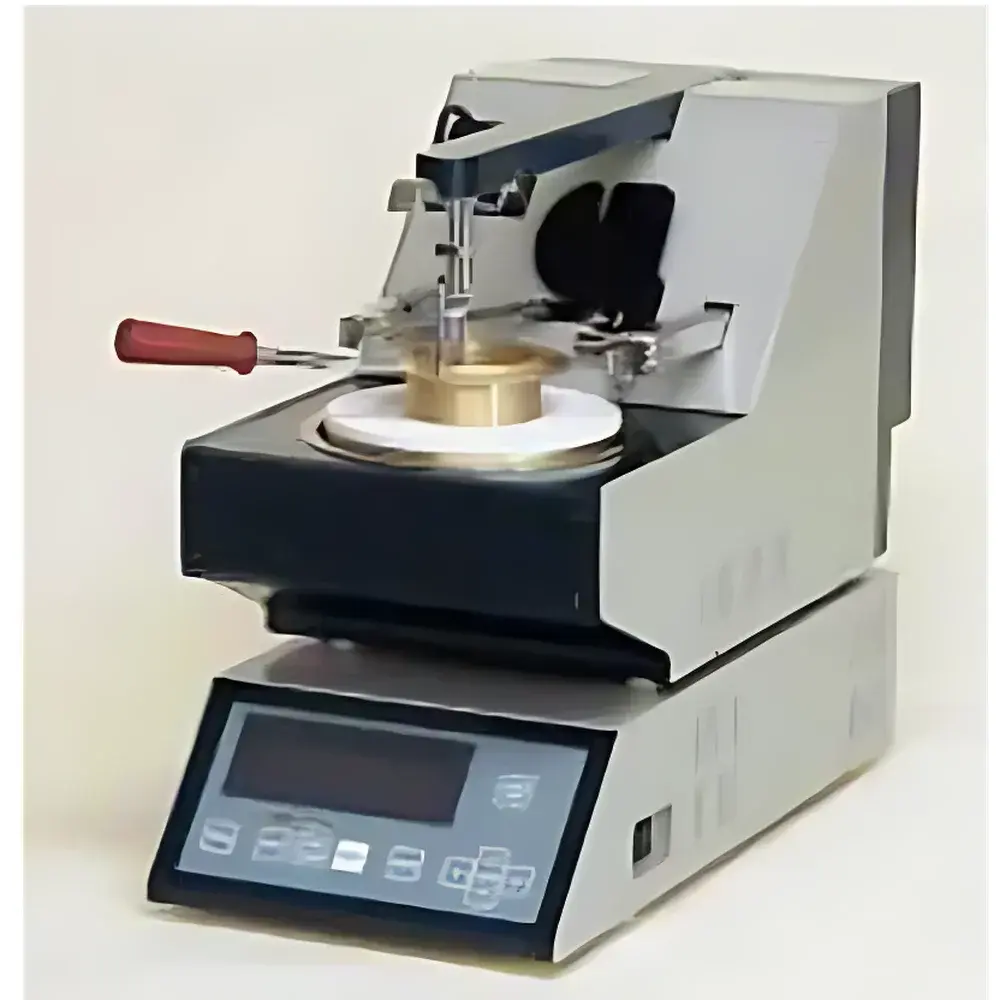
Xufeng FP92B Automated Cleveland Open Cup Flash Point Tester
| Brand | Xufeng |
|---|---|
| Origin | Shanghai, China |
| Model | FP92B |
| Test Method | Cleveland Open Cup (COC), ASTM D92-compliant |
| Operation Mode | Fully Automatic |
| Temperature Range | 79–400 °C |
| Ignition Method | Fully Automatic Gas Flame |
| Compliant Standards | GB/T 3536-2022, ISO 2592, ASTM D92, IP 36, JIS K 2265 |
Overview
The Xufeng FP92B Automated Cleveland Open Cup (COC) Flash Point Tester is an engineered solution for precise, repeatable flash point determination of viscous and high-boiling petroleum products—particularly asphalt binders, heavy fuel oils, and residual lubricants. It operates on the principle of the Cleveland Open Cup method, in which a sample is heated at a controlled rate in an open test cup while an ignition source is periodically passed across the vapor space above the surface. The flash point is defined as the lowest temperature at which application of the test flame causes the vapors to ignite momentarily—producing a visible flash—under standardized atmospheric conditions. Designed to meet the strict procedural requirements of ASTM D92, ISO 2592, and GB/T 3536-2022, the FP92B integrates closed-loop microcontroller (MCU)-based thermal regulation, ionization-based flame detection, and real-time barometric pressure compensation to ensure metrological integrity across global laboratory environments.
Key Features
- Fully automated test execution: User inputs only the expected flash point; the instrument autonomously executes heating, scanning, detection, and cooling per ASTM D92 protocol.
- Ionization ring (O-ring type) flash detection system: Offers high sensitivity to transient flame events, minimal false positives, and tool-free disassembly for routine cleaning and maintenance.
- VFD (Vacuum Fluorescent Display) interface: Provides real-time temperature readout, status indicators, and auto-locked final results upon test completion—with audible alert and forced-air cooling initiation.
- Dual-mode operation: Standard mode for known samples and SEP (Sample Estimation Protocol) mode for unknown or highly variable matrices—enabling adaptive ramp rates and extended detection windows.
- Integrated FIRE program: Activated post-flash-point detection, this mode continues heating to determine ignition point (fire point), with automatic flame suppression upon confirmation.
- Intelligent safety architecture: Halts heating and triggers visual/audible alarms under four failure conditions: (1) temperature exceeding preset flash point by >30 °C, (2) sensor or detector fault (PT100 or ionization circuit), (3) uncontrolled combustion triggering thermal fuse blowout, or (4) MCU communication loss.
- Barometric pressure correction: Supports both manual input (ACOC mode) and automatic real-time correction (ACOCH mode) via integrated pressure sensor—critical for compliance with ASTM D92 Section 7.2 and ISO 2592 Clause 8.3.
- RS-232C serial interface: Enables bidirectional data exchange with LIMS, QA/QC software, or thermal printers—supporting GLP/GMP traceability requirements including user ID logging and timestamped result export.
Sample Compatibility & Compliance
The FP92B is specifically optimized for high-viscosity, high-boiling-point materials where conventional Pensky-Martens closed-cup methods are unsuitable—including oxidized and polymer-modified asphalt binders (PG and AASHTO M320 compliant), bituminous emulsions, cutback asphalts, and heavy industrial lubricants. Its robust cup geometry and elevated temperature ceiling (up to 400 °C) accommodate slow-volatilizing matrices without premature charring or thermal decomposition artifacts. All operational sequences strictly adhere to the apparatus specifications, heating rate tolerances, and flame application timing mandated by ASTM D92 (2023 edition), ISO 2592:2021, GB/T 3536-2022, IP 36/07, and JIS K 2265. The instrument’s design supports audit readiness for ISO/IEC 17025-accredited laboratories, with full traceability of calibration records, environmental parameters, and operator actions.
Software & Data Management
While the FP92B operates as a standalone unit with embedded firmware, its RS-232C port enables integration into regulated digital workflows. Exported data includes: test ID, date/time stamp, sample ID, ambient pressure, observed flash point (°C), fire point (if activated), heating rate (°C/min), final cup temperature, and pass/fail status against method-defined repeatability limits (e.g., ASTM D92 repeatability: ≤17 °C for values ≥210 °C). When connected to validated PC software, the system supports 21 CFR Part 11-compliant electronic signatures, audit trail generation, and secure user access levels—aligning with pharmaceutical-grade quality systems and refinery QA protocols.
Applications
- Asphalt binder qualification per AASHTO T 48 and ASTM D36 for road construction material certification.
- Flash point verification of reclaimed asphalt pavement (RAP) binders during recycling process control.
- Quality release testing of bitumen emulsions and cutbacks in accordance with EN 13808 and ASTM D244.
- Regulatory compliance screening for hazardous classification under UN GHS and CLP Regulation Annex VI.
- R&D evaluation of thermal stability in polymer-modified asphalts and bio-bitumen alternatives.
- Refinery intermediate QC for vacuum residuum and coker feedstocks prior to further processing.
FAQ
What standards does the FP92B fully support?
ASTM D92, ISO 2592, GB/T 3536-2022, IP 36, and JIS K 2265—all implemented with hardware-level adherence to cup geometry, stirrer speed, and flame dimensions specified in each standard.
Can the FP92B measure fire point without manual intervention?
Yes—the FIRE program initiates automatically after flash point detection when the START key is pressed a second time; it applies continuous heating and activates the integrated flame suppression mechanism upon confirmed ignition.
Is barometric pressure correction mandatory for compliance?
Per ASTM D92 Section 7.2 and ISO 2592 Clause 8.3, correction is required for reporting; the FP92B offers both manual (ACOC) and automatic (ACOCH) modes to satisfy internal SOPs and external accreditation requirements.
How many test results can be stored locally?
The instrument retains up to 50 complete test records with timestamps, including raw temperature profiles and final determinations—accessible via front-panel navigation or serial export.
What ignition gas is compatible?
Liquefied petroleum gas (LPG) or pipeline natural gas at ≤10 kPa supply pressure; the system includes pressure-regulated delivery and failsafe shut-off valves.





