
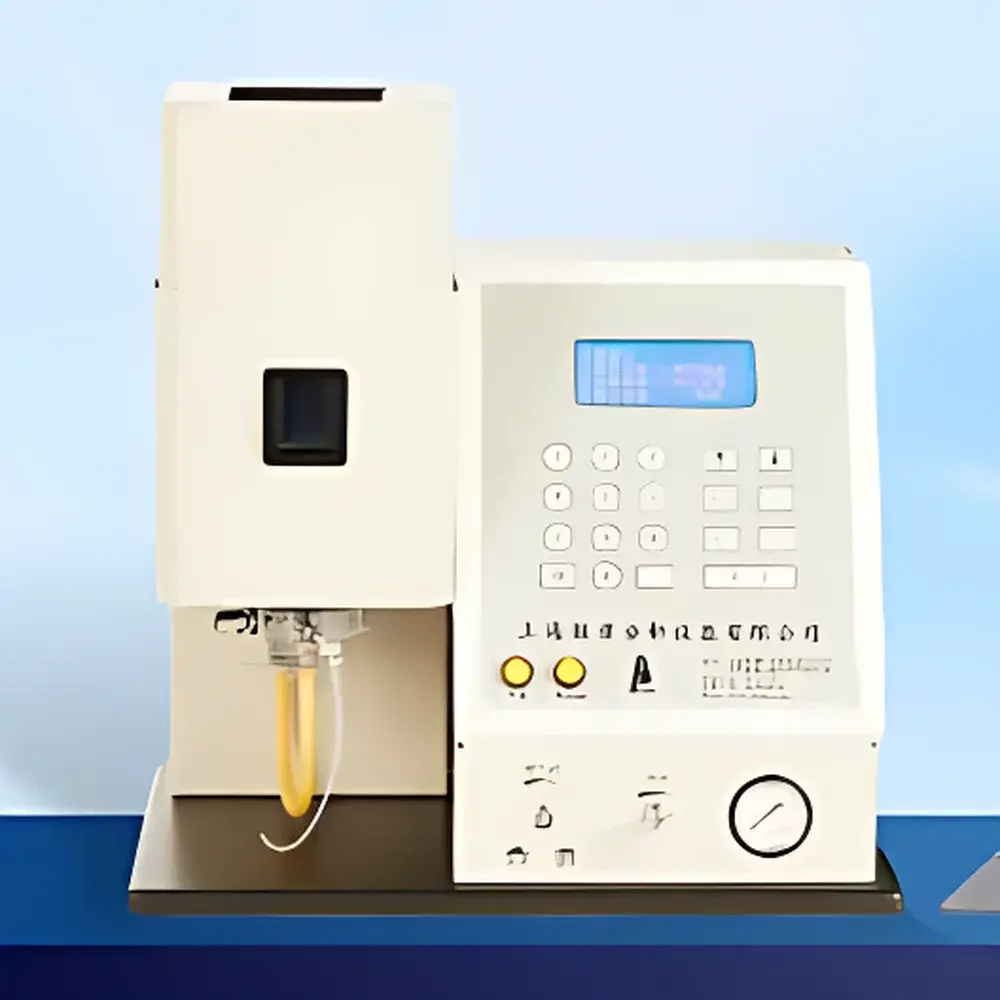
AOPU AP1302 Flame Photometer
| Brand | AOPU |
|---|---|
| Origin | Shanghai, China |
| Manufacturer | AOPU Instrument Co., Ltd. |
| Model | AP1302 |
| Detection Elements | K, Na, Ca |
| Measurement Range | K: 0–100 µg/mL |
| Na | 0–100 µg/mL |
| Ca | 0–1000 µg/mL |
| Detection Limit | K ≤ 0.004 mmol/L |
| Response Time | < 8 s |
| Repeatability | ≤ 3% |
| Sample Uptake Rate | < 6 mL/min |
| Optical System | Interference filter-based monochromator with three dedicated channels (K, Na, Ca) |
| Detector | Silicon photovoltaic cell |
| Calibration Modes | Linear, segmented linear, and quadratic polynomial fitting |
| Stability | ≤ 3% RSD over 15 s |
| Linearity Error | K ≤ 0.005 mmol/L |
| Ignition System | One-touch electronic ignition with flame-ionization safety cutoff and auto-alarm (8 s timeout) |
| Interface | RS232 serial port for PC or printer connectivity |
| Dimensions | 440 × 310 × 500 mm |
| Weight | 12.5 kg |
| Power Supply | 220 V ± 22 V, 50 Hz ± 1 Hz, 250 W |
| Operating Environment | 10–35 °C, RH ≤ 85%, vibration-free, non-corrosive, non-explosive atmosphere |
Overview
The AOPU AP1302 Flame Photometer is a benchtop atomic emission spectrometer engineered for quantitative determination of potassium (K), sodium (Na), and calcium (Ca) in aqueous solutions via flame atomic emission spectroscopy (FAES). It operates on the principle that alkali and alkaline earth metal ions—when introduced into a stable, low-temperature hydrocarbon flame (liquefied petroleum gas, propane, or butane)—are thermally excited and emit characteristic wavelengths of visible light. These emissions are isolated using precision interference filters and measured by silicon photovoltaic detectors. Unlike ICP-OES or AAS systems, the AP1302 delivers rapid, cost-effective elemental analysis without requiring high-purity argon, complex optics, or vacuum components—making it especially suitable for routine quality control and field-deployable environmental or agricultural laboratories where robustness, ease of operation, and low operational overhead are critical.
Key Features
- Triple-channel optical architecture with dedicated interference filters for K (766.5 nm), Na (589.0 nm), and Ca (422.7 nm), enabling simultaneous multi-element detection and direct concentration readout.
- Integrated flame safety system featuring ion-sensing electrode, automatic gas shutoff within 1 second of flame extinction, and audible/visual alarm with 8-second timeout and manual reset capability.
- Intuitive touch-panel interface with numeric keypad, real-time LCD display, and onboard memory for storing up to 10 calibration curves per element.
- Three calibration algorithms—linear, segmented linear, and quadratic polynomial—supporting accurate quantification across wide dynamic ranges, including low-concentration biological matrices and high-Ca samples such as dairy or mineral extracts.
- Wet-gas separator integrated into the nebulizer assembly minimizes aerosol carryover and improves long-term baseline stability during extended batch runs.
- RS232 serial interface compliant with standard laboratory data acquisition protocols, supporting direct export to LIMS or spreadsheet applications without proprietary software dependencies.
Sample Compatibility & Compliance
The AP1302 accepts clarified, low-viscosity aqueous samples with total dissolved solids (TDS) < 0.5%. It is routinely applied to beverages (juices, beer, milk), soil extracts (1:5 or 1:10 water leachates), plant digests (HNO₃/H₂O₂ microwave-assisted), clinical serum/plasma (diluted 1:10–1:50), and industrial process streams (coolants, boiler feedwater, catalyst washes). The instrument meets fundamental performance criteria aligned with ASTM D1292 (sodium in water), ISO 9297 (potassium in fertilizers), and AOAC 975.03 (calcium in food). While not certified to GLP or 21 CFR Part 11 out-of-the-box, its RS232 audit trail capability, calibration lockout function, and repeatability ≤3% RSD support internal validation under ISO/IEC 17025-accredited quality systems when paired with documented SOPs and traceable standards.
Software & Data Management
No proprietary software is required for basic operation. All calibration, measurement, and data review occur via the embedded firmware interface. For enhanced traceability, the RS232 output transmits ASCII-formatted data packets containing timestamp, element ID, concentration (µg/mL), and measurement status flag. When connected to a Windows PC, third-party terminal emulators (e.g., Tera Term, PuTTY) or custom Python scripts can log measurements directly into CSV or SQL databases. Optional Excel add-ins—developed by qualified AOPU application engineers—are available upon request for automated curve fitting, outlier rejection, and report generation compliant with ISO 8466-1 linearity assessment guidelines.
Applications
- Beverage & Food Quality Control: Quantification of Na⁺ in soft drinks (ASTM D4292), K⁺ in fruit juices (AOAC 984.27), and Ca²⁺ in fortified dairy products (ISO 5725).
- Agricultural & Soil Science: Rapid screening of exchangeable K⁺ and Na⁺ in Mehlich-3 or ammonium acetate extracts; Ca²⁺ in lime requirement assessments per USDA-NRCS protocols.
- Clinical & Biological Labs: Monitoring electrolyte imbalances in serum/plasma (CLIA-waived use pending local regulatory review); Ca²⁺ in urine for nephrology studies.
- Industrial Process Monitoring: Na⁺ contamination in steam condensate (ASME PTC 19.11), K⁺ in catalyst regeneration streams, and Ca²⁺ scaling potential in cooling tower water.
- Geological & Mining: Semi-quantitative analysis of alkali metals in acid-digested rock powders prior to ICP-MS confirmation.
FAQ
What fuel gases are compatible with the AP1302?
Liquefied petroleum gas (LPG), propane, or butane—provided they are free of sulfur compounds, heavy hydrocarbons, and particulate contaminants. Natural gas is not recommended due to inconsistent flame temperature and elevated CO emission risk.
Can the AP1302 measure lithium or barium?
No. The optical path includes only K-, Na-, and Ca-specific interference filters. Retrofitting additional filters is not supported by the manufacturer’s mechanical or firmware design.
Is external air compression required?
Yes. The system requires a clean, oil-free compressed air supply at 4–6 bar (60–90 psi) and flow rate ≥12 L/min. An integrated air compressor is included in the standard configuration.
How often must the nebulizer capillary be cleaned?
Daily cleaning with 5% HNO₃ followed by deionized water rinse is recommended for high-TDS samples. For low-salinity matrices (e.g., distilled water blanks), weekly inspection suffices.
Does the AP1302 comply with FDA 21 CFR Part 11?
The base instrument does not include electronic signature, audit trail, or user access controls required for Part 11 compliance. However, raw RS232 data logs—when captured via validated third-party software and stored on a secured network drive—may satisfy ALCOA+ principles under a site-specific validation protocol.




