
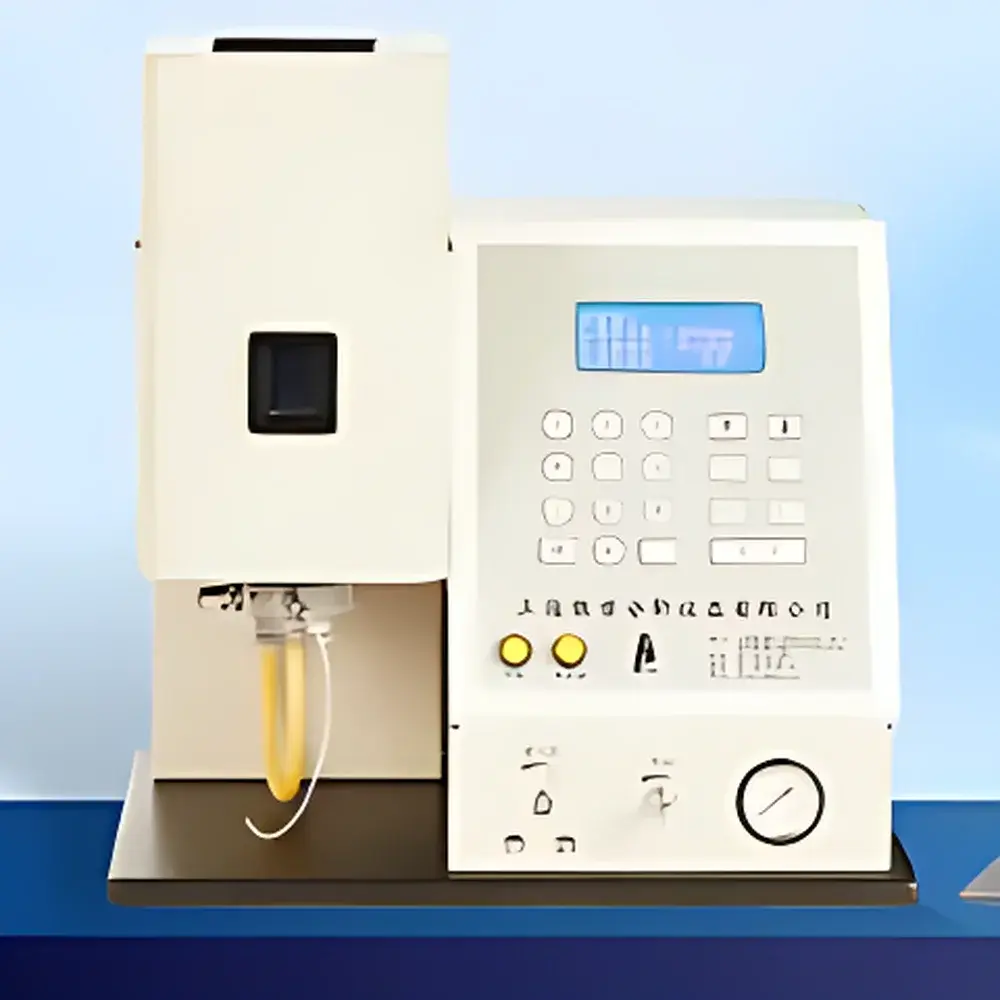
AOPU AP1200 Flame Photometer
| Brand | AOPU |
|---|---|
| Origin | Shanghai, China |
| Manufacturer Type | Direct Manufacturer |
| Model | AP1200 |
| Measurement Range | K: 0–100 µg/mL |
| Na | 0–100 µg/mL |
| Detection Limit | K ≤ 0.004 mmol/L |
| Response Time | < 8 s |
| Repeatability | ≤ 3% |
| Sample Uptake Rate | < 6 mL/min |
Overview
The AOPU AP1200 Flame Photometer is a benchtop dual-channel atomic emission spectrometer engineered for quantitative determination of potassium (K) and sodium (Na) in aqueous solutions via flame atomic emission spectroscopy (FAES). Operating on the principle of atomization in a stable hydrocarbon-air flame (LPG, propane, or butane), the instrument excites ground-state K⁺ and Na⁺ ions to emit characteristic visible radiation—766.5 nm for potassium and 589.0 nm for sodium—which is isolated using precision interference filters and detected by silicon photodiodes. Designed for routine analysis in quality control and research laboratories, the AP1200 delivers high reproducibility and operational robustness under GLP-aligned workflows. Its compact footprint (440 × 310 × 500 mm), low power consumption (250 W nominal), and integrated safety architecture—including flame ion-sensing auto-shutoff and 8-second audible alarm upon flame failure—enable reliable deployment in academic, clinical, agricultural, and industrial settings without requiring dedicated gas cabinets or exhaust hoods.
Key Features
- Dual-channel simultaneous detection: Independent optical paths with certified interference filters for K (766.5 nm) and Na (589.0 nm), enabling real-time co-quantification and direct concentration readout in µg/mL
- Integrated flame management system: One-touch ignition with flame-ionization monitoring; automatic gas cutoff within 1 second of flame loss, followed by audible alert and safe reset protocol
- Three calibration algorithms: Linear, segmented linear, and quadratic curve fitting—supporting trace-level quantitation across wide dynamic ranges (0–100 µg/mL for both elements)
- Touch-sensitive digital keypad with LCD display: Intuitive navigation, on-board calibration storage (up to 10 user-defined curves), and single-point standardization capability
- Moisture separation module: Integrated condensate trap minimizes aerosol water carryover, enhancing signal stability during extended batch analysis
- RS232 serial interface: Enables bidirectional communication with external PCs or thermal printers for audit-trail-compliant data export (ASCII format)
Sample Compatibility & Compliance
The AP1200 accepts clarified, filtered aqueous extracts from diverse matrices—including biological fluids (serum, urine), food homogenates (juices, dairy), soil digests (HNO₃/HF leachates), mineral acid-dissolved geological samples, and industrial process streams (coolants, lubricants, catalyst slurries). Sample introduction is via fixed-capillary nebulization at ≤6 mL/min uptake rate, compatible with standard 13-mm borosilicate test tubes. The instrument meets fundamental performance criteria aligned with ISO 6955:2007 (Flame photometric determination of alkali metals) and supports method validation per USP and ASTM D1529–18 (Standard Test Method for Sodium and Potassium in Fuel Oils). While not 21 CFR Part 11–certified out-of-the-box, its RS232 logging capability allows integration into validated LIMS environments with appropriate electronic signature and audit trail protocols.
Software & Data Management
No proprietary software is bundled; however, the RS232 port supports ASCII-based data streaming to third-party applications (e.g., LabVIEW, MATLAB, or custom Python scripts) for automated report generation and statistical process control (SPC). Calibration curves are retained in non-volatile memory with timestamp-free recall. All measurement events—including calibration date, operator ID (manually entered), sample ID, and raw intensity values—are exportable as tab-delimited text files suitable for traceability in ISO/IEC 17025-accredited labs. Internal stability verification follows defined protocols: ≤3% RSD over 15 s continuous injection; ≤15% max deviation across six 1-minute intervals.
Applications
- Clinical chemistry: Quantification of serum/plasma Na⁺ and K⁺ for electrolyte balance assessment (CLIA-waived use case)
- Agricultural science: Rapid screening of K/Na ratios in plant tissue digests, fertilizer formulations, and irrigation water
- Food & beverage QA: Monitoring sodium content in processed foods (ISO 18422 compliance support) and potassium enrichment in functional beverages
- Geological & metallurgical analysis: Alkali metal profiling in silicates, clays, and metal ores prior to XRF or ICP-MS confirmation
- Petrochemical QC: Detection of catalytic poison Na/K in crude oil fractions and refinery feedstocks (ASTM D1529–18)
- Building materials testing: Soluble alkali content (Na₂O + K₂O) in cement and concrete admixtures per ASTM C150/C1157
FAQ
What fuel gases are compatible with the AP1200?
Liquefied petroleum gas (LPG), propane, or butane—provided they are free of sulfur compounds and particulate contaminants. No hydrogen or acetylene operation is supported.
Does the instrument require external compressed air?
Yes. An oil-free air compressor (≥4 bar, 20 L/min flow) is mandatory for nebulizer aspiration and flame stabilization. AOPU-supplied compressors meet ISO 8573-1 Class 1.4.1 specifications.
Can the AP1200 measure lithium or calcium?
No. Optical configuration is fixed to K and Na wavelengths only; no filter wheel or multi-element detector is included.
Is GLP-compliant data archiving possible?
Raw output supports manual or scripted archiving; full GLP compliance requires external validation of the host PC system, including electronic signatures and audit trail configuration.
What maintenance intervals are recommended?
Daily: Nebulizer capillary inspection and moisture trap emptying. Monthly: Filter cleaning with isopropanol; annual photodiode sensitivity verification using NIST-traceable standards.





