
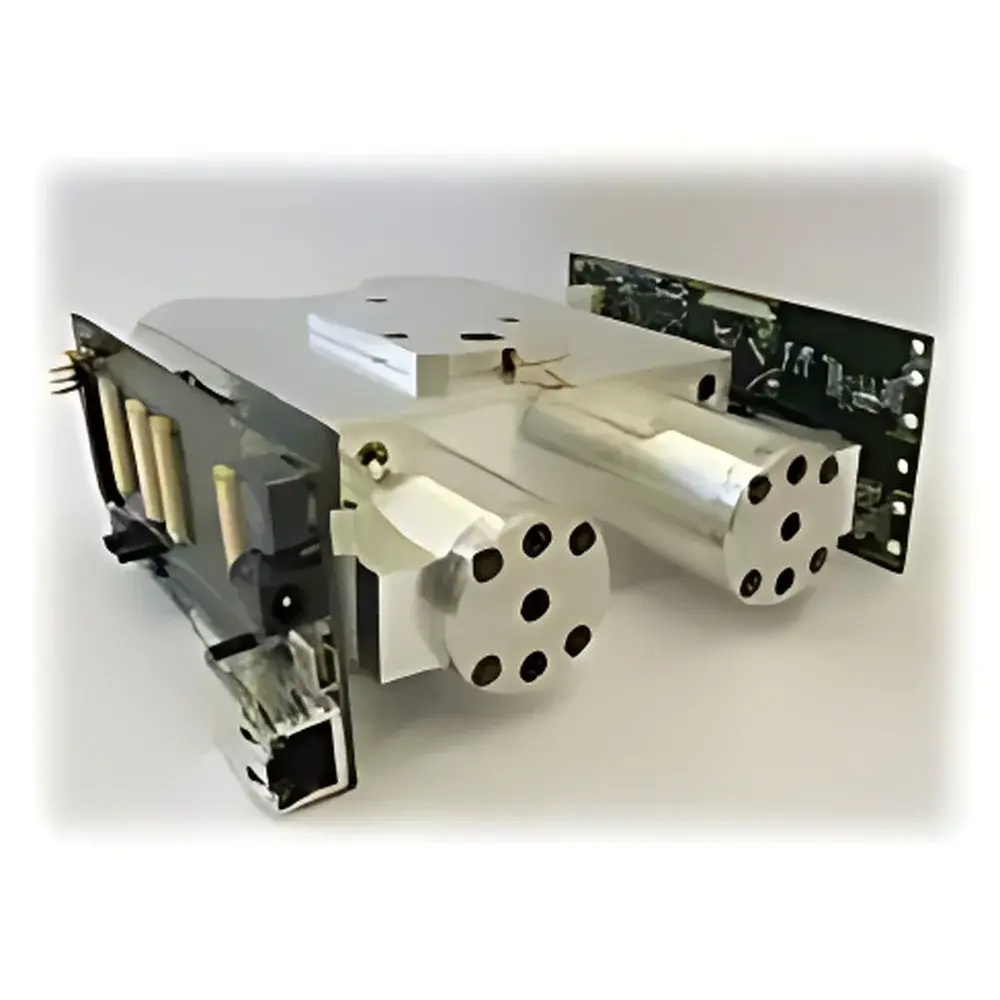
ARCoptix Miniature Fourier Transform Infrared Spectrometer
| Brand | SPL |
|---|---|
| Origin | Switzerland |
| Model | ARCoptix |
| Type | Fourier Transform (FTIR) |
| Configuration | Online/Portable |
| Wavelength Range | 2–12 µm |
| Wavenumber Resolution | 4 cm⁻¹ |
| Wavelength Resolution | <2 nm (at 2 µm), <10 nm (at 4 µm), <12 nm (at 6 µm) |
| Signal-to-Noise Ratio | >1000:1 |
| Scan Rate | 1 spectrum/sec (interferogram averaging mode) |
| IR Source | Miniature blackbody emitter (1150 K) |
| Reference Laser | Solid-state 850 nm diode laser |
| Interference Compensation | Built-in dynamic self-compensation |
| Compliance | CE, RoHS, ISO/IEC 17025-compatible operation |
Overview
The ARCoptix Miniature Fourier Transform Infrared Spectrometer is an ultra-compact, field-deployable FTIR system engineered for real-time, in-situ molecular identification and quantitative analysis across industrial process lines, environmental monitoring stations, and mobile laboratory platforms. Based on Michelson interferometry, the instrument generates high-fidelity interferograms by splitting broadband infrared radiation from a stabilized 1150 K miniature blackbody source using a precision dielectric beam splitter. One beam reflects off a high-stability moving mirror driven at constant velocity, while the other reflects off a fixed mirror; recombination at the beam splitter produces path-length-dependent interference. The resulting interferogram—modulated by sample absorption—is detected by a thermoelectrically cooled MCT or InSb detector (model-dependent), then digitized and transformed via fast Fourier transform (FFT) into a calibrated absorbance or transmittance spectrum across 2–12 µm (5000–833 cm⁻¹). Its monolithic optical bench, solid-state 850 nm reference laser for precise mirror position encoding, and dynamic self-interference compensation ensure long-term spectral stability without recalibration—critical for unattended online operation.
Key Features
- True miniature form factor: Fully integrated optical path within a 120 × 85 × 55 mm housing—smallest commercially available FTIR platform with full interferometric functionality.
- Real-time online capability: Designed for continuous process stream integration via fiber-coupled or direct-beam sampling; supports 1 Hz spectral acquisition with interferogram averaging for enhanced SNR.
- High metrological fidelity: 4 cm⁻¹ wavenumber resolution (user-selectable down to 0.5 cm⁻¹ via zero-filling), wavelength accuracy traceable to NIST-certified standards.
- Robust environmental tolerance: Operating temperature range −10 °C to +50 °C; sealed optics compartment compliant with IP54 for dust and splash resistance.
- Self-compensating interferometer: Active correction of thermal drift and mechanical hysteresis using dual-position feedback from the reference laser, eliminating need for external alignment or periodic recalibration.
- Low-power operation: Consumes 8 hours with optional Li-ion pack.
Sample Compatibility & Compliance
The ARCoptix spectrometer interfaces with standard gas cells (path lengths 0.1–10 m), liquid flow cells (10–500 µL volume), and reflective ATR accessories (ZnSe, diamond, or Si crystals) for solids and viscous samples. It supports both transmission and attenuated total reflectance (ATR) modalities without hardware modification. All firmware and data handling routines comply with ISO/IEC 17025 requirements for analytical instrument validation, including audit-trail logging of calibration events, user access control, and spectral metadata embedding (time stamp, ambient T/P, detector bias). While not FDA 21 CFR Part 11–certified out-of-the-box, its software development kit (SDK) enables integration into validated GMP/GLP environments through configurable electronic signature and data integrity modules.
Software & Data Management
The instrument ships with ARCoptix SpectraSuite™ v4.x—a cross-platform application (Windows/macOS/Linux) supporting real-time spectral visualization, baseline correction, peak integration, and multivariate analysis (PCA, PLS regression). Raw interferograms and processed spectra are stored in HDF5 format with embedded calibration coefficients and measurement context. An open API (C/C++, Python, MATLAB) allows direct integration into SCADA, DCS, or LIMS systems. Spectral libraries—including NIST/EPA gas-phase, BioRad polymer, and custom-built food authenticity databases—are fully searchable and exportable. Data export formats include CSV, JCAMP-DX, and XML-compliant ASTM E1421 metadata structures.
Applications
- Food & beverage quality assurance: Rapid quantification of fat, moisture, protein, and ethanol in milk, juice, wine, and dairy powders via characteristic C–H, O–H, and C=O band modeling.
- Industrial gas monitoring: Continuous detection of CO, CO₂, CH₄, NH₃, and NOₓ in combustion exhaust, biogas upgrading, and semiconductor fab ambient air.
- Agricultural feedstock analysis: On-site assessment of starch, cellulose, and lignin content in silage, grain, and biofuel feedstocks.
- Environmental field screening: Identification of VOCs and PAHs in soil headspace or water vapor extracts using portable gas cell configurations.
- Defense & security: Standoff detection of explosive residues (e.g., RDX, TNT) and chemical warfare agent simulants via reflection-mode ATR or open-path measurements.
- Pharmaceutical process analytical technology (PAT): Real-time reaction monitoring during granulation, drying, and coating steps in fluid-bed processors.
FAQ
Is the ARCoptix spectrometer suitable for regulatory-compliant QC testing?
Yes—when deployed with documented IQ/OQ protocols and integrated into a validated software environment, it meets ISO 17025 and USP <1119> criteria for spectroscopic method verification.
Can it operate unattended for extended periods?
Yes—the interferometer’s self-compensation architecture and low thermal drift enable stable 72+ hour continuous operation under controlled ambient conditions.
What fiber optic interface options are supported?
Standard SMA-905 connectors accept 400 µm core silica fibers (UV-VIS-NIR) or fluoride fibers (MIR); custom ZrF₄ or chalcogenide fiber coupling available upon request.
Does it require liquid nitrogen cooling?
No—all detector variants use thermoelectric (Peltier) cooling to −20 °C; no cryogens or vacuum pumps are required.
How is wavelength calibration verified?
Factory calibration uses polystyrene film (1602 cm⁻¹ C=C stretch) and atmospheric water vapor lines (1388, 1530, 1840 cm⁻¹); users may perform field verification using built-in HeNe laser reference or external NIST-traceable standards.
Related Products





