
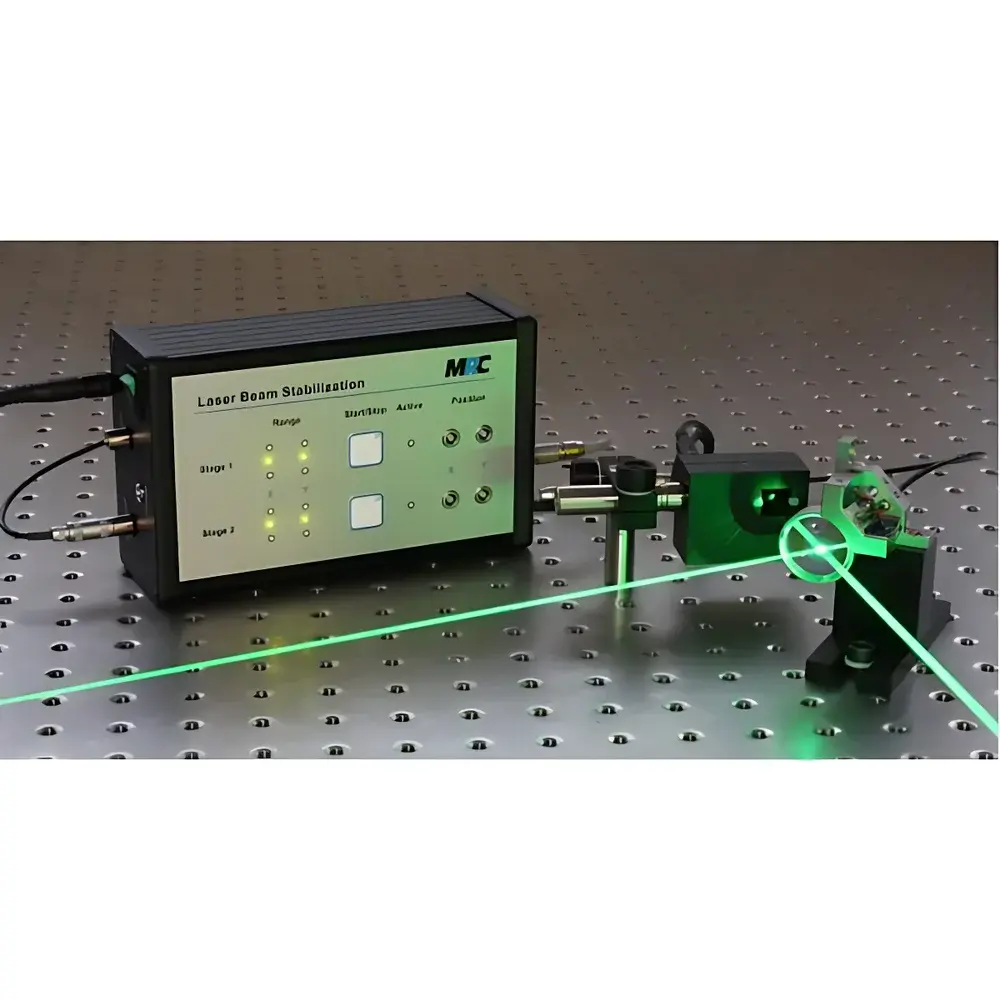
MRC PKS/PSH/P4S30 Laser Autocollimation System
| Brand | MRC |
|---|---|
| Origin | Germany |
| Model Series | PKS, PSH, P4S30 |
| Component Category | Optical Element |
| Vacuum Compatible | Yes |
| Max Aperture Support | 4-inch optics |
| Operating Laser Frequency Range | Low-frequency lasers |
| Signal Processing | Real-time analog |
| Power Supply | 12 V DC |
| ISO 13485 Certified | Yes |
Overview
The MRC PKS/PSH/P4S30 Laser Autocollimation System is a precision optical stabilization platform engineered for high-fidelity beam alignment and active angular control in demanding photonic applications. Based on the principle of laser autocollimation—where a collimated beam is reflected back from a retroreflective or flat surface and its deviation measured via position-sensitive detection—the system delivers sub-milliradian angular resolution and real-time closed-loop correction without reliance on digital computation or host PC integration. Designed and manufactured in Germany, the system complies with ISO 13485 quality management standards for medical device–related instrumentation, reflecting rigorous traceability in design control, production, and calibration documentation. Its fully analog signal path ensures minimal latency (< 10 µs loop delay), deterministic response, and immunity to software-induced jitter—critical for ultra-stable interferometric setups, cavity locking, and low-noise laser pointing stabilization.
Key Features
- Compact all-in-one controller housing integrating amplifier, driver electronics, and power regulation—operable from a single 12 V DC input
- Three interchangeable piezo-actuated steering mirror models: PKS (±0.5 mrad tilt), PSH (±1 mrad tilt, enhanced resonance via spring-balanced mechanics), and P4S30 (±2 mrad mirror tilt / ±4 mrad beam deflection, quad-stack piezoelectric actuation for >5 kHz mechanical resonance)
- Vacuum-compatible construction (UHV-rated materials and outgassing compliant per ASTM E595) enabling integration into vacuum beamlines and laser cavities
- Real-time analog processing architecture eliminating quantization noise, clock skew, and firmware dependency
- Support for optics up to 100 mm (4-inch) clear aperture with optional mounting adapters
- Low-frequency laser compatibility—including CW and pulsed sources operating below 100 kHz repetition rates
Sample Compatibility & Compliance
The system accommodates standard 25.4 mm (1″) mirrors as default, with scalable mechanical interfaces for larger substrates (e.g., 50.8 mm, 76.2 mm, and custom diameters). All mirror mounts are kinematically constrained and designed for thermal stability under ambient and controlled-environment operation. The platform meets ISO 13485:2016 requirements for design history file (DHF) maintenance, process validation, and supplier-controlled component sourcing. While not explicitly certified to IEC 61000-6-3 (EMC) or IEC 61000-6-4, its analog architecture inherently exhibits low electromagnetic susceptibility and minimal conducted emissions—verified per internal EMC screening protocols aligned with EN 55011 Class B limits. No FDA 510(k) or CE marking is claimed, as the system is supplied as a component-level optical subsystem intended for OEM integration.
Software & Data Management
The MRC Laser Autocollimation System operates entirely in hardware-defined analog mode and requires no software drivers, SDKs, or configuration utilities. Control signals—including setpoint voltage inputs, error signal outputs, and status monitoring—are accessible via standardized BNC and LEMO connectors. For users requiring data logging or synchronization with external instruments, the analog error output (±10 V full scale, linear with beam displacement) may be digitized using third-party DAQ systems compliant with IEEE 1057 or NIST-traceable calibration. Audit trails, parameter versioning, and electronic signatures are not applicable, as no digital control layer exists; all operational states are physically deterministic and reproducible across units without firmware revision dependencies.
Applications
- Laser cavity alignment and passive/active resonator stabilization
- Fiber-to-laser and laser-to-waveguide coupling optimization
- Beam pointing stabilization in gravitational wave detector auxiliary systems
- Ultra-precise angular metrology in optical null testing and interferometer reference arm conditioning
- Pump-probe alignment in time-resolved spectroscopy where timing jitter must remain below 1 ns
- Micro-machining beam delivery systems requiring long-term drift compensation (< 0.1 µrad/hour)
- Vacuum-based lithography tool beam conditioning subassemblies
FAQ
Does the system support digital communication interfaces such as USB or Ethernet?
No. The MRC autocollimation system is strictly analog—no microcontroller, FPGA, or serial interface is embedded. Communication is limited to analog voltage I/O via BNC/LEMO connectors.
Can the P4S30 mirror be used with a 75 mm diameter optic?
Yes—mechanical adapters are available for mounting optics up to 100 mm diameter. Custom flange designs can be provided under NDA for OEM integration.
Is the high-dynamic-range quadrant detector compatible with pulsed lasers at 10 kHz?
Yes—the detector’s automatic gain control (AGC) circuit maintains constant SNR across input intensities spanning 10³, including nanosecond pulses with peak powers up to 5 W average, provided pulse energy remains within diode damage thresholds.
What is the maximum operating temperature range for vacuum-compatible operation?
The vacuum-rated variant is qualified for continuous operation from –20 °C to +60 °C under 1×10⁻⁶ mbar base pressure, with bake-out tolerance up to 80 °C for ≤2 hours.
Do PSD detectors require external bias voltage?
Yes—PSD operation requires a stable ±15 V DC supply. Output signals are ratiometric analog voltages proportional to centroid position across the full 9 × 9 mm² active area.





