
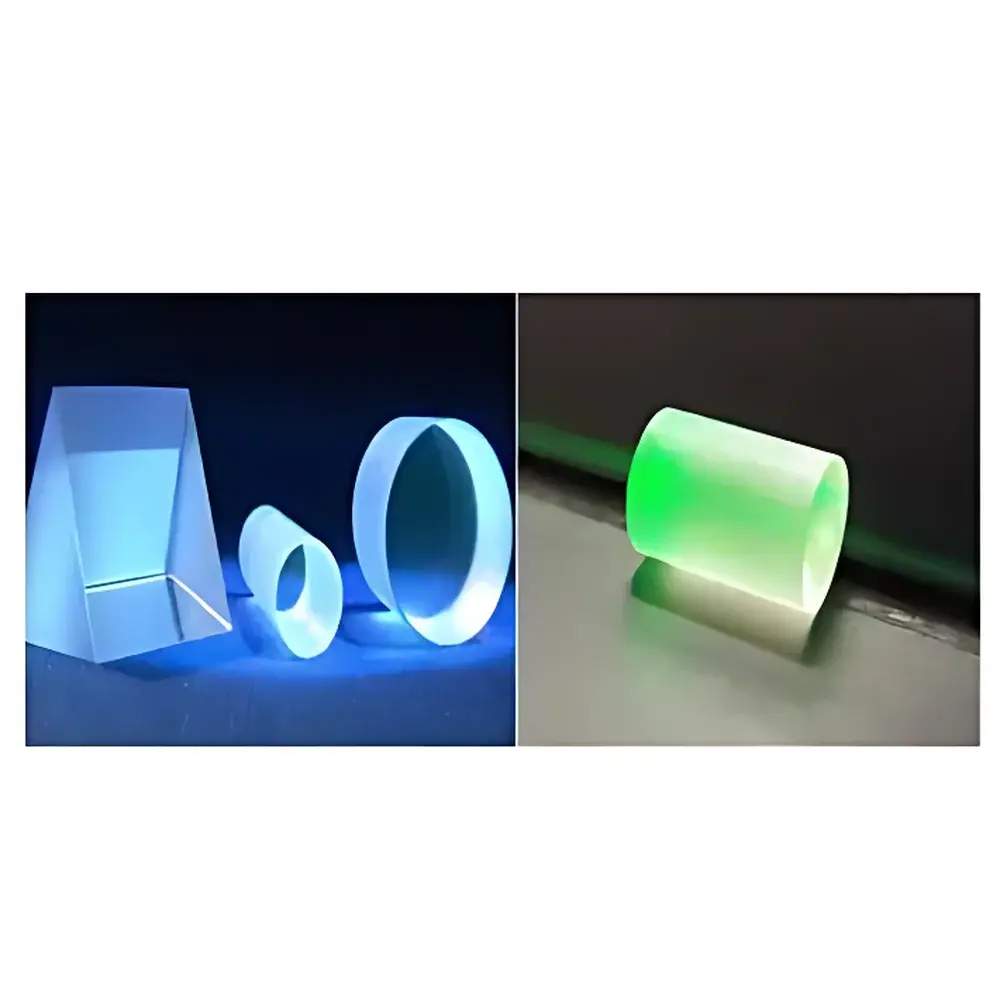
SYNOPTICS KTF Laser Crystal
| Brand | SYNOPTICS |
|---|---|
| Origin | USA |
| Manufacturer Type | Authorized Distributor |
| Origin Category | Imported |
| Model | KTF |
| Price Range | USD $0 – $7,200 (FOB) |
| Crystal Structure | Cubic |
| Chemical Formula | KTb₃F₁₀ |
| Primary Application | Faraday Rotators & Optical Isolators for High-Power Lasers |
| Transmission Range | 400–1500 nm |
| Orientation | Standard <100>, Optional <111> |
| Diameter Tolerance | +0.000″ / −0.002″ |
| Edge Chamfer | 0.005″ ± 0.003″ @ 45° |
| Roll-off Polish | ≤55 µin Ra |
| Surface Flatness | λ/10 @ 633 nm |
| Parallelism | ≤60 arc-seconds |
| Perpendicularity | ≤10 arc-minutes |
| Wavefront Distortion | <¼ wave per inch @ 633 nm |
| AR Coating | R < 0.25% per surface (1064 nm, 0° AOI) |
Overview
The SYNOPTICS KTF Laser Crystal is a high-performance magneto-optic birefringent material engineered for precision Faraday rotation in demanding high-average-power laser systems. Composed of potassium terbium fluoride (KTb₃F₁₀), KTF exhibits a cubic crystal structure and delivers exceptional thermal and optical stability under intense irradiation. Unlike conventional terbium gallium garnet (TGG), KTF features a significantly lower absorption coefficient (~0.02%/cm at 1064 nm) and an order-of-magnitude reduced thermo-optic coefficient (~1 × 10⁻⁶ K⁻¹), minimizing thermally induced depolarization and lensing effects. Its intrinsic Verdet constant—comparable to TGG at 396 rad/T·m @ 1064 nm—enables compact, high-efficiency Faraday rotators and polarization-dependent isolators in industrial fiber lasers, scientific ultrafast amplifiers, and defense-grade directed-energy platforms. All KTF crystals are grown, oriented, polished, coated, and metrologically certified in-house by SYNOPTICS under ISO 9001:2008 quality management protocols.
Key Features
- Ultra-Low Thermal Load: Absorption coefficient of ~0.02%/cm at 1064 nm reduces thermal gradient formation, enabling stable operation in CW and quasi-CW lasers exceeding 500 W average power.
- Minimal Thermal Lensing: Thermo-optic coefficient of ~1 × 10⁻⁶ K⁻¹ ensures negligible refractive index drift across operational temperature ranges, preserving beam quality and isolation extinction ratio.
- Precision Metrology Compliance: Surface flatness λ/10 @ 633 nm, parallelism ≤60 arc-seconds, and wavefront distortion <¼ wave per inch meet stringent OEM requirements for high-finesse optical cavities and interferometric systems.
- High-Damage-Threshold AR Coating: Broadband anti-reflection coating optimized for 1064 nm (R 15 J/cm² (10 ns, 10 Hz, 1064 nm) supports pulsed and modulated laser architectures.
- Crystallographic Flexibility: Standard orientation supplied; custom -oriented variants available for specialized magneto-optic phase-matching configurations.
- Traceable Manufacturing: Full process traceability from Czochralski growth through spectral transmission verification, including interferometric surface inspection and Verdet constant validation per ASTM E1335.
Sample Compatibility & Compliance
KTF crystals are compatible with standard optomechanical mounts (e.g., Thorlabs KM100, Newport UH100 series) and integrate seamlessly into commercial Faraday isolator housings (e.g., Qioptiq iFLEX, EKSMA Optics FIO series). All units comply with RoHS Directive 2011/65/EU and REACH Regulation (EC) No. 1907/2006. Material safety data is provided per GHS Annex VI classification. Dimensional and optical specifications conform to ISO 10110-3 (surface form) and ISO 10110-7 (surface imperfections). Batch-level certification includes spectral transmittance curves (200–3000 nm), interferometric surface maps, and Verdet constant measurement reports referenced to NIST-traceable calibration standards.
Software & Data Management
While KTF is a passive optical component, SYNOPTICS provides full digital documentation via secure customer portal access. Each shipped crystal is assigned a unique serial number linked to its complete metrology dossier—including raw interferogram exports (.tif), spectral transmission CSV files, and PDF-certified test reports compliant with FDA 21 CFR Part 11 electronic record requirements. Audit logs record all measurement timestamps, operator IDs, instrument calibration status (e.g., Zygo Verifire™ Interferometer, PerkinElmer Lambda 950 UV/Vis/NIR), and environmental chamber conditions during testing (temperature ±0.1°C, humidity <30% RH). This infrastructure supports GLP/GMP-aligned quality systems and facilitates integration into enterprise LIMS or MES platforms via RESTful API.
Applications
- High-Power Industrial Lasers: Isolation modules in multi-kilowatt fiber and disk lasers used in automotive welding, battery electrode processing, and additive manufacturing.
- Scientific Ultrafast Systems: Pulse-preserving isolators in Ti:sapphire and Yb-doped amplifier chains operating at repetition rates >1 kHz and peak powers >1 GW.
- Defense & Aerospace: Ruggedized Faraday rotators in airborne laser communication terminals and directed-energy weapon beam control subsystems requiring long-term thermal stability under vibration and thermal cycling.
- Quantum Optics Infrastructure: Low-noise polarization rotation elements in cavity-enhanced magnetometers and atomic vapor cell-based gyroscopes where residual thermal birefringence must be below 10⁻⁴ wave RMS.
- Medical Laser Systems: Compact isolators in ophthalmic femtosecond lasers (e.g., 1030 nm Yb-based platforms) where pulse fidelity and M² maintenance are critical to surgical accuracy.
FAQ
What is the primary advantage of KTF over TGG in high-power applications?
KTF’s absorption coefficient at 1064 nm is approximately one-eighth that of TGG (~0.02%/cm vs. ~0.16%/cm), resulting in substantially lower heat deposition and mitigating thermal lensing, depolarization, and stress-induced fracture risk.
Is custom doping or orientation available?
Yes—SYNOPTICS offers orientation, custom diameter/thickness combinations (±0.05 mm mechanical tolerance), and optional ion-beam sputtered hard coatings for extended environmental durability.
How is Verdet constant verified for each crystal?
Each batch undergoes Faraday rotation angle measurement using a calibrated 1064 nm HeNe-stabilized diode laser, precision solenoid (±0.01 T field uniformity), and lock-in amplified polarimetry, per ISO 11551 Annex B.
Can KTF be used outside the 1064 nm band?
Yes—its transmission range spans 400–1500 nm; Verdet constant remains >350 rad/T·m at 980 nm and >280 rad/T·m at 1550 nm, supporting telecom and pump-laser isolation.
Do you provide mounting hardware or thermal interface solutions?
Standard copper or OFHC mounts with indium foil thermal interfaces are available as configurable accessories; thermal expansion mismatch analysis (α = 13.7 × 10⁻⁶ K⁻¹) is included in mechanical integration support packages.





