
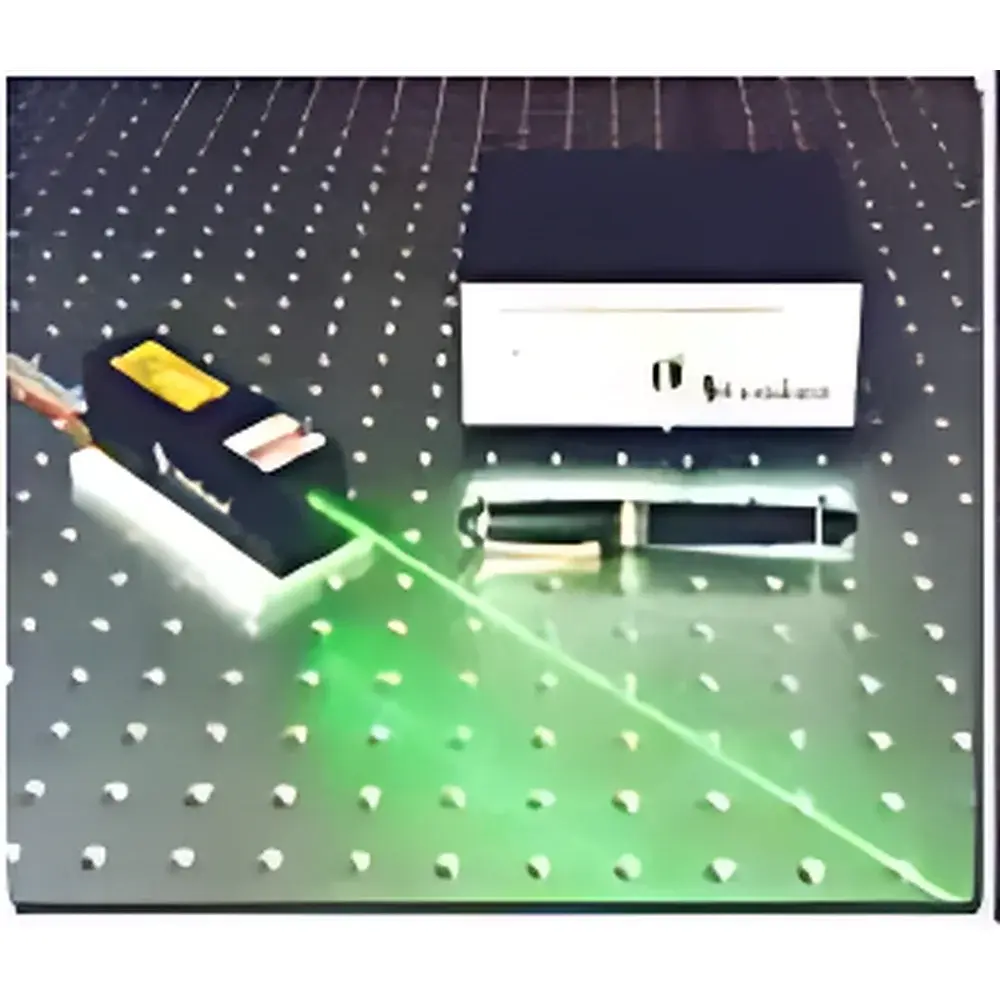
CrystaLaser CL523/CL527/CL542 Continuous-Wave Diode-Pumped Solid-State Green Laser Systems
| Brand | CrystaLaser |
|---|---|
| Wavelengths | 523 nm, 527 nm, 542 nm |
| Output Power | 5–400 mW (model-dependent) |
| Beam Mode | TEM₀₀, M² > 1.1 |
| Linewidth | < 10⁻⁵ nm (SLM), 0.2 nm (basic) |
| Coherence Length | > 300 m (SLM) |
| RMS Noise | < 0.5% (10 Hz–20 MHz), 2% (0–10 kHz) |
| Power Stability | < 2% (8 h), optional < 0.5% or < 0.25% (24 h) |
| Beam Diameter (1/e²) | 0.2 mm |
| Full Beam Divergence | 4 mrad (expandable) |
| Beam Pointing Stability | < 0.02 mrad (isothermal) |
| Polarization Ratio | ≥50:1 (standard), up to >300:1 (optional) |
| Polarization | Linear |
Overview
The CrystaLaser CL523, CL527, and CL542 series are continuous-wave (CW), diode-pumped solid-state (DPSS) green lasers engineered for high-stability optical metrology, interferometry, holography, fluorescence excitation, and precision alignment applications. Unlike gas-based green lasers, these DPSS systems leverage Nd:YVO₄ or Nd:YAG gain media frequency-doubled via nonlinear crystals (e.g., KTP or LBO) to generate narrow-linewidth, diffraction-limited output at three discrete wavelengths: 523 nm, 527 nm, and 542 nm. The architecture eliminates plasma tube aging and thermal drift associated with argon-ion or He–Ne alternatives, delivering superior long-term power consistency and reduced maintenance overhead. Each model is available in two configurations: a basic multimode version optimized for cost-sensitive OEM integration, and a single-longitudinal-mode (SLM) variant designed for coherence-critical tasks requiring linewidths below 10⁻⁵ nm and coherence lengths exceeding 300 meters.
Key Features
- Three precisely stabilized emission wavelengths—523 nm, 527 nm, and 542 nm—enabling spectral selection for material-specific absorption or fluorescence excitation
- TEM₀₀ spatial mode with M² > 1.1 ensures near-diffraction-limited beam quality suitable for coupling into single-mode fibers and high-NA optics
- Ultra-low amplitude noise: RMS fluctuation < 0.5% over 10 Hz–20 MHz bandwidth; critical for lock-in detection and heterodyne interferometry
- Thermally stabilized cavity design minimizes wavelength drift (< ±0.005 nm/°C) and enables sub-microradian beam pointing stability (< 0.02 mrad) under constant ambient conditions
- Optional polarization purity upgrades: standard 50:1 extinction ratio, extendable to >100:1 or >300:1 for polarization-sensitive measurements such as ellipsometry or magneto-optic Kerr effect (MOKE)
- Integrated thermoelectric cooler (TEC) and feedback-controlled current driver ensure < 2% RMS power stability over 8 hours; ultra-stable variants maintain ≤ 0.25% deviation over 24 hours for GLP-compliant calibration workflows
Sample Compatibility & Compliance
These lasers are compatible with standard 1-inch optical mounts, kinematic platforms, and fiber-coupling adapters (FC/PC or FC/APC). No sample preparation or consumables are required—the system operates as a stable illumination source across vacuum, ambient air, or nitrogen-purged enclosures. From a regulatory standpoint, the CL-series conforms to IEC 60825-1:2014 Class 3B laser safety requirements. All units ship with interlock-ready connectors, key-switch enablement, and integrated emission indicators compliant with FDA 21 CFR Part 1040.10. For laboratories operating under ISO/IEC 17025 or GMP frameworks, the optional 24-hour ultra-stable configuration supports documented power repeatability required in analytical method validation protocols (e.g., USP <857>).
Software & Data Management
While the CL-series operates as a stand-alone analog device, CrystaLaser provides optional USB- or RS-232–enabled controller modules supporting remote power modulation (0–10 V input), TTL blanking, and real-time status monitoring (temperature, current, output flag). Logged operational data—including runtime hours, thermal sensor readings, and fault codes—is retained in non-volatile memory for audit trail generation. When integrated into automated test benches, the laser’s analog control interface aligns with SCPI-compatible instrumentation buses (GPIB, Ethernet), facilitating traceable parameter logging in LabVIEW, Python (PyVISA), or MATLAB environments. All firmware updates adhere to secure signed-binary protocols to satisfy ITAR-restricted deployment requirements in defense and aerospace R&D settings.
Applications
- High-resolution digital holographic microscopy (DHM) requiring long coherence length and low phase noise
- Confocal fluorescence imaging of GFP-tagged biological specimens, where 527 nm matches optimal excitation peaks
- Gravitational wave detector prototype alignment and cavity locking using 542 nm for reduced Rayleigh scattering in fused silica optics
- Calibration of spectroradiometers and photometric sensors per CIE S 025/E:2015
- Optical trapping and manipulation of dielectric microspheres using 523 nm for minimized photodamage in live-cell studies
- Interferometric surface profiling of semiconductor wafers under cleanroom-grade environmental controls
FAQ
What distinguishes the SLM version from the basic version?
The SLM variant incorporates an intra-cavity etalon and precision temperature control to enforce single-frequency operation, achieving linewidths 300 m—essential for coherent detection schemes. The basic version offers broader linewidth (~0.2 nm) and higher available power but lacks longitudinal mode selectivity.
Can the beam divergence be reduced for long-distance projection?
Yes. The native 4 mrad full-angle divergence is compatible with commercially available Galilean or Keplerian beam expanders. Custom collimation optics can be specified to achieve < 0.5 mrad divergence while preserving M² and pointing stability.
Is wavelength tuning possible across the 523–542 nm range?
No. Each model is factory-aligned to a fixed wavelength. Tuning requires physical replacement of the nonlinear crystal and cavity mirrors—performed only by CrystaLaser service centers under controlled cleanroom conditions.
How is power stability verified during qualification?
Power output is monitored continuously over 24 hours using a NIST-traceable thermal power meter (Ophir 3A-FS) sampling at 10 Hz. Stability is reported as RMS deviation normalized to mean output, per ISO 11554 Annex B guidelines for laser beam parameter testing.







